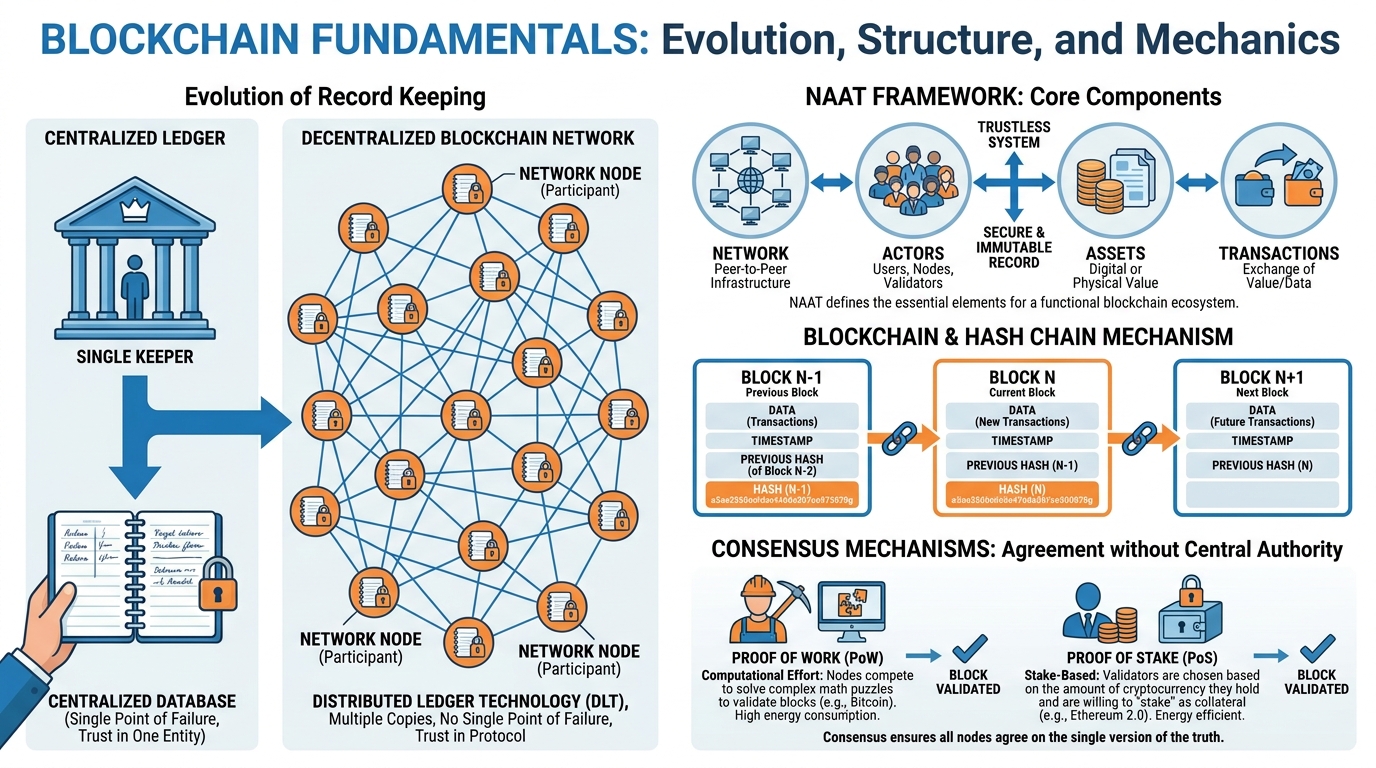
Figure 1:Chapter 0 Explainer Infographic: From the village notebook to the distributed ledger — understanding blockchains as a trust solution, not just a technology.
Imagine a village with one notebook.
Every debt, every land sale, every inheritance is written in that notebook by a single keeper — a trusted elder who has held the role for forty years. The system works because everyone trusts the keeper. But one morning, the keeper disappears. Or worse: the keeper does not disappear, but you discover that two pages were quietly rewritten three years ago, changing who owns the field at the edge of town.
What would it take to build a notebook that nobody could disappear with, and nobody could secretly edit?
That question — not any particular technology, not cryptocurrency speculation, not Silicon Valley hype — is the precise question that produces a blockchain. And it is not an exotic question. It is the oldest question in commerce, in governance, in law. Every institution you have ever trusted to keep a record about you is that village elder with a notebook. The bank. The university registrar. The title company. The medical records system. The supply chain auditor.
This chapter is about understanding what blockchains actually are, why they exist, and — most importantly — when they are and are not the right answer to the problems your organization faces.
1The Ledger: Humanity’s Oldest Business Technology
Before accounting software, before spreadsheets, before double-entry bookkeeping, before paper — there were ledgers.
The oldest business records we have found are clay tablets from ancient Mesopotamia, approximately 5,000 years old. They are receipts. They are inventory lists. They record who delivered how many bushels of grain and who owes what. They are, in every meaningful sense, ledgers.
A ledger is deceptively simple: a structured record of who owns what, who did what, and who owes what. Every business runs on ledgers. Your bank account is a ledger entry. Your stock portfolio is a ledger entry. The deed to your house is a ledger entry. The medical record of your last visit to the doctor is a ledger entry. The invoice you sent last Tuesday is a ledger entry.
What varies across five thousand years of human commerce is not the concept of a ledger — it is the answer to the question: who controls the ledger?
For most of human history, the answer has been: a trusted central authority. A temple scribe. A guild master. A monarch’s treasury. A national bank. A title company. A corporate database. The form has changed; the structure has not. We outsource the record-keeping function to an entity we trust (or are forced to trust) and then we rely on that entity’s integrity, competence, and permanence.
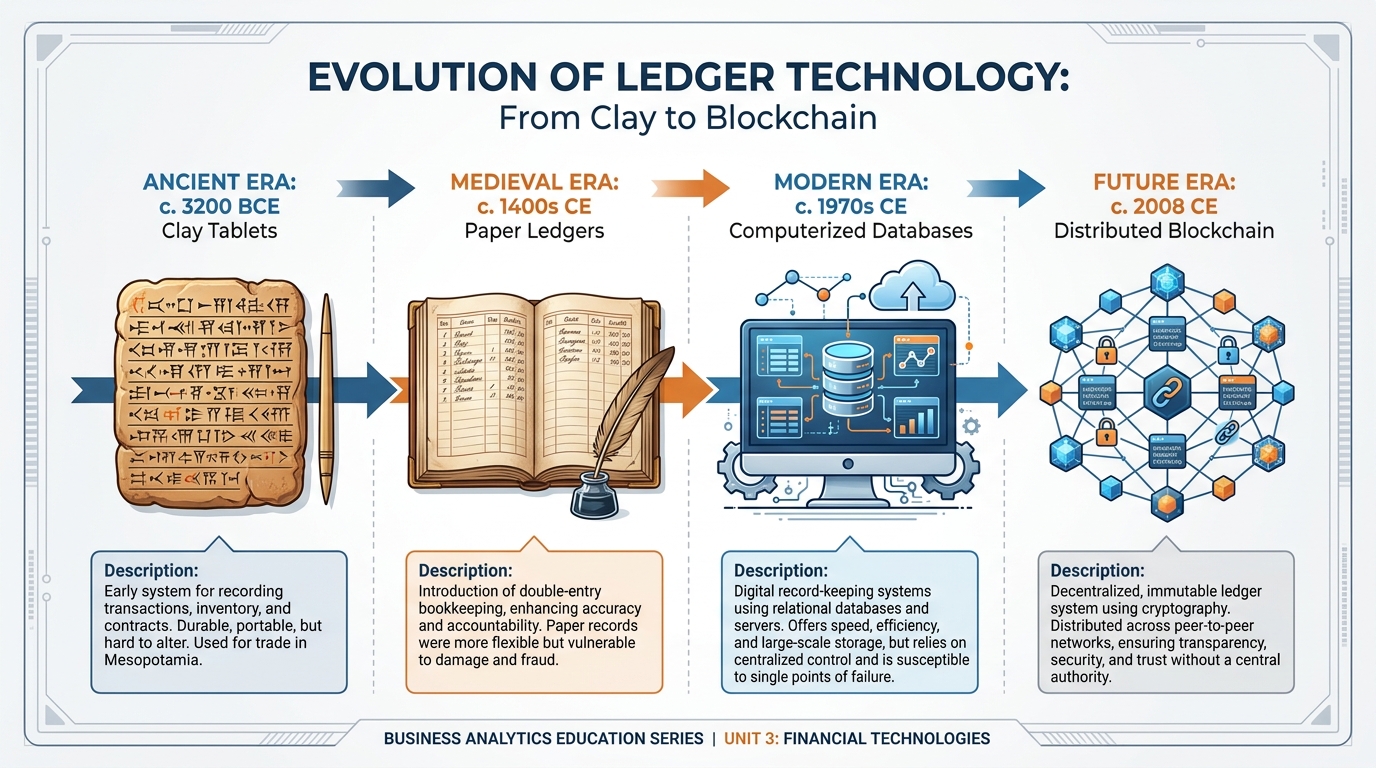
Figure 2:5,000 Years of Ledger Technology: The medium has changed dramatically — from clay to code — but the fundamental question of who controls the record has remained constant until blockchain.
This arrangement works well enough — until it does not.
▶ Watch: How does a blockchain work — Simply Explained (6 min)
2The Trust Problem
The centralized ledger has three failure modes. They are not hypothetical. They happen regularly, at significant cost, across every industry.
Failure Mode 1: The Keeper Disappears. In 2001, Enron’s accountants did not disappear — but their ledgers effectively did. Roughly $74 billion in shareholder value evaporated because the keepers of the records were also falsifying the records. This is not unique to Enron. It happens to small businesses when the only person with database access leaves without transition. It happens to governments when regimes change and archives are destroyed. It happens when a startup folds and its cloud subscription lapses. Centralized records are as permanent as the institution keeping them, and institutions are more fragile than we acknowledge.
Failure Mode 2: The Keeper Edits Pages. This is the subtler danger. A single authoritative record that can be changed unilaterally — with no automatic trail, no external verification — is an invitation to manipulation. Title fraud costs American property owners an estimated $1 billion per year. Medical record errors affect 80 million Americans. Supply chain fraud — false certifications, phantom shipments, counterfeit goods — costs the global economy hundreds of billions of dollars annually. In each case, someone with write access to a centralized ledger quietly edited the pages.
Failure Mode 3: The Keeper Becomes a Bottleneck. Even when the keeper is perfectly honest, centralization creates friction. International wire transfers take 3–5 business days — not because the money is physically moving, but because a chain of correspondent banks must each update their own ledgers and reconcile them with each other. A patient’s medical records, technically owned by multiple hospitals, cannot be instantly shared in an emergency because each hospital’s ledger is a proprietary silo. A manufacturer cannot instantly verify a supplier’s sustainability certifications because each actor in the supply chain maintains its own records.
▶ Watch: Bitcoin is Worthless (But So Is Your “Real” Money) — Simply Explained (6 min)
3The Blockchain Solution: Distributed, Immutable, and Trustless
A blockchain solves the trust problem not by finding a more trustworthy keeper — but by eliminating the single keeper entirely.
Instead of one village elder holding the notebook, imagine five hundred villagers each holding an identical copy of the notebook. Every time a transaction occurs, it is announced to all five hundred. Each villager checks whether the transaction is valid (does the sender actually own what they claim to own?). If enough of them agree it is valid, they all add the same entry to the bottom of their notebooks simultaneously. Now try to secretly edit a page: you would have to convince a majority of five hundred people — who do not know each other, who are scattered across the world, who have no reason to coordinate with you — to all make the same edit to their own copies at the same time.
This is the foundational intuition of a blockchain. The technical details vary, but the architecture is always the same: many participants, one shared truth, no single controller.
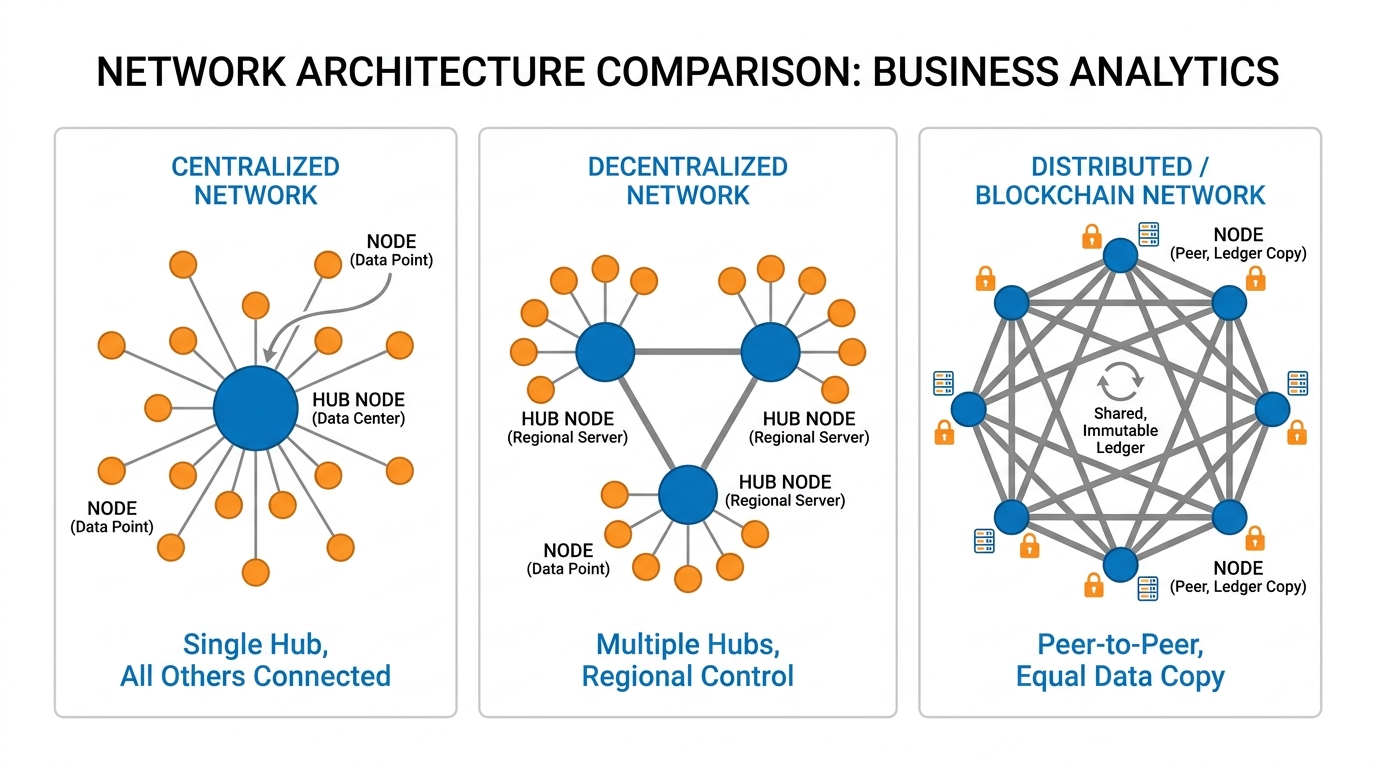
Figure 3:Network Architectures: The blockchain model (right) distributes both the data and the authority — every node holds the full ledger, and no single node can alter the truth for others.
Let’s now build the technical vocabulary, piece by piece, without any mathematics.
3.1Blocks: Batching Transactions
Transactions on a blockchain are not processed one at a time. They are collected into groups called blocks. Think of a block as a page in the village notebook — it contains several recent entries, grouped together. On Solana (the blockchain we will use throughout this course), a new block is added approximately every 400 milliseconds. On the original Bitcoin network, a new block is added approximately every 10 minutes. The frequency depends on the network’s design goals.
3.2Chains: Linking History Together
Here is where the “chain” in blockchain becomes critical. Each block contains, as one of its entries, a reference to the block that came immediately before it. Not just a name or number — a cryptographic fingerprint of the entire previous block.
A cryptographic hash is a fingerprint for data. If you put any document — any string of text, any file — through a hashing function, you get a fixed-length string of characters that is unique to that document. Change even a single character anywhere in the document, and the entire fingerprint changes completely. This is not like a serial number (which you could copy); it is derived from the content itself.
Because each block contains the hash of the previous block, the blocks form a literal chain. Block 10 contains the hash of Block 9. Block 9 contains the hash of Block 8. All the way back to the very first block — called the genesis block.
This chaining creates immutability through dependency. If you wanted to alter a transaction in Block 9, the hash of Block 9 would change. But Block 10 contains the old hash of Block 9, so Block 10 is now inconsistent. Fix Block 10 to contain the new hash, and Block 11 is now inconsistent. You would have to redo every subsequent block all the way to the present — and you would have to do it faster than the entire rest of the network is adding new blocks. For a network with thousands of nodes, this is computationally impossible.
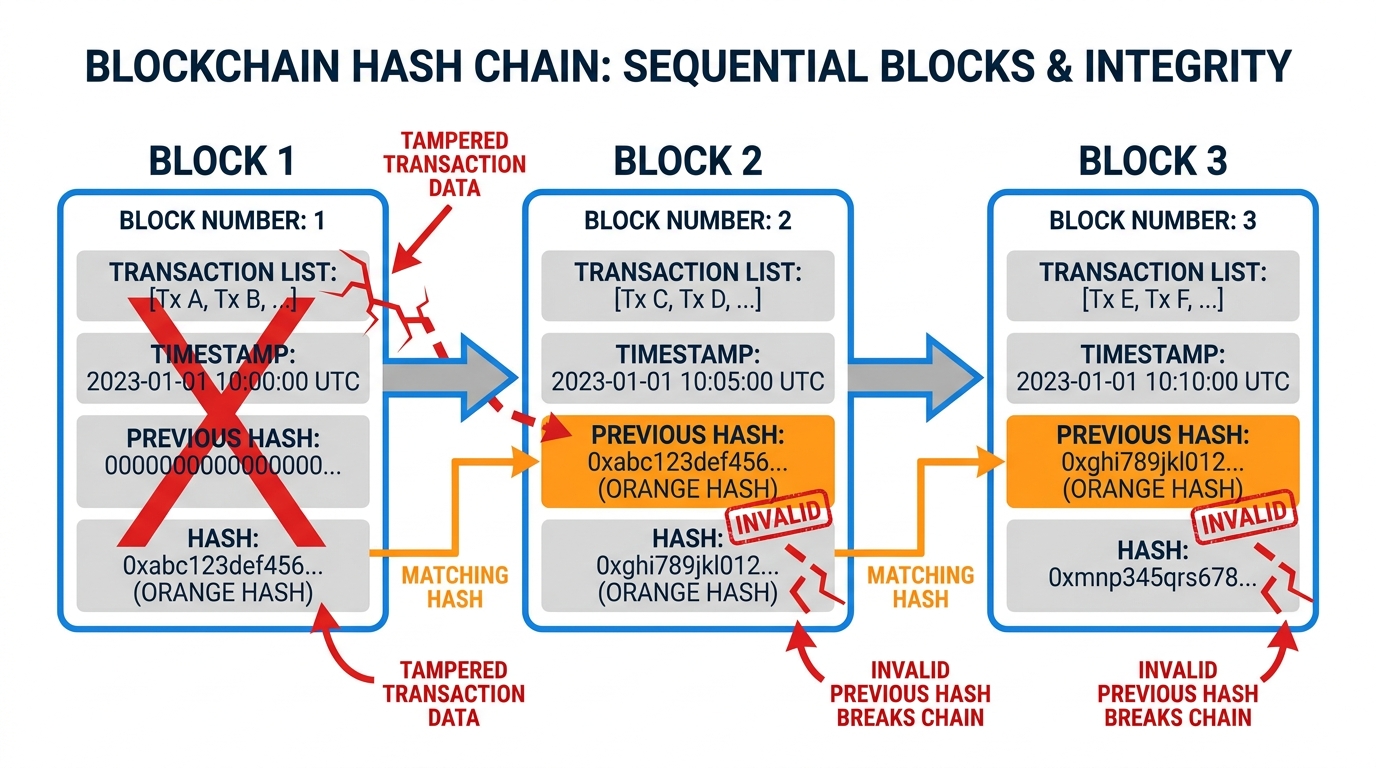
Figure 4:The Hash Chain: Each block’s fingerprint is embedded in the next block. Altering any historical block would require recalculating every subsequent block faster than the rest of the network — a task that is computationally infeasible.
▶ Watch: Passwords & hash functions — Simply Explained (7 min)
3.3Consensus: How the Network Agrees
The five hundred villagers with notebooks need a procedure for agreeing on which transactions to add — and for detecting and rejecting fraudulent ones. This procedure is called a consensus mechanism.
Different blockchains use different consensus mechanisms. The original Bitcoin uses Proof of Work, in which nodes compete to solve a computational puzzle, and the winner gets to add the next block. This is famously energy-intensive, because millions of computers are running the same computation simultaneously.
Solana, which we will use in this course, uses Proof of History combined with Proof of Stake. The details are technical, but the key intuition is this: rather than competing with energy, nodes in Proof of Stake systems put up collateral (staked tokens). If they validate fraudulent transactions, they lose their stake. Economic punishment replaces computational competition, which is why Solana can process a theoretical ceiling of 65,000 transactions per second (sustained real-world throughput is in the low thousands) and complete them in 400 milliseconds — while consuming a fraction of Bitcoin’s energy.
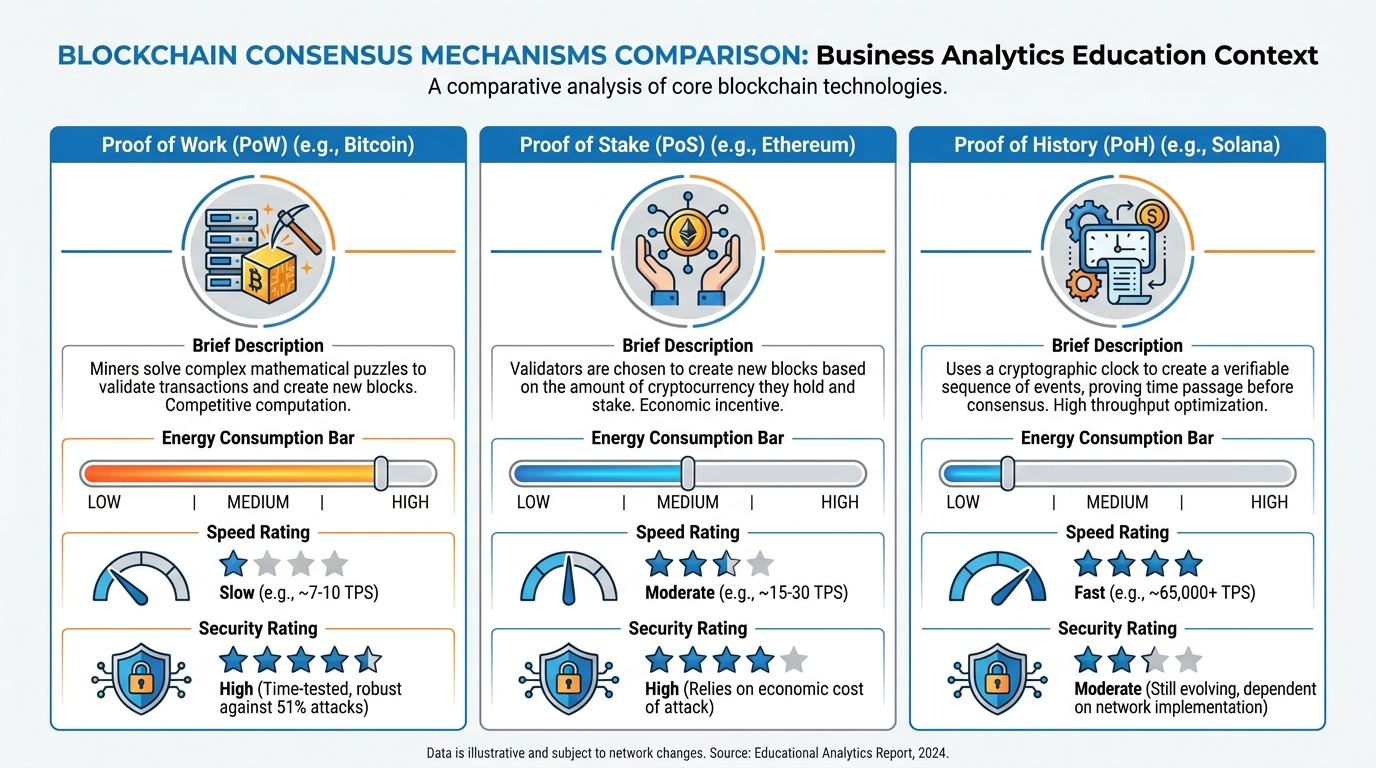
Figure 5:Consensus Mechanisms Compared: The three dominant approaches differ dramatically in their speed, energy consumption, and security model — with Solana’s Proof of History enabling transaction speeds that were previously impossible on a decentralized network.
The consensus mechanism is what makes the network trustless — meaning you do not need to trust any individual participant, because the rules of the system make cheating economically self-defeating. This is one of the most subtle and important ideas in this course. We are not replacing trust with faith in a better institution. We are replacing trust with mathematics and economic incentives. The village elder is replaced not by five hundred elders — but by five hundred people who are each paid to be honest and punished for being dishonest, enforced automatically by code.
▶ Watch: Proof-of-Stake (vs Proof-of-Work) (8 min)
▶ Watch: Cardano — Simply Explained (8 min)
▶ Watch: IOTA — Simply Explained (5 min)
4The NAAT Framework: This Book’s Analytical Lens
Now that you understand what a blockchain is, we need a systematic way to analyze any business situation and ask: does this actually need a blockchain? Could a blockchain improve it? What would it look like?
Throughout this course, we will use the NAAT Framework:
N — Network: Who are the participants? How many? What are their relationships?
A — Actors: Who initiates actions? Who validates? Who has read vs. write access?
A — Assets: What is being tracked, transferred, or transformed? Digital or physical?
T — Transactions: What events change the state of assets? Who authorizes them?
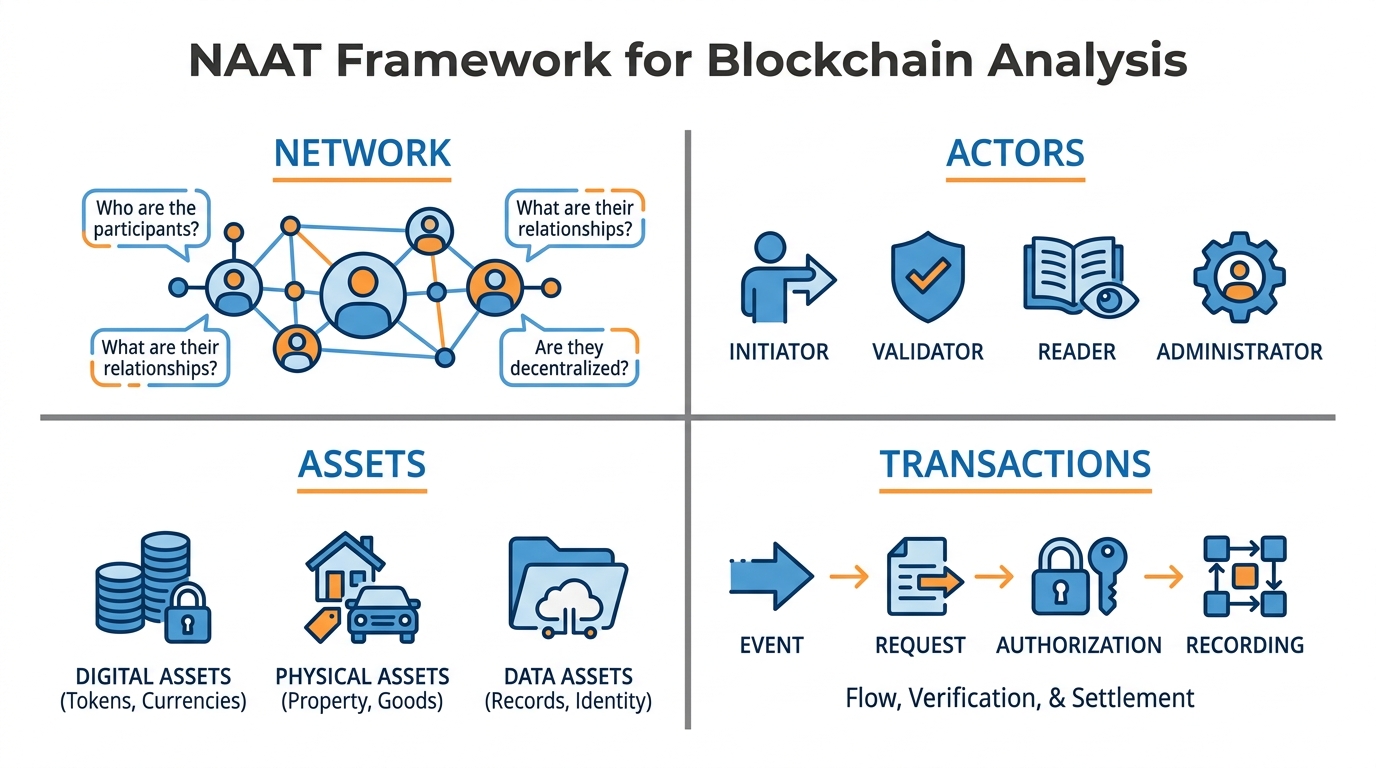
Figure 6:The NAAT Framework: The analytical lens for every blockchain evaluation in this course. Map any business through these four quadrants to understand what a distributed system would need to do.
The NAAT framework is not a checklist — it is a structured way of thinking. It forces you to be precise about what you are actually trying to solve before you start considering technical solutions.
4.1N: Network
The network describes the ecosystem of participants who interact with the shared ledger. A blockchain adds the most value when the network has these characteristics:
Multiple independent parties who do not naturally trust each other
No existing trusted intermediary that all parties accept without cost or friction
Geographic or organizational distribution that makes centralized coordination difficult
Ongoing relationships — not one-off transactions, but repeated interactions over time
A single company with multiple internal departments usually does not need a blockchain — the company itself can serve as the trusted intermediary for its own data. But a network of fifty suppliers, three manufacturers, ten distributors, and a dozen retailers? That network has no natural central authority, and every participant’s incentive to keep accurate records is complicated by their competitive relationship with the others.
4.2A: Actors
Actors are the participants who take specific roles within the network. In a well-designed blockchain system, you need to identify:
Initiators — who creates transactions? (A buyer placing an order, a patient requesting their record, a farmer certifying a harvest)
Validators — who confirms transactions are legitimate? (In Solana, this is done by validator nodes running the protocol; in a permissioned enterprise blockchain, validators might be designated partner companies)
Readers — who has permission to see what? (All participants might see transaction hashes but not transaction contents; or the ledger might be fully public)
Administrators — in permissioned systems, who manages protocol upgrades and participant access?
The actor map reveals whether a blockchain is necessary or whether a simpler shared database would suffice. If there is one entity who will inevitably control validator access, you effectively have a centralized database with extra complexity.
4.3A: Assets
Assets are what the ledger tracks. Blockchains handle assets differently depending on their nature:
Native digital assets — tokens that exist only on the blockchain (cryptocurrencies, governance tokens, NFTs) — are the simplest case. The asset and the ledger are the same system.
Digital representations of real-world assets — a token that represents a kilogram of coffee on a specific farm, or a share of real estate, or a kilogram of carbon credits — require a bridge between the blockchain record and the physical reality. The blockchain can guarantee that the digital record is accurate and immutable; it cannot, by itself, guarantee that the physical asset actually exists as described. This distinction is crucial, and we will return to it throughout the course.
Data assets — records, certifications, credentials, supply chain events — are tracked as hashes rather than the data itself. The actual content might be stored off-chain (in a database or distributed storage system), but the fingerprint of that content is recorded on the blockchain, making any tampering detectable.
4.4T: Transactions
Transactions are the events that change asset state. The NAAT analysis should identify:
What triggers a transaction? (A shipment arriving at a warehouse, a payment being released, a vote being cast)
What validates the transaction? (A physical IoT sensor, a digital signature from an authorized party, a smart contract condition being met)
What information needs to be recorded? (Just the fact that a transaction occurred? The parties involved? The asset value? The metadata?)
What happens if a transaction is disputed? (Can it be reversed? Is there an arbitration mechanism? Is the record final?)
The transaction design reveals whether you need the full power of a blockchain (immutable, decentralized, consensus-verified) or whether a traditional database with proper auditing would accomplish the same goal.
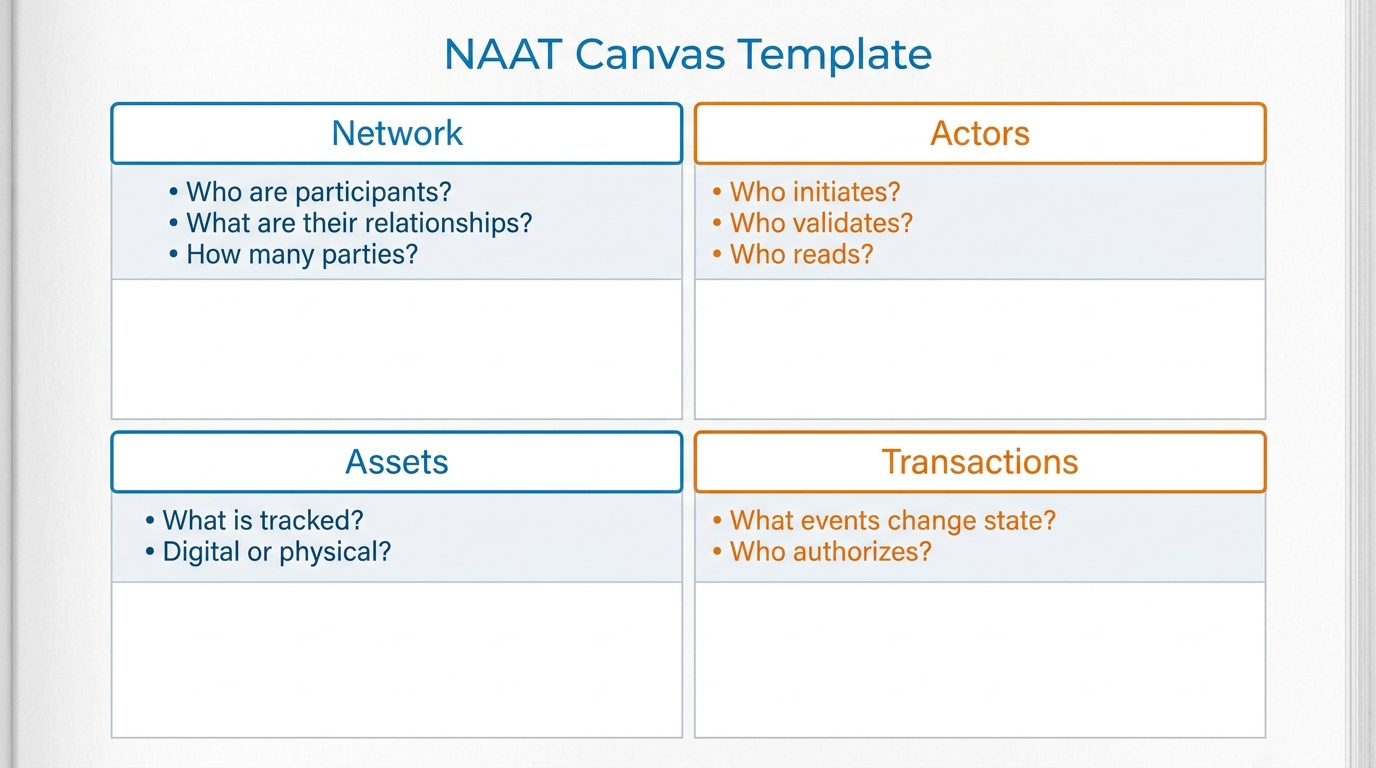
Figure 7:The NAAT Canvas: Your analytical template for every blockchain evaluation. In the Activity section of this chapter, you will fill one of these out for a real business.
5Why Every Industry Has a Distributed Use Case
Let’s apply the NAAT lens briefly to several industries to illustrate how universal the trust problem actually is.
5.1Healthcare: The Fragmented Medical Record
A patient in Miami visits their primary care physician at Baptist Health, gets a specialist referral at the University of Miami Health System, has a procedure at Nicklaus Children’s Hospital, and fills a prescription at CVS. These four institutions hold four different fragments of that patient’s medical history. None of them talk to each other in real time. In an emergency, the attending physician in the ER may have access to none of it.
The NAAT analysis for healthcare reveals:
Network: Multiple competing, disconnected institutions with no mutual trust relationship and strong competitive incentives to maintain data silos
Actors: Patients (who technically own their own data under HIPAA), physicians, hospitals, insurers, pharmacies — each with different read/write permissions
Assets: Digital health records — structured data, imaging files, prescription histories, lab results
Transactions: Test orders, medication dispensations, diagnoses, referrals, insurance claims
A patient-controlled blockchain-based health record would allow the patient to hold their own cryptographic key, granting time-limited read access to any provider — without any institution controlling the master record. Projects like Health Nexus and the European MyHealthMyData consortium have explored this architecture. Solana’s speed and low transaction fees make it particularly relevant here: each access grant and each record update can be logged immutably without prohibitive costs.
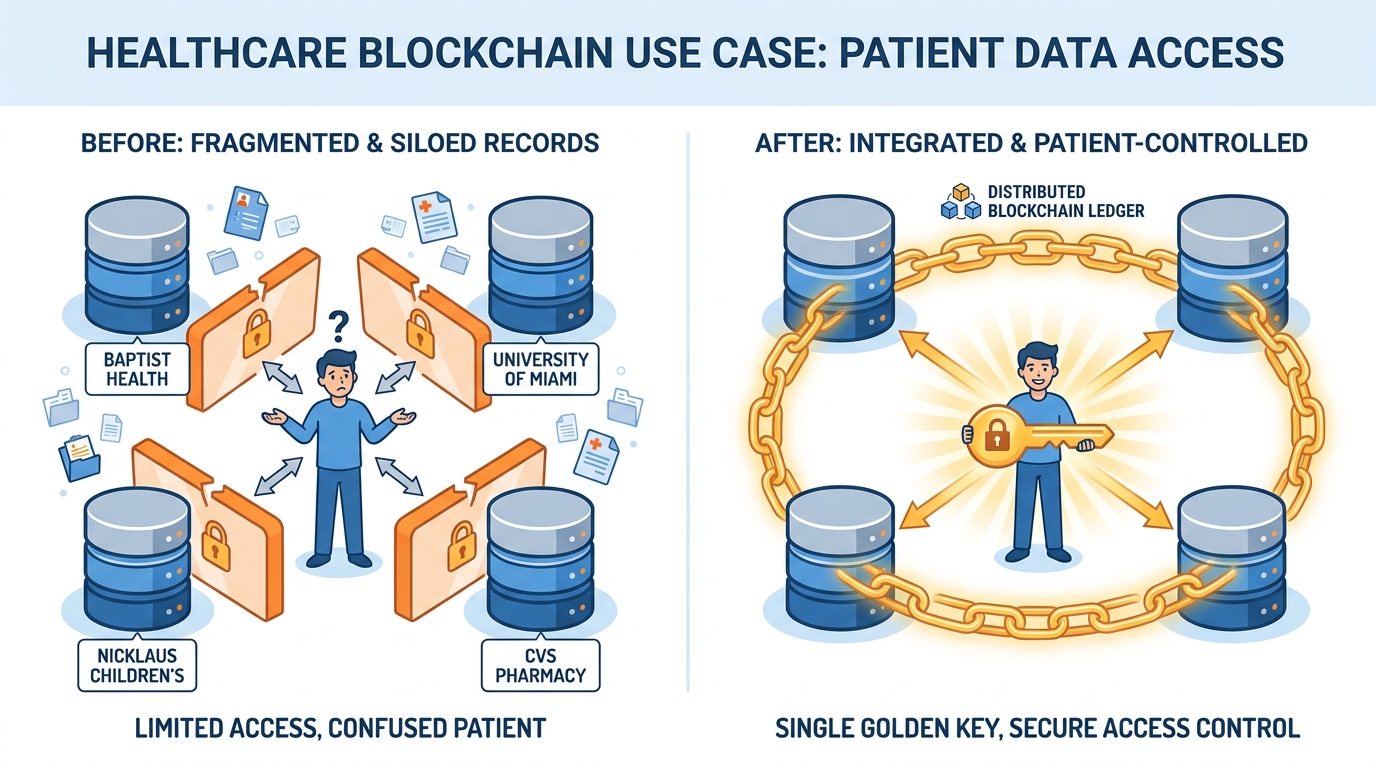
Figure 8:Healthcare’s Trust Problem: Medical records are siloed across competing institutions. A blockchain model puts the patient in control of their own cryptographic key — granting access to any provider, removing any institution from the equation.
5.2Supply Chain: The Provenance Problem
A mango in a grocery store in New York City has passed through approximately seven to ten hands since leaving the farm in Ecuador: farm → local aggregator → export packager → port logistics → ocean freight → customs broker → national distributor → regional distributor → store. At each step, a paper document or siloed database entry is created by a different company with different software and different incentives.
In 2018, a romaine lettuce E. coli outbreak in the United States required 11 days for the FDA to trace the source. During those 11 days, retailers pulled all romaine lettuce from shelves across the country — destroying hundreds of millions of dollars in inventory. IBM Food Trust (built on Hyperledger) demonstrated that the same trace could be performed in 2.2 seconds using blockchain-recorded supply chain events. Walmart subsequently made blockchain adoption mandatory for its leafy vegetable suppliers.
The NAAT analysis here is textbook: multiple independent actors with competing interests (farms, exporters, shippers, distributors, retailers, regulators) — no natural central authority — physical assets with digital representations at each handoff — and transactions that must be verified by multiple parties without any single party controlling the record.
5.3Real Estate: The Title Problem
Buying a house in the United States involves a title search — a process that traces the ownership history of a property back through decades of records to verify that the current seller actually has clear title to sell. This process takes 1–2 weeks and costs $500–$2,000 in title insurance and search fees. It is necessary precisely because property records are held in separate, often paper-based county records systems that can be incomplete, inconsistent, or fraudulently altered.
In Broward County, Florida — where many of our students work — title fraud is a documented problem. Properties have been fraudulently transferred out from under their legitimate owners using forged notarized documents recorded at the county clerk’s office. The county clerk’s office is the “village elder with a notebook,” and the notebook can be manipulated.
A blockchain-based property registry would create an immutable record of every transfer, accessible to any party, verifiable without a title company intermediary. The Republic of Georgia implemented a blockchain property registry in 2016. The state of Wyoming has enacted legislation enabling blockchain-based property records. This is not theoretical — it is happening.
▶ Watch: Blockchains — how can they be used? (7 min)
6The Decision Test: When Blockchain Is the Wrong Answer
The trust problem is ubiquitous. Blockchain technology is not always the right solution to it.
Here is a diagnostic framework — a set of questions that will tell you, in most cases, whether you actually need a blockchain or whether a simpler solution will do:
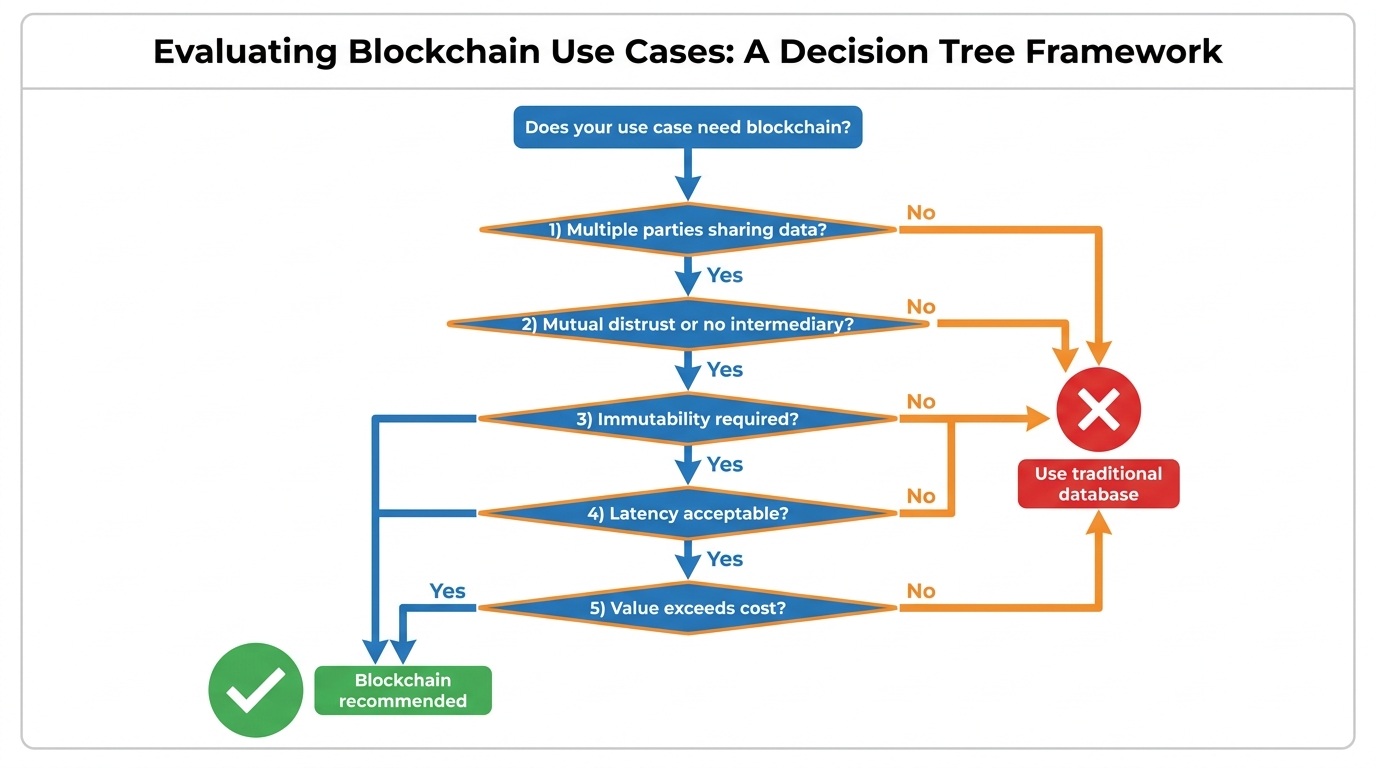
Figure 9:The Blockchain Decision Test: Five diagnostic questions that determine whether your problem requires a distributed ledger or whether a simpler solution will serve better.
Question 1: Do you need to store data that will be shared or verified by multiple independent parties?
If no — if the data is only ever used by a single entity — a blockchain adds complexity with no benefit. A private company’s internal inventory system does not need a blockchain.
Question 2: Are there multiple parties involved who do not fully trust each other, or who cannot rely on a shared trusted intermediary?
If no — if there is an existing trusted intermediary that all parties accept without friction or cost — a blockchain may be unnecessary. The US dollar settlement system, for all its inefficiencies, is trusted by virtually all parties for dollar-denominated transactions. Building a blockchain settlement layer on top of it adds complexity without solving a real trust problem.
Question 3: Do you need the record to be immutable — do you need to prevent retroactive changes?
If no — if your business process specifically requires the ability to edit, correct, or delete records (which is true for many regulated industries under GDPR, for example) — blockchain’s immutability is a liability, not an asset.
Question 4: Can you tolerate the current latency of available blockchain networks?
If no — if your system requires sub-millisecond confirmation times — even Solana (with its 400ms block time) may introduce unacceptable latency for some real-time applications. High-frequency trading, for instance, operates on microsecond timescales that no current blockchain can match.
Question 5: Does the value created by removing the intermediary exceed the cost and complexity of the blockchain implementation?
This is the most important question. Blockchains are not free. They require infrastructure, token economics, developer expertise, user onboarding, and ongoing maintenance. If the intermediary you are replacing costs $5 per transaction and serves the purpose adequately, building a blockchain system that costs $2 million to implement and $500,000 per year to maintain is not a business case — it is blockchain theater.
7NAAT in Practice: Three Business Analyses
Let’s work through three short NAAT analyses to see the framework in action.
7.1Case 1: A Boutique Coffee Brand’s Supply Chain Story
Background: Café Sol is a specialty coffee brand in Boca Raton that wants to tell a provenance story to its customers: which specific farm in Colombia produced their beans, what the farmer was paid, what the shipping and roasting conditions were, and an end-to-end sustainability certification.
NAAT Analysis:
| Dimension | Detail |
|---|---|
| Network | Farm in Medellín → export cooperative → freight forwarder → Miami importer → Boca Raton roaster → retail customer — six independent parties across two countries |
| Actors | Farm manager (certifies harvest data), cooperative (certifies export), freight forwarder (certifies chain of custody), importer (certifies customs clearance), roaster (certifies roasting conditions), consumer (reads provenance) |
| Assets | Batch of green coffee beans (physical), provenance certification data (digital), sustainability metrics (digital), payment records (digital) |
| Transactions | Harvest certification, cooperative handoff, export clearance, shipping milestone, import clearance, roasting certification, QR code scan by consumer |
Decision Test Result: ✅ Strong blockchain use case. Multiple parties, no natural central authority, immutability critical for certification integrity, consumer verification requires public readable record. Recommended architecture: Solana-based token representing each batch, with metadata written at each supply chain milestone.
7.2Case 2: A Regional Credit Union’s Member Loan System
Background: Sunbelt Credit Union wants to explore blockchain for its internal loan approval and servicing workflow.
NAAT Analysis:
| Dimension | Detail |
|---|---|
| Network | Internal departments (loan origination, underwriting, servicing, compliance) — all within a single regulated institution |
| Actors | Loan officers, underwriters, servicers, compliance officers — all employees of the same organization |
| Assets | Loan applications, approvals, payment records — all governed by existing regulatory frameworks |
| Transactions | Application submission, credit check, approval, disbursement, payment, payoff — all processed through existing core banking software |
Decision Test Result: ❌ Blockchain is the wrong answer. All parties are within a single institution. The credit union itself is the trusted intermediary. Immutability of individual records may conflict with regulatory requirements to modify records upon court order. A modern database with proper audit logging accomplishes the same goals at a fraction of the cost and complexity.
7.3Case 3: A University Credential Verification System
Background: Florida Atlantic University wants to allow employers to instantly verify the authenticity of graduates’ diplomas and transcripts without calling the registrar.
NAAT Analysis:
| Dimension | Detail |
|---|---|
| Network | University (issuer), graduates (holders), employers and graduate schools (verifiers) — three distinct parties with no existing shared verification system |
| Actors | Registrar (issues credentials), graduate (holds and shares), employer/admissions office (verifies without registrar involvement) |
| Assets | Diploma, official transcript — digital representations of academic accomplishments |
| Transactions | Issuance (registrar writes to ledger), sharing (graduate shares proof), verification (employer checks proof without contacting university) |
Decision Test Result: ✅ Strong use case, with nuance. The core value is verifiable credentials without intermediary contact — which blockchain achieves elegantly. However, it is worth noting that MIT, MIT Media Lab’s Digital Diplomas project (using Bitcoin’s blockchain), and the Blockcerts open standard have already implemented this. FAU could adopt an existing standard rather than building from scratch. The blockchain use case is sound; the build vs. buy decision requires further analysis.
8The Revolution You Just Understood
Let us pause and appreciate what the technology we have just described actually means at scale.
We have built an entire global civilization on the assumption that trust requires an institution. You cannot own property without a county recorder’s office. You cannot own stocks without a broker and a clearinghouse. You cannot send money internationally without a network of correspondent banks. You cannot prove your education without calling a registrar. You cannot prove your identity without a government-issued document that depends on government records.
Each of these institutions is valuable. Each also extracts a rent — in fees, in delays, in data ownership, in the power to deny access. The American title insurance industry alone generates $16 billion in annual premiums precisely because the record-keeping system is fragmented and unreliable. Swift, the interbank messaging network that coordinates international wire transfers, charges fees on every transaction and introduces multi-day delays — not because the technology requires it, but because the institutional architecture does.
Blockchain technology is not a technology story first. It is a property rights story. It is an economic architecture story. When ownership can be proven by a cryptographic key — not by a document in a file in an office in a county courthouse — the concept of who can own what, who can transfer what, and who can verify what changes fundamentally.
Globally, about 1.4 billion adults lack access to formal banking (World Bank Global Findex). Not because they lack money or economic activity — but because the institutional infrastructure for ownership and credit does not exist in their communities, or actively excludes them. A blockchain-based financial system needs only a smartphone and an internet connection. It does not need a branch office, a Social Security number, a credit history, or the discretion of a loan officer.
This is not utopian speculation. It is an application of the exact technology we have just described. In countries with unstable currencies — Venezuela, Lebanon, Argentina, Zimbabwe — citizens are using Solana-based stable coins to hold value that their national banking systems cannot protect. The value is in the wallet. The key is in their hands.
▶ Watch: Mining Difficulty — Simply Explained (5 min)
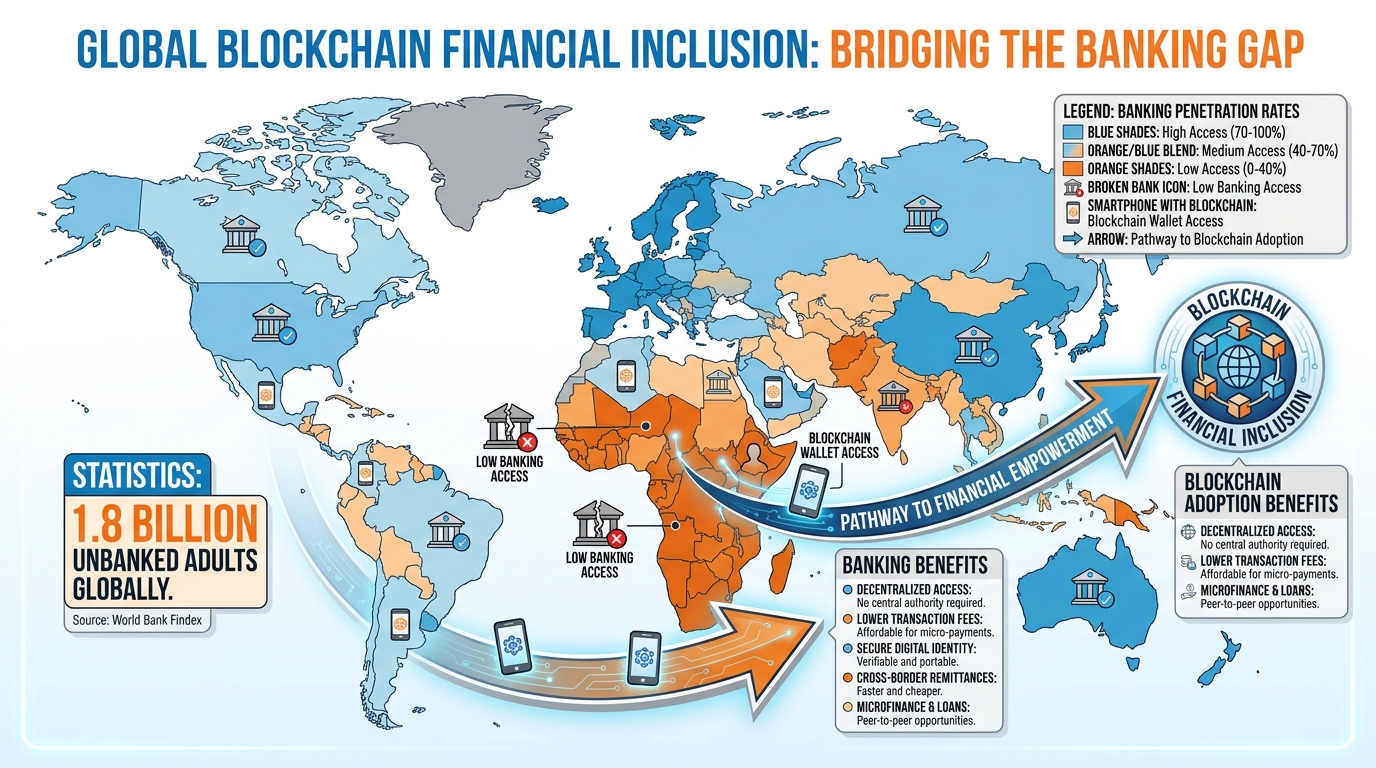
Figure 10:The Stakes Are Global: About 1.4 billion adults lack formal banking access. Blockchain-based financial systems require only a smartphone — no branch office, no credit history, no institutional permission. This is what trustless ownership means in practice.
9Chapter Summary
Let us consolidate what we have covered:
10🔬 Hands-On Lab: See a Blockchain Work (30 minutes)
Before the NAAT canvas, you will manipulate a hash, break a chain, and watch two live networks produce blocks. No wallet needed — just a browser.
10.1Part 1 — Hashes (5 min)
Open
https://andersbrownworth.com/blockchain/hash.Type your full name in the Data box. Copy the 64-character hash into your notes.
Change one letter of your name. Observe the entire hash change. Record the new hash.
Paste a paragraph of any length. Observe the hash is still 64 characters.
Write one sentence: why can’t you work backwards from the hash to the paragraph?
10.2Part 2 — A block (5 min)
Open
https://andersbrownworth.com/blockchain/block.Type any data. Notice the block shows red (invalid) because the hash does not start with the required zeros.
Click Mine. Watch the Nonce field count up until a valid hash is found. Record the nonce.
Change one character of the data. The block turns red again. This is why editing a block requires re-mining it.
10.3Part 3 — Break a chain (10 min)
Open
https://andersbrownworth.com/blockchain/blockchain. Five linked blocks appear, all green.Edit the data in Block 2. Observe Blocks 2, 3, 4, and 5 all turn red — every later block contains Block 2’s old hash.
Click Mine on Block 2. It turns green; 3, 4, 5 stay red. Mine each one in order until the chain is green again. Count how many mines it took.
Write one sentence: on a real network with thousands of nodes adding new blocks every 400 ms, why can an attacker never finish this catch-up?
10.4Part 4 — Distributed copies (5 min)
Open
https://andersbrownworth.com/blockchain/distributed. Three peers (A, B, C) each hold an identical chain.Edit Block 3 on Peer B and re-mine it and every block after it until Peer B’s chain is fully green.
Compare the final hash of Block 5 on Peer B to Peer A and Peer C. They differ. Write one sentence: how do A and C know B is lying?
10.5Part 5 — Two live networks (5 min)
Open
https://mempool.space. Watch the block row at the top. Note the time since the last Bitcoin block and the average block interval (~10 min). Note the fee estimates in sat/vB.Open
https://explorer.solana.comand click Live Cluster Stats (or observe the stats panel on the home page). Note the current slot number, transactions per second, and the block time (~400 ms). Wait 10 seconds and note how many slots advanced.Click any recent Solana block. Note the number of transactions in it and the “Block Hash” and “Parent Block Hash” fields — this is Part 3, live.
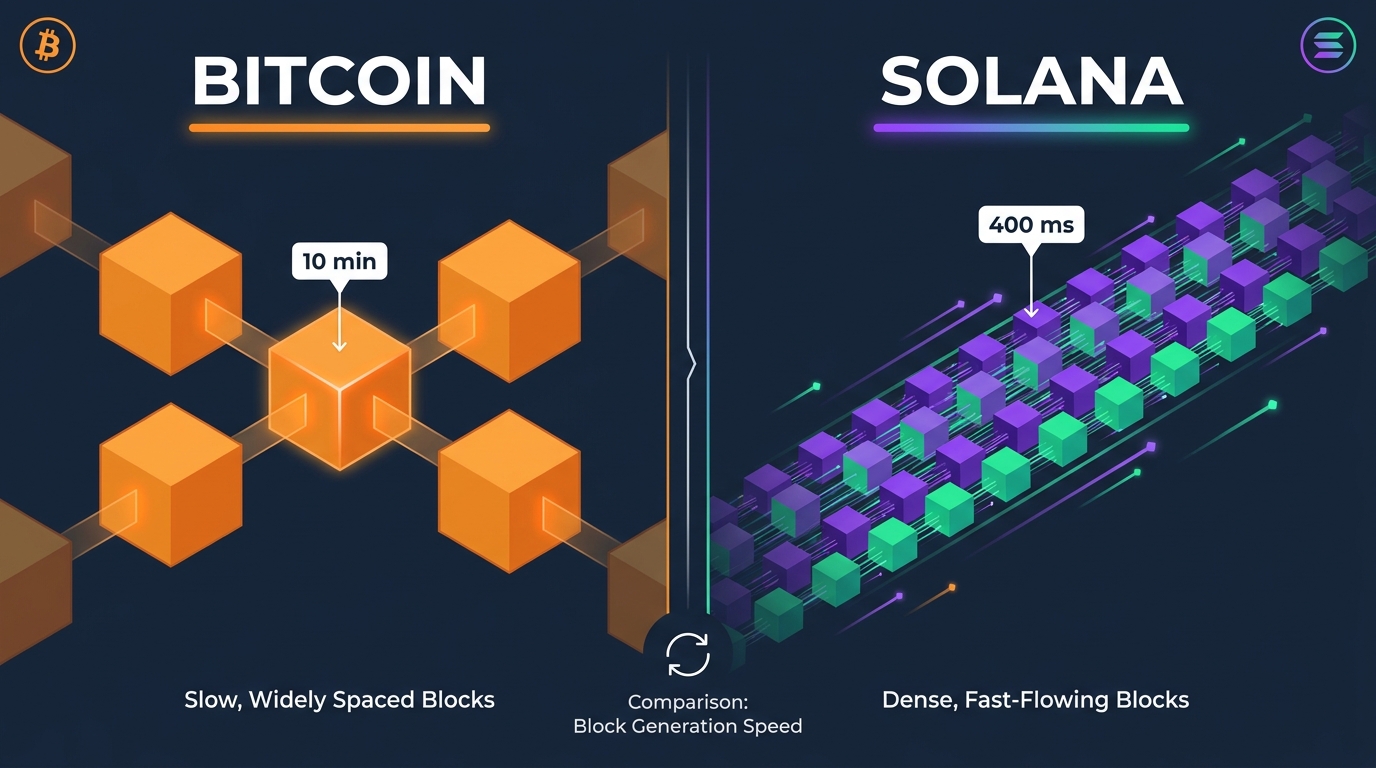
Figure 11:Two Live Networks: Bitcoin (mempool.space) and Solana (explorer.solana.com) producing blocks in real time — the hash chain from Part 3, running live at two very different speeds.
Deliverable: a one-page PDF with your four screenshots (hash, broken chain, peers disagreeing, Solana block with parent hash highlighted) and your four one-sentence answers.
11🎯 Activity: The NAAT Canvas
11.1Instructions
This activity should take approximately 30 minutes in class, followed by a 2-minute presentation per team.
Step 1: Choose a Business (5 minutes)
Select one of the following (or propose your own, with instructor approval):
A local farmers’ market cooperative tracking produce from farm to table
A South Florida real estate title and escrow company
A Miami-Dade County public school system managing student records
A healthcare network managing patient records across hospitals
A music streaming platform managing royalty payments to artists
A cruise line managing loyalty points and onboard purchases
Step 2: Fill Out the NAAT Canvas (15 minutes)
On a whiteboard or shared document, complete the four-quadrant canvas:
| Quadrant | Your Analysis |
|---|---|
| Network | Who are the participants? How many? What are their relationships and trust dynamics? |
| Actors | Who initiates, validates, reads, and administers? |
| Assets | What is being tracked? Digital-native or physical with digital representation? |
| Transactions | What events change asset state? Who authorizes each? |
Step 3: Run the Decision Test (5 minutes)
Answer each of the five diagnostic questions:
Multiple parties sharing/verifying data? ✅ / ❌
Mutual distrust or no trusted intermediary? ✅ / ❌
Immutability required? ✅ / ❌
Current blockchain latency acceptable? ✅ / ❌
Value exceeds implementation cost? ✅ / ❌
Step 4: State Your Position (5 minutes)
Based on your canvas and decision test, complete this statement:
“[Business Name] does/does not need a blockchain because [specific reason rooted in the NAAT analysis]. The current pain point is [specific trust or efficiency problem], and a blockchain would/would not solve it better than [alternative approach].”
Step 5: Present (2 minutes)
Share your canvas, your decision test result, and your position statement with the class. Be prepared to defend your reasoning.
12🚀 Walk Away With
By the end of this chapter and activity, you should have:
✅ A completed NAAT Canvas for a real business you understand
✅ A defensible yes/no position on whether that business needs a blockchain, with specific reasoning
✅ A clear vocabulary: ledger, block, chain, hash, consensus, trustless, distributed
✅ An intuition for the difference between blockchain theater and a genuine distributed trust problem
Keep your NAAT Canvas. We will return to the same business in later chapters to design the token, the tokenomics, and the governance structure — so the more thoughtful your initial analysis, the more valuable the subsequent work will be.
13💬 Discussion Question
14Glossary
Ledger A structured record of assets, ownership, and transactions. The oldest business technology in human history — from Mesopotamian clay tablets to blockchain nodes.
Block A group of validated transactions recorded together as a single unit on a blockchain. Like a page in a ledger that contains multiple entries.
Hash A cryptographic fingerprint — a fixed-length string of characters derived from any input data. Changing even a single character in the input produces a completely different hash.
Blockchain A distributed ledger in which each block of transactions contains the cryptographic hash of the previous block, forming an immutable chain. Maintained by a decentralized network with no single controlling authority.
Consensus Mechanism The protocol by which distributed network participants agree on the validity of transactions and the contents of the next block, without a central authority.
Proof of Work (PoW) A consensus mechanism in which nodes compete to solve a computational puzzle. Energy-intensive but historically secure. Used by Bitcoin.
Proof of Stake (PoS) A consensus mechanism in which validators stake tokens as collateral. Dishonest validators lose their stake. Far more energy-efficient than Proof of Work.
Proof of History (PoH) Solana’s novel consensus contribution — a verifiable delay function that creates a cryptographic timestamp for events before they are added to a block. Enables Solana’s high throughput and fast finality.
Trustless A property of blockchain systems meaning that participants do not need to trust each other or a central authority — they need only trust the protocol rules, which are enforced automatically by code and economic incentives.
Immutability The property of a blockchain record that, once confirmed, cannot be altered without invalidating all subsequent records — making retroactive tampering computationally infeasible.
Genesis Block The very first block in a blockchain — the anchor of the entire chain from which all subsequent blocks derive their validity.
Decentralization The distribution of authority, data, and decision-making across many independent nodes rather than concentrating it in a single institution.
NAAT Framework A structured analytical tool for evaluating blockchain use cases: Network, Actors, Assets, Transactions.
Blockchain Theater A pejorative term for blockchain implementations that adopt the technology for its signaling value rather than to solve a genuine distributed trust problem.
Validator A node in a blockchain network that participates in the consensus process — verifying transaction validity and voting on which blocks to add to the chain.
Node A computer participating in a blockchain network. Full nodes maintain a complete copy of the ledger. Validator nodes also participate in consensus.
Smart Contract Self-executing code stored on a blockchain that automatically enforces the terms of an agreement when predefined conditions are met. We will work with Solana smart contracts starting in Chapter 8.
Token A digital asset issued and tracked on a blockchain. Can represent currency, ownership, access rights, voting power, or virtually any other form of value. We design our first token in Chapter 2.