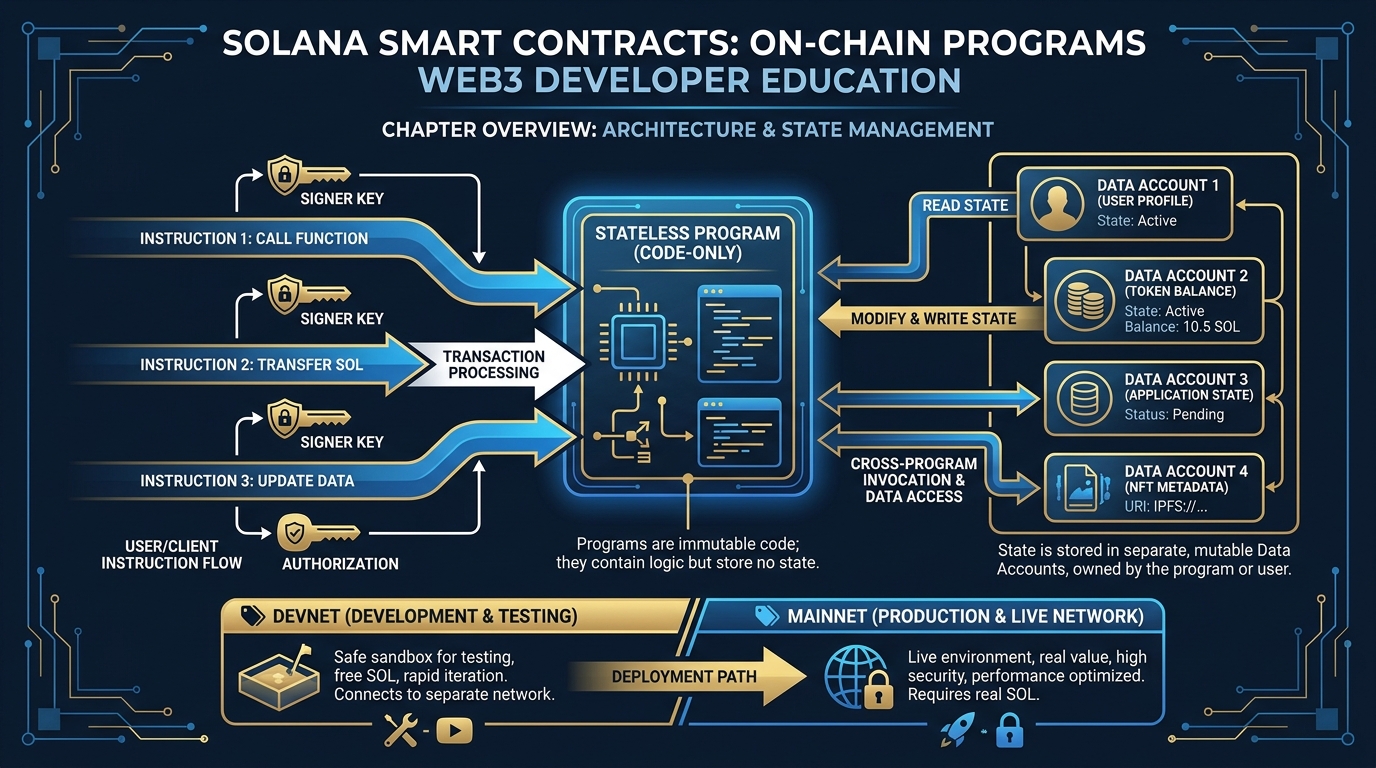
Figure 1:Chapter 8 Explainer Infographic: A Solana program is a stateless rule deployed to the network. Accounts hold the data. Instructions trigger the rules. Signers authorize the action. By the end of this chapter, you will have deployed all three to devnet and watched them run.
Everything you have built so far in this course has been built inside someone else’s rules. You used Phantom because Phantom’s code connects your wallet to Solana’s network. You used Raydium because Raydium’s smart contracts calculate prices and move liquidity. You used Jupiter because Jupiter’s routing program finds the best swap path across a dozen pools. Every tool you have touched is just a program — a rule deployed to a public network — and that program runs exactly as written, forever, for anyone who sends it the right instruction.
Now you are going to write and deploy one of your own.
▶ Watch: Smart contracts — Simply Explained (4 min)
This is not a software engineering chapter. You will not need to install anything. You will not need to understand every line of code. What you will understand is what a program actually is, how it differs from what you might have heard about Ethereum smart contracts, why the phrase “code is law” is both a promise and a serious warning, and how a business leader — not a developer — reads a deployed program and evaluates whether it is safe to trust.
The activity at the end deploys a check-in program to Solana’s devnet entirely inside your browser using Solana Playground. By the time you finish, you will have a real transaction on a real network proving your program ran.
1What a Program Is (And Why Solana Flipped the Architecture)
Let us start with the most important mental model in this chapter, because getting it wrong will cause confusion every time you read about Solana development.
On Ethereum, a smart contract is a bundle that contains two things in one place: the rules (the logic, the code) and the data (the state, the balances, the counts, the records). The contract lives at a single address, and every interaction reads from and writes to that same bundle. The contract owns its data.
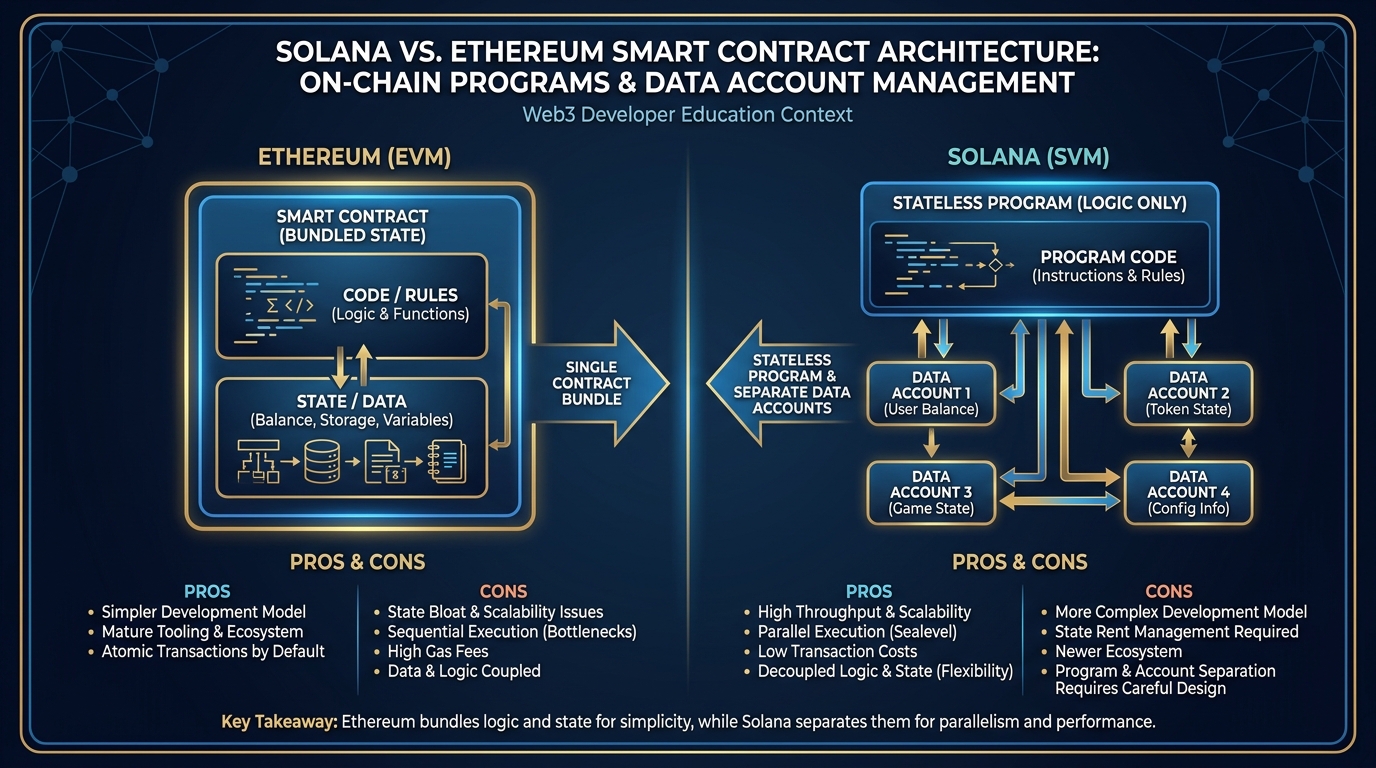
Figure 2:Architecture Contrast: Ethereum bundles rules and state in one contract address. Solana separates them — programs are stateless, and accounts hold the data. This separation is why Solana can process transactions in parallel.
Solana made a different choice. On Solana, programs are stateless. A program contains only the rules — the logic, the instructions it knows how to execute. It holds no data of its own. The data lives in separate accounts that the program can read from and write to when instructed to do so. The program does not own those accounts; it is merely authorized to modify them under specific conditions.
Think of it this way. Imagine a vending machine. The vending machine’s logic — accept money, dispense item, return change — is the program. But the vending machine has no idea what inventory it currently holds or how much money is in the cash drawer until you look at those storage compartments separately. In Solana’s model, the vending machine logic (program) and the inventory + cash tray (accounts) are physically separate. The logic runs, reads from the accounts, writes to the accounts, then steps back.
This design has enormous consequences for performance. Because programs do not hold state themselves, Solana’s runtime can execute multiple transactions in parallel as long as they touch different accounts. When you hear that Solana processes 65,000 transactions per second, the stateless program model is a major reason why.
The analogy breaks down in one important way: a vending machine operator can open the machine and physically change things. On Solana, the only way to change account data is through an authorized instruction executed by the program. Nobody can reach in from outside the machine.
2Instructions, Accounts, and Signers: The Three Things Every On-Chain Action Needs
Every single action on Solana — every token transfer, every NFT mint, every liquidity pool trade, and every check-in you will run today — requires exactly three things. Learn these and you can read any Solana transaction.
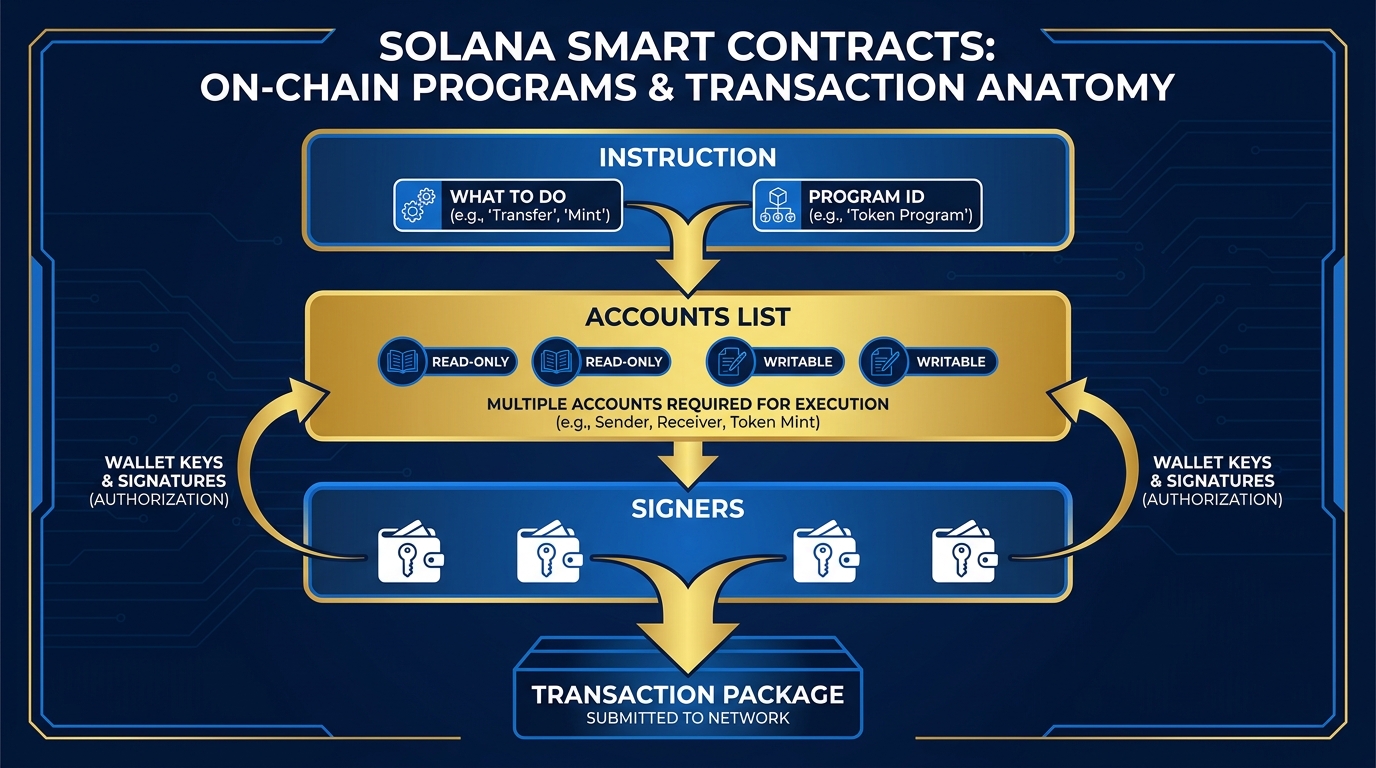
Figure 3:Transaction Anatomy: Every Solana transaction carries an instruction (the action), a list of accounts (the data locations), and one or more signers (the authority). Missing any one of these three elements, the transaction fails.
Instructions tell a program what to do. A program may know how to execute many different instructions — initialize, increment, transfer, close, vote, stake. An instruction is a specific call to one of those capabilities. When you hit “Confirm” in Phantom, your wallet is packaging an instruction and sending it to the Solana network to be executed.
Accounts are the data locations that the instruction needs to read from or write to. Every instruction must explicitly declare which accounts it will touch. This is not optional and not implicit — the declaration is built into the transaction itself. When the Solana runtime receives the transaction, it uses this account list to decide whether the transaction can be processed in parallel with others (if their account lists do not overlap, they can run simultaneously).
Accounts come in two varieties relevant here. A program account holds the compiled program code — it is read-only during execution. A data account holds the state that your program reads and modifies. When you deploy a program and then “initialize” it, you are creating a data account associated with that program and writing starting values into it.
Signers are wallets that have cryptographically authorized the transaction. The signer’s private key produces a digital signature proving “I own this wallet and I approve this action.” Most transactions require at least one signer — typically the person paying the transaction fee (the fee payer) and often the person whose assets are being affected. Some instructions require multiple signers: a multisig treasury might require three out of five designated wallets to sign before any funds move.
3How a Program Holds Your Token: PDAs and CPI
Two more concepts complete the picture of how programs interact with tokens — and both have been operating behind the scenes of everything you built in earlier chapters.
Program Derived Address (PDA). A PDA is an address computed from the program’s ID plus some chosen seeds — and here is the crucial property: no private key exists for it. Nobody holds the key, because there is no key. Only the program that derived the address can sign for it. This is how a vesting contract (Chapter 6), a liquidity pool (Chapter 5), a multisig vault (Chapter 11), or an escrow “holds” tokens: the tokens sit in a token account owned by a PDA, and the program’s rules are the only mechanism by which they can ever move. Think of it as a safe with no key — only a rulebook bolted to the door. When Streamflow locked your vesting tokens, this is where they went: not into a founder’s wallet, but into an account only the vesting program’s logic can release.
Cross-Program Invocation (CPI). A CPI is a program calling another program. Your check-in program does not reinvent token transfers; if it needed to move tokens, it would call the SPL Token program’s transfer or mint_to instruction, signing as its PDA. Every DeFi “money lego” from Chapter 5 is CPI in action: Jupiter calls Raydium; Kamino calls the Token program; Realms executes a passed proposal by CPI. Composability is not a metaphor — it is programs invoking each other’s instructions in a single atomic transaction.
What this means for your evaluation checklist in Reading, Not Writing, Code below: add a sixth step — which programs does this program call, and does it hold assets in PDAs or in a human’s wallet? A protocol whose “vault” is a wallet with a private key is one compromised laptop away from losing everything. A protocol whose vault is a PDA is exactly as safe as its code.
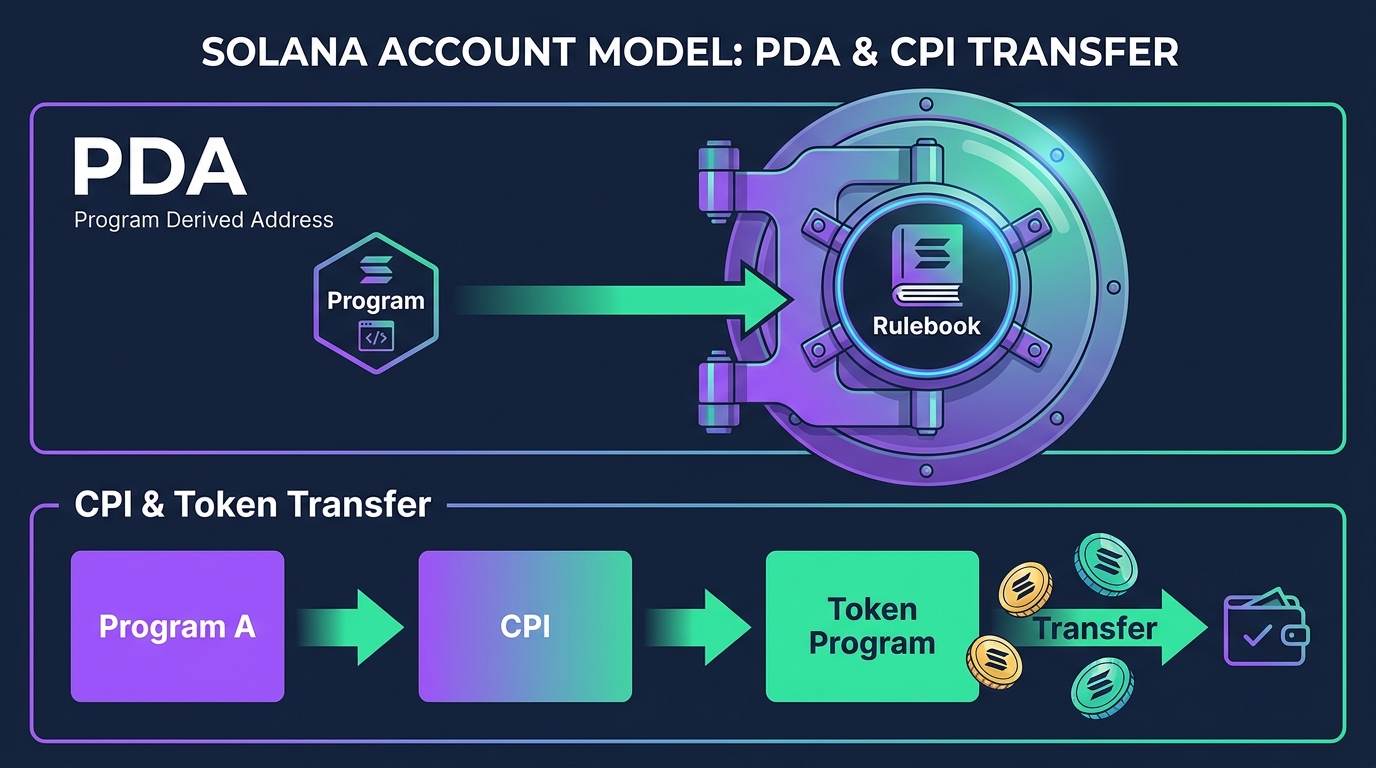
Figure 4:PDAs and CPI: A Program Derived Address is an account with no private key — only the deriving program can sign for it (left). Cross-Program Invocation is one program calling another’s instructions, the mechanism behind every “money lego” (right).
4“Code Is Law”: The Promise and the Warning
The phrase code is law is the oldest and most contentious slogan in blockchain culture. It means exactly what it sounds like: the rules encoded in a smart program are the governing authority. Not a CEO’s decision, not a regulator’s ruling, not a court order, not a change of heart. The code runs as written.
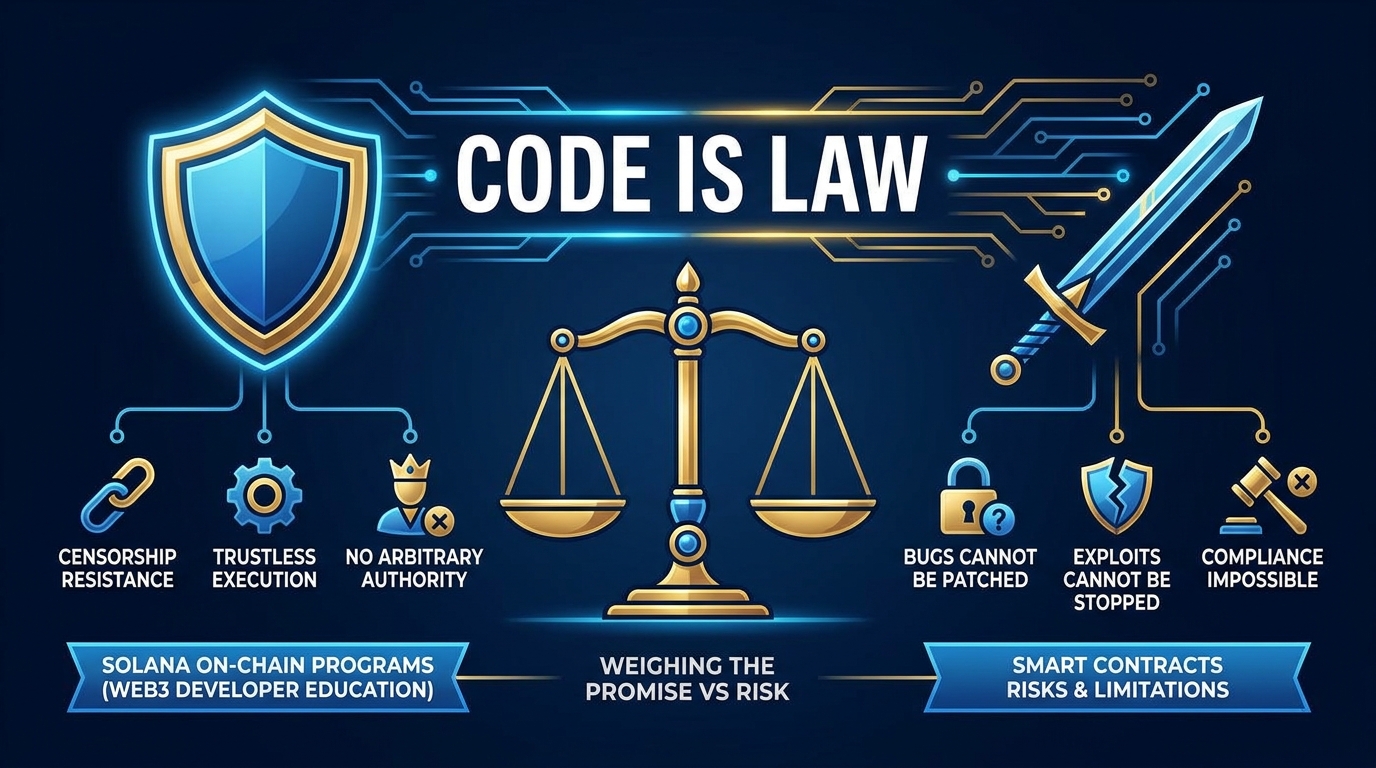
Figure 5:Code Is Law — Promise and Risk: The same property that protects users from arbitrary authority also protects exploiters from correction. Immutability is not inherently good or bad; it is a design choice with consequences that must be evaluated before deployment.
For users, this is a powerful guarantee. When you deposit funds into a Solana protocol whose program has been audited and whose upgrade authority has been revoked, you know with certainty that no one — not the founders, not regulators, not hackers — can change the rules after the fact. The promise made to you at deposit time is the promise that will govern your funds forever.
For builders and regulators, this is a genuine problem. Consider: in 2016, a vulnerability in Ethereum’s “The DAO” contract allowed an attacker to drain $60 million. The code was doing exactly what it was written to do. The attack was, in a strict technical sense, legal under the code-is-law framework. The Ethereum community ultimately chose to fork the blockchain and reverse the theft — an enormously controversial decision that resulted in the split between Ethereum and Ethereum Classic.
The uncomfortable question code-is-law raises for business is this: who bears the risk of a bug? In a traditional business, when a software error causes harm, the company patches it, compensates affected customers, and updates its systems. In a deployed-and-immutable smart program, there is no patch. There is no compensation path. There is the code, running as written, processing the exploit as a valid instruction because the rules permit it.
This is not a reason to avoid programs. It is a reason to choose your upgrade strategy deliberately.
5Upgradeable vs. Immutable: A Business Decision, Not a Technical One
When you deploy a program on Solana, you can choose one of three stances on upgrades:
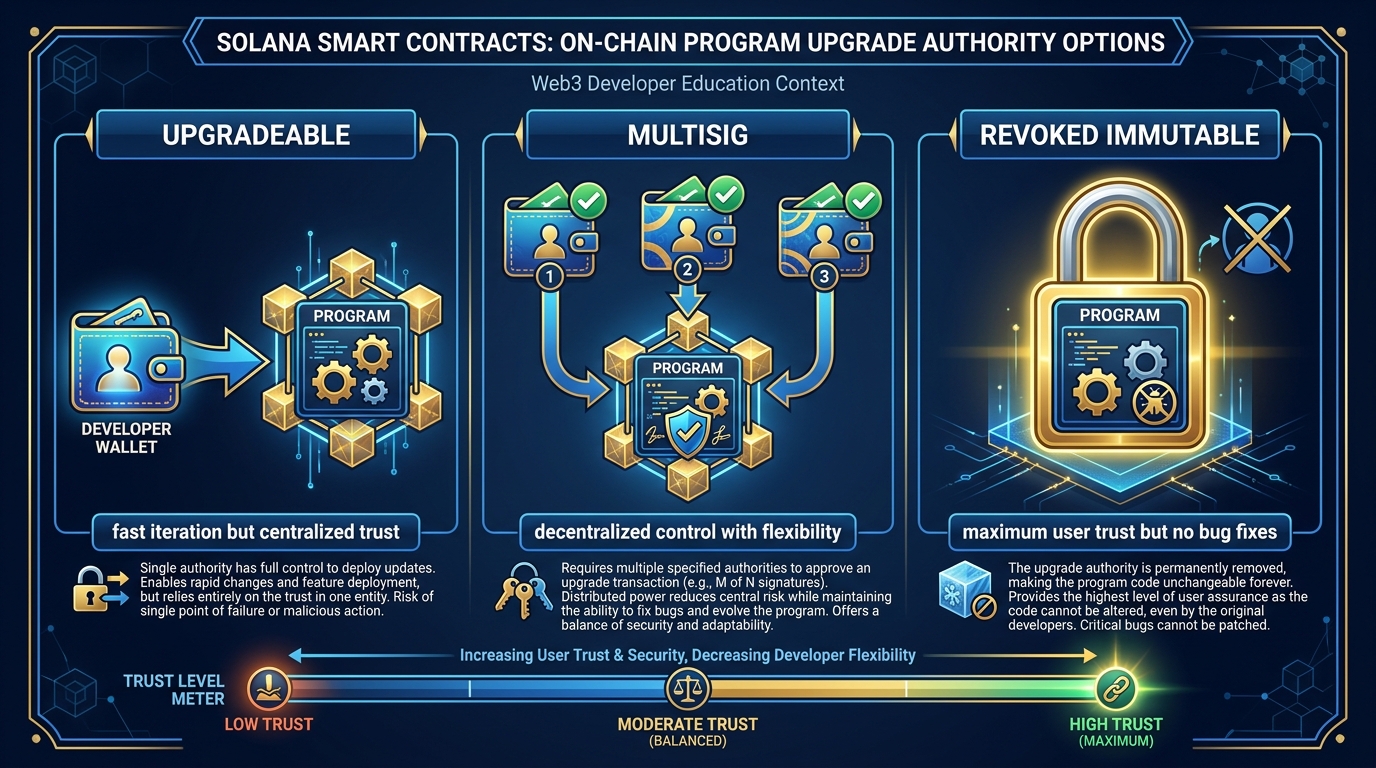
Figure 6:Upgrade Authority Spectrum: Every deployed program occupies one of three positions on the upgrade spectrum. The right choice depends on the stage of your protocol, the nature of your users’ assets, and your regulatory exposure.
Upgradeable programs have a designated upgrade authority — typically the deploying wallet. The authority can push new code to the same program address at any time. Users interacting with that program are trusting not just the current code but also the authority’s future intentions. This is appropriate for early-stage protocols where bugs are likely and the team needs to iterate. It is a trust relationship, like trusting a CEO.
Multisig upgrade authority transfers upgrade control to a multisignature wallet or a DAO governance program. Code changes require approval from multiple independent parties. This is the middle path: the protocol can still be updated to fix bugs or comply with regulations, but no single person can push malicious code. Most mature DeFi protocols use this model.
Revoked upgrade authority means the program is permanent. No one can change it. Ever. This maximizes user trust in the code-is-law sense — the rules are literally fixed — but it also means bugs live forever and compliance with new legal requirements becomes impossible. Protocols that have revoked upgrade authority and hold significant user funds are making a statement: we are so confident in this code that we are giving up the ability to fix it.
As a business leader building a token economy, your choice of upgrade authority is a stakeholder communication. Before you revoke upgrade authority, ask: have we had the program audited by at least two independent firms? Have we run it on devnet and mainnet with real funds for a meaningful period? Do our users understand and want immutability? Is immutability actually required for our use case?
The answer is often: not yet. Most token economies should start upgradeable and revoke authority only after extended battle-testing and community agreement.
6Devnet vs. Mainnet: Rehearsal and Performance
Solana runs multiple parallel networks that share the same software but have separate ledgers, separate tokens, and separate validators.
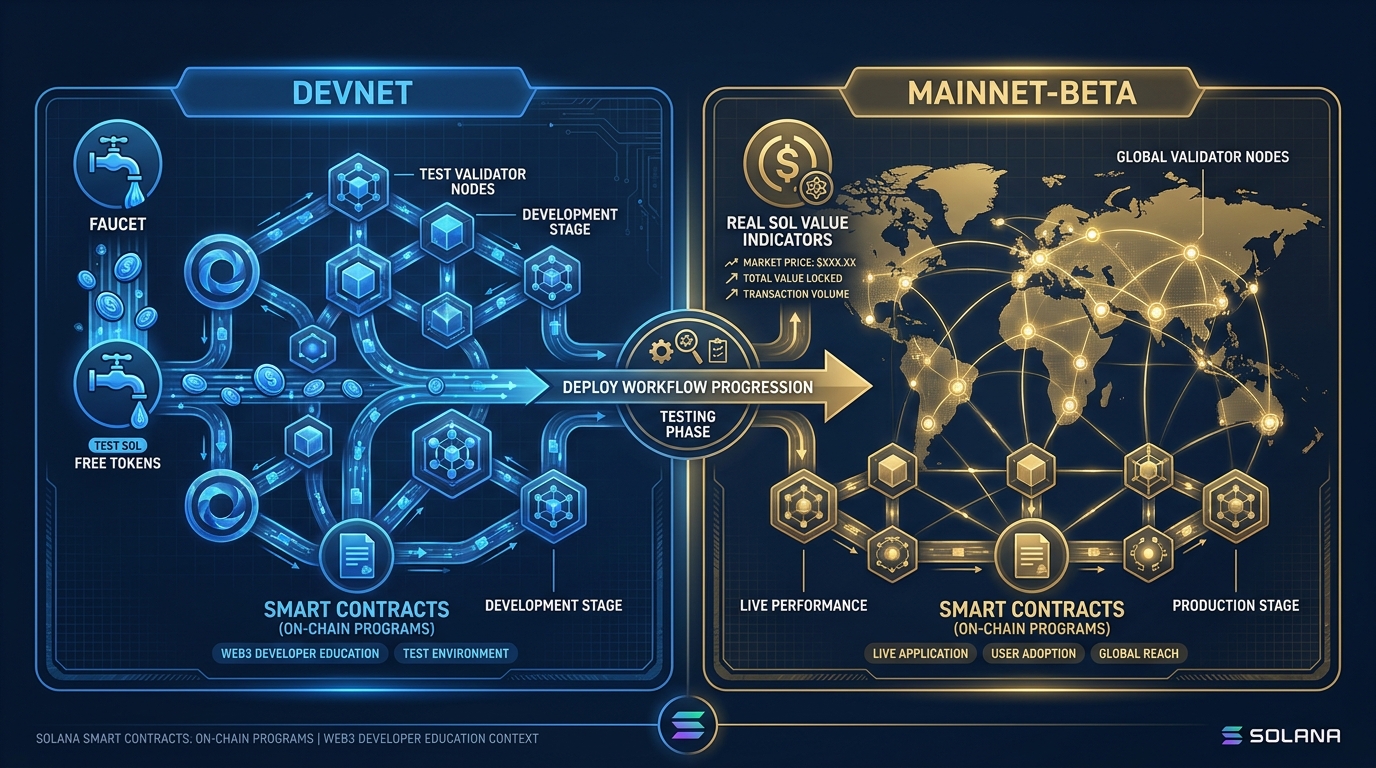
Figure 7:Devnet and Mainnet: Two separate Solana networks. Devnet is the rehearsal stage where tokens are free and mistakes cost nothing. Mainnet-beta is the performance — real SOL, real users, real consequences.
Devnet is the rehearsal stage. SOL on devnet has no real-world value and can be obtained for free via a faucet. Programs deployed to devnet run exactly the same way as they would on mainnet, but mistakes cost nothing. Devnet is where you test your program’s logic, verify your instructions work as expected, and practice the full deploy-and-test workflow.
Mainnet-beta is the live performance. SOL is real money, users are real people, and mistakes have real consequences. Deploy to mainnet only after exhaustive devnet testing and (ideally) an independent audit.
Testnet exists as a third option used primarily by Solana validators and core developers to test protocol upgrades. For application developers, devnet is the right environment.
The workflow is always: develop locally or on Playground → test exhaustively on devnet → audit → deploy to mainnet. Skipping steps in this sequence is how protocols lose user funds.
For today’s activity, you are working on devnet. Everything you deploy there is real in terms of code execution — it uses the same runtime, the same instruction format, the same account model — but the SOL costs you nothing and the program affects no one’s actual finances.
7Reading, Not Writing, Code: How a Business Leader Evaluates a Program
You do not need to write Rust to evaluate a deployed Solana program. A business leader’s job is to understand what a program can and cannot do and whether those boundaries match the protocol’s stated purpose.
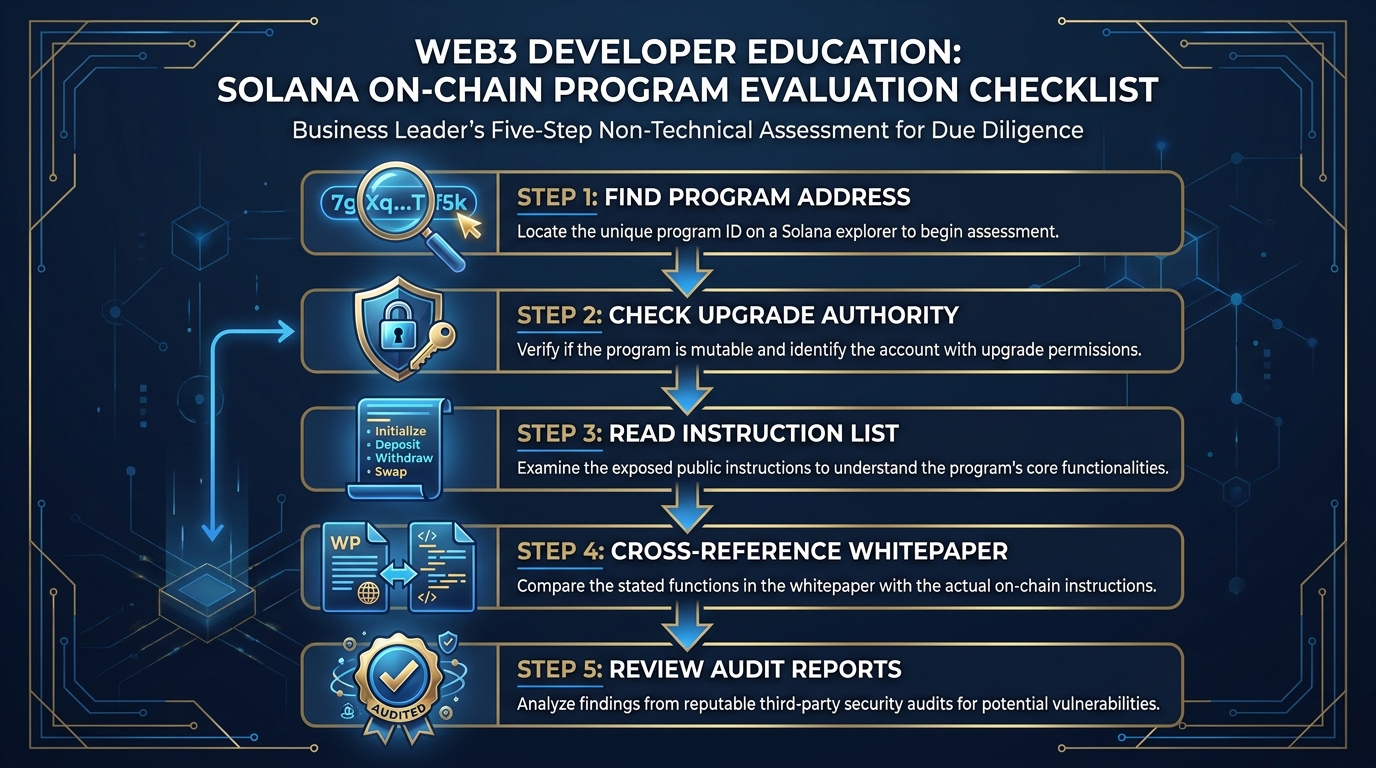
Figure 8:Evaluating a Program Without Writing Code: The program’s instruction list, its account access patterns, and its upgrade authority status are the three things a business-minded evaluator reads. These are publicly available for every deployed program.
Here is the checklist:
1. Find the program address. Every protocol publishes its program ID — a base58-encoded public key that uniquely identifies the deployed program on the network. Look for it in the protocol’s documentation, their GitHub repository, or their audit reports.
2. Check the upgrade authority. Go to explorer.solana.com, search the program ID, and look at the program account’s details. The upgrade authority field tells you who can change this program. If it shows “None,” the program is immutable. If it shows a wallet address, that wallet is the god of that protocol.
3. Read the instruction list. Open-source protocols publish their program source code (typically Rust using the Anchor framework). The list of pub fn function names in the program’s lib.rs file is the instruction list. Each function is something the program can do. If the function does not exist, the program cannot do it — not by a clever hack, not by calling a hidden API. The instruction list is the complete capability set.
4. Cross-reference with the whitepaper. A protocol’s stated purpose and its actual program capabilities should match. If the whitepaper says “we cannot mint additional tokens” but the program has a mint_tokens instruction, there is a discrepancy worth investigating.
5. Review the audit reports. Reputable programs have been audited by firms like Halborn, OtterSec, Trail of Bits, or Neodyme. Audit reports identify vulnerabilities found and whether they were resolved. No audit means no one has professionally searched for ways to exploit this code.
This process takes an hour and requires no coding. For any protocol where you or your organization plans to hold significant funds, it is due diligence.
8Activity: Deploy a Check-In Program to Devnet
This activity uses Solana Playground — a browser-based development environment at beta.solpg.io. No installation required. No local toolchain. Just a browser.
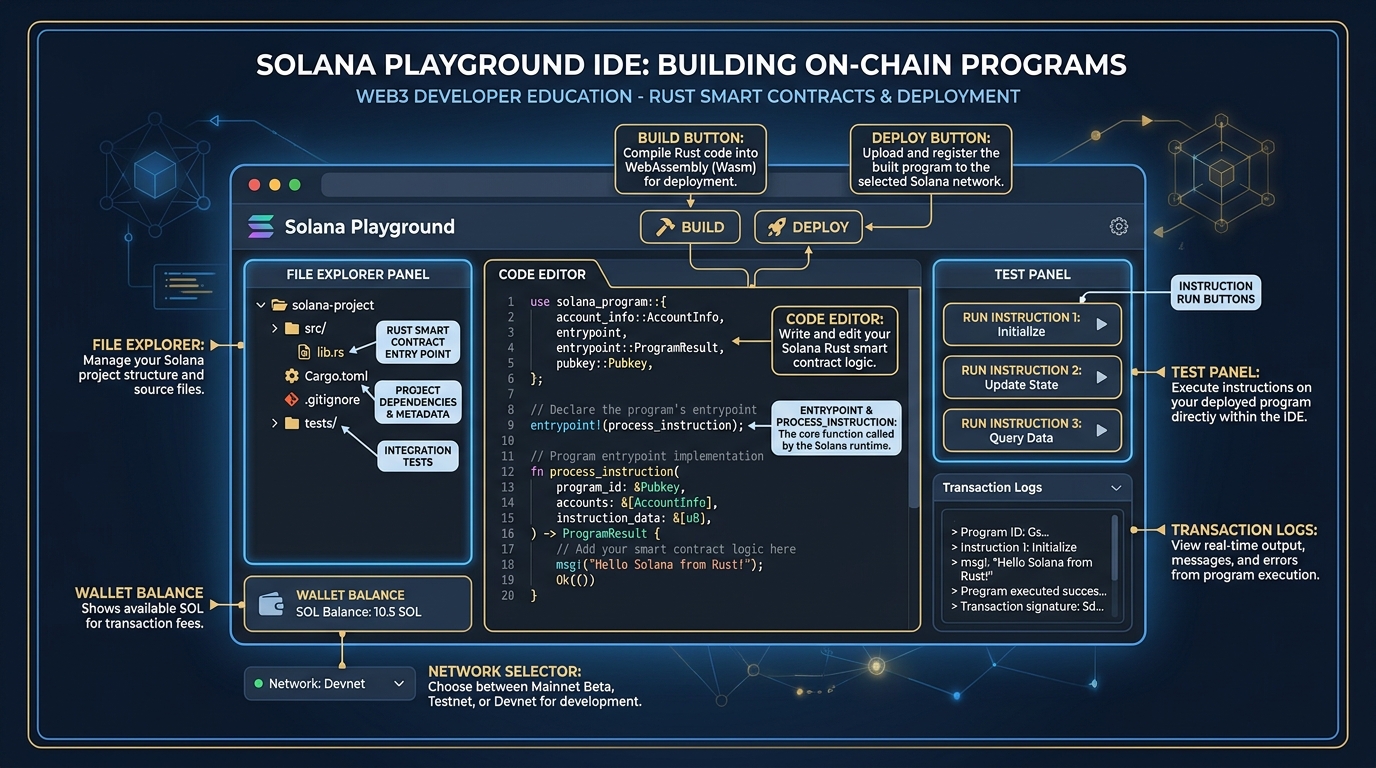
Figure 9:Solana Playground Interface: The browser-based IDE includes a file panel, code editor, build system, and interactive test panel. Every step of today’s activity happens inside this interface — no installation needed.
8.1Step 1: Open Solana Playground and Create a Wallet
Navigate to beta.solpg.io in your browser. Click “Not connected” in the bottom left corner. Solana Playground will generate a devnet wallet for you automatically. Save the keypair when prompted — you can export it if you want to reuse it. Your devnet SOL balance will appear at the bottom left.
If your balance shows 0 SOL, click the airdrop button (the faucet icon) to request free devnet SOL. You will need a small amount to pay for deployment.
8.2Step 2: Load the Counter Template
Click “File → New Project” and choose the “Counter” template from the starter options. This is a minimal Anchor program with three instructions: initialize, increment, and a stored count. It is the simplest possible stateful program.
You will see three files:
lib.rs— the program logic (Rust + Anchor)Anchor.toml— project configurationtests/counter.test.ts— the test file
Here is the full lib.rs, annotated for a business reader. The comments are yours to read; the code compiles unchanged.
use anchor_lang::prelude::*;

// This is the Program ID — the program's public address on the network.
// Solana Playground replaces it with YOUR program's address when you deploy.
// This is the address an investor looks up on Solana Explorer (Step 8).
declare_id!("11111111111111111111111111111111");

// The #[program] module is the instruction list — the program's complete
// capability set. This is the checklist from "Reading, Not Writing, Code"
// step 3: each pub fn below is one instruction, and if a function is not
// listed here, the program cannot do it.
#[program]
pub mod counter {
    use super::*;

    // Instruction 1: create the data account and set the count to zero.
    // "ctx" carries the list of accounts this instruction is allowed to touch.
    pub fn initialize(ctx: Context<Initialize>) -> Result<()> {
        let counter = &mut ctx.accounts.counter;
        counter.count = 0; // the starting state, written into the account
        Ok(())
    }

    // Instruction 2: add one to the count. This is your "check-in."
    pub fn increment(ctx: Context<Increment>) -> Result<()> {
        let counter = &mut ctx.accounts.counter;
        counter.count += 1;
        Ok(())
    }
}

// Every instruction must declare, up front, every account it will read or
// write. These #[derive(Accounts)] structs ARE those declarations — the
// account list you see under "Account Inputs" on Solana Explorer.
#[derive(Accounts)]
pub struct Initialize<'info> {
    // "init" = a new data account is created here. "payer = user" = the
    // signer pays the rent-exempt deposit (the same rent from Chapter 3).
    // "space" = how many bytes the account reserves for its data.
    #[account(init, payer = user, space = 8 + 8)]
    pub counter: Account<'info, Counter>,
    // Signer = who must sign. This wallet authorizes the transaction and
    // pays for the new account. No signature, no execution.
    #[account(mut)]
    pub user: Signer<'info>,
    // The System Program is Solana's built-in program that creates accounts.
    pub system_program: Program<'info, System>,
}

#[derive(Accounts)]
pub struct Increment<'info> {
    // "mut" = this instruction will modify the counter account's data.
    #[account(mut)]
    pub counter: Account<'info, Counter>,
    pub user: Signer<'info>,
}

// This is the state — and notice it lives in its OWN struct, stored in a
// data account, not inside the program. The program above is stateless;
// this account holds the number. That separation is the chapter's central
// idea, in eight bytes.
#[account]
pub struct Counter {
    pub count: u64, // an unsigned 64-bit integer: the check-in count
}8.3Step 3: Rename It as Your Check-In Program
This step is optional but meaningful. The counter template counts generic increments. We are renaming it mentally to represent check-ins in your token economy — a loyalty program where users earn points each time they check in to your platform.
In lib.rs, find the struct named Counter and the field named count. You can rename these to CheckInAccount and check_in_count throughout the file if you wish to practice reading Rust, or leave the template unchanged and simply understand that “increment” means “check in” for our purposes.
The code, unchanged, still performs exactly the logic we need:
initializecreates a new account and sets the count to zero.incrementadds one to the count each time it is called.
8.4Step 4: Build the Program
Click the “Build” button (the hammer icon) in the left sidebar. Solana Playground compiles your Rust code into a binary that Solana’s BPF (Berkeley Packet Filter) runtime can execute. Watch the terminal at the bottom for output. A successful build ends with:
Build successful. Completed in X.XXs.If you see errors, they will point to specific lines in the code. The counter template builds without modification — if you renamed fields, double-check that every reference was updated consistently.
8.5Step 5: Deploy to Devnet
Ensure the network selector in the top right shows “devnet” — not mainnet. Click the “Deploy” button. Playground will:
Upload the compiled program binary to a program account on devnet
Set your Playground wallet as the upgrade authority
Return your Program ID — a base58 public key that uniquely identifies your deployed program
Copy and save your Program ID. It looks something like: 7JyKbGkKp5sS... (32 bytes encoded in base58).
8.6Step 6: Run the Initialize Instruction
Click the “Test” tab (beaker icon) in the left sidebar. Solana Playground generates an interactive test panel from your program’s instruction definitions.
Find the initialize instruction and click “Run”. Playground will:
Create a new data account associated with your program
Set
check_in_count(orcount) to zeroReturn a transaction signature
Click the transaction signature to open it in Solana Explorer. You will see:
The program ID you just deployed
The accounts touched: your wallet (signer), the new data account (writable)
The instruction name:
initializeThe fee paid: a tiny fraction of a devnet SOL
8.7Step 7: Run the Increment Instruction
Back in the Test panel, find increment and click “Run”. This fires the check-in instruction — adding 1 to the counter.
Run it three or four times. Each execution is a separate transaction, each with its own signature and its own entry on the Solana Explorer. This is your transaction log: irrefutable on-chain proof that the rule ran.
8.8Step 8: Locate Your Program on Solana Explorer
Navigate to explorer.solana.com and switch the network selector to “Devnet”. Search your Program ID. You will see the program account, its upgrade authority (your wallet), the number of transactions processed, and a list of recent transactions including your initialize and increment calls.
This is what your program looks like from the outside. This is what an investor, user, or auditor sees when they look up your protocol.
8.9Stretch Activity — Make the Program Touch a Token (30 min, devnet)
Solana Playground bundles the
solanaandspl-tokencommand-line tools in its terminal (bottom panel) and theanchor-splcrate in its build system. Create a throwaway devnet token there:spl-token create-token, thenspl-token create-account <MINT>, thenspl-token mint <MINT> 100. Record the mint address.Gate the check-in: add to the
Incrementaccounts struct atoken_account: Account<'info, TokenAccount>with an Anchor constraint requiringtoken_account.owner == user.key()andtoken_account.amount >= 1, and importanchor_spl::token::TokenAccount. Rebuild and redeploy.In the Test panel, run
incrementpassing your token account. It succeeds. Run it passing an empty token account (create one withspl-token create-accountfor a second mint, or an account with 0 balance). It fails with a constraint error. Screenshot both transactions on Solana Explorer.Write three sentences: which vulnerability class from the auditor box would you have introduced by omitting the
ownerconstraint, and what could an attacker have done?
Students who do not wish to modify code: the deploy-and-test loop above, with the template unchanged, is the complete activity. You have deployed a real program.
9Walk Away With
By the end of this activity you have:
A Program ID — a real address on Solana’s devnet network identifying your deployed program
A transaction log — multiple Solana Explorer links proving your program was initialized and executed
A mental model of programs, accounts, and instructions that applies to every protocol you will ever use or evaluate
The ability to look up any deployed program and evaluate its upgrade authority and capability set without writing a line of code
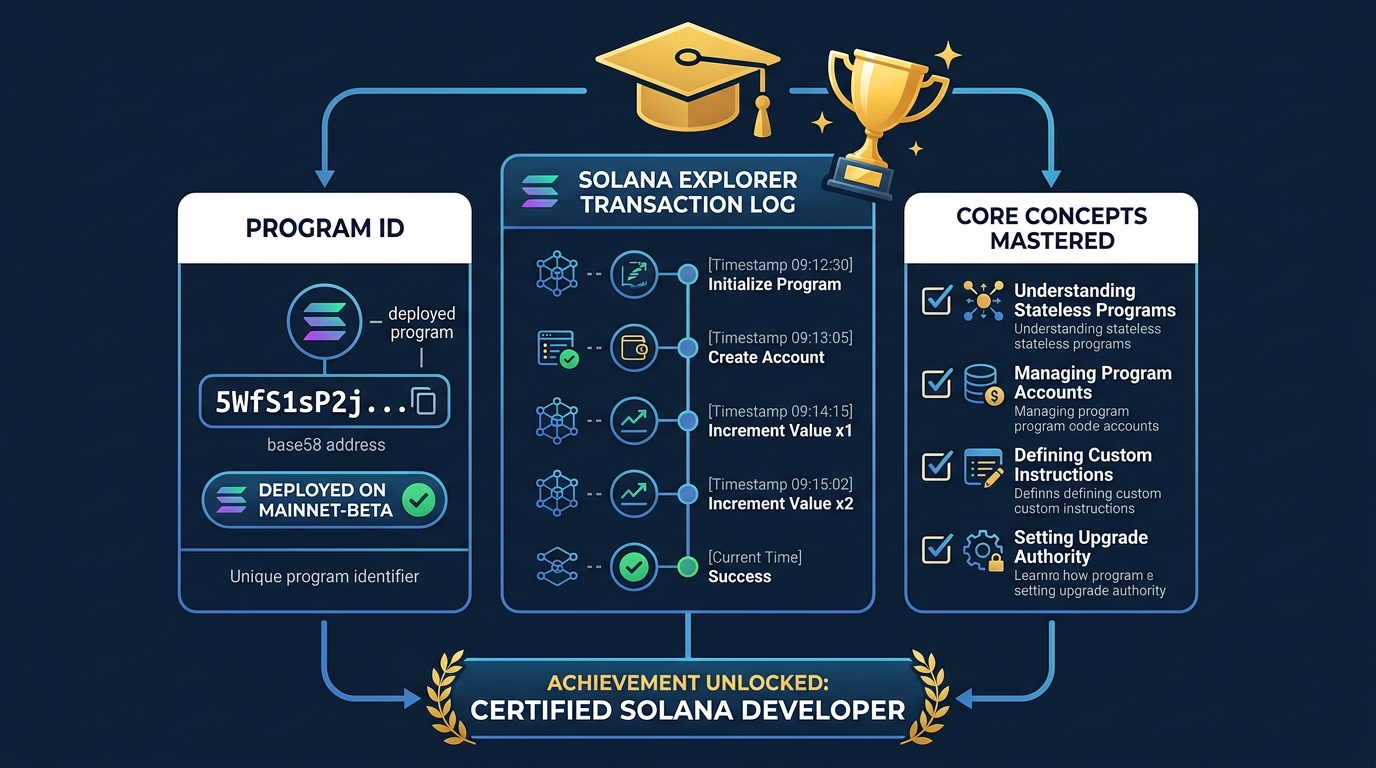
Figure 10:What You Built: A deployed program on devnet (Program ID), a verifiable transaction log on Solana Explorer, and a framework for evaluating any Solana protocol from the outside.
10Application Cases
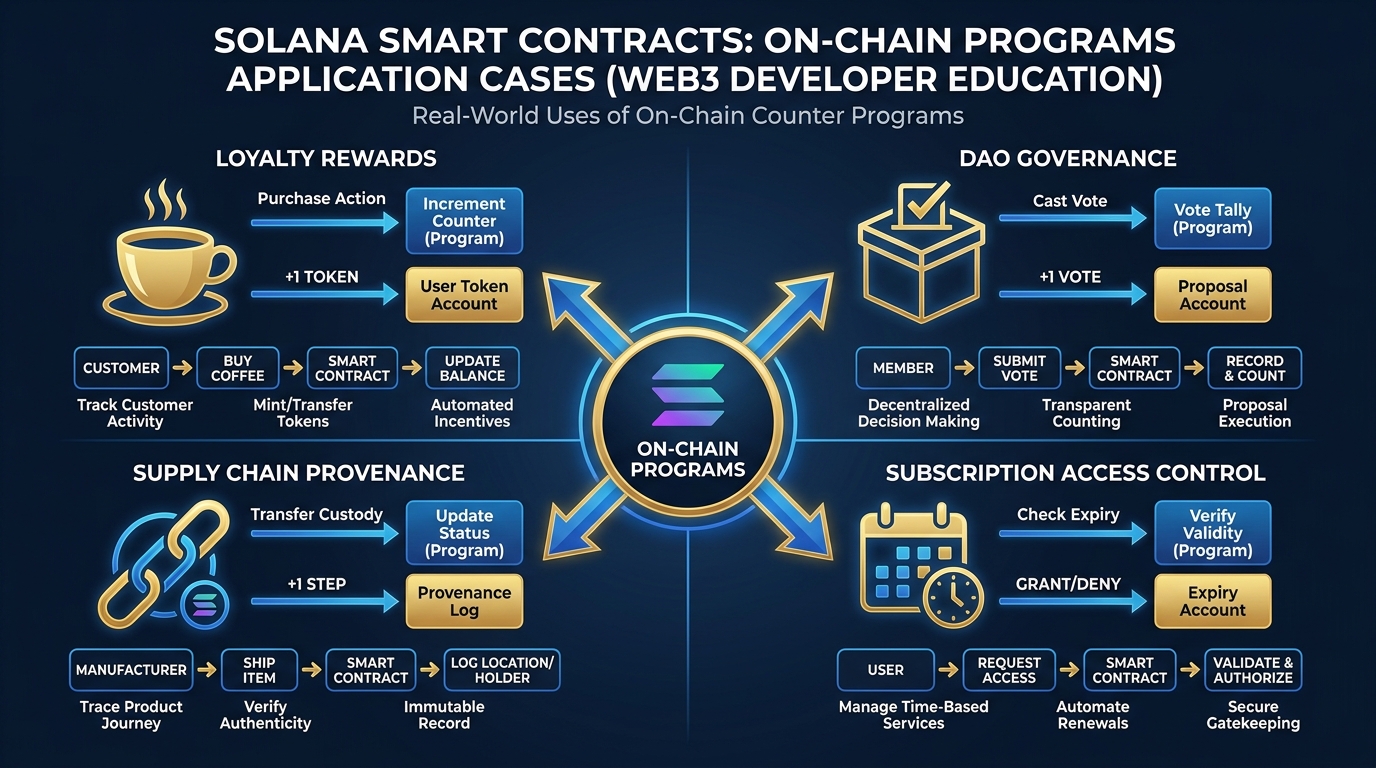
Figure 11:Real-World Applications of On-Chain Programs: The same program architecture you deployed today — initialize an account, increment on each event — underlies loyalty systems, governance votes, supply chain records, and subscription access control.
10.1Loyalty and Rewards Programs
Starbucks’ Odyssey program launched in 2022 as a blockchain-based loyalty extension, using smart contract logic to issue NFT stamps and track engagement points. The underlying principle — a check-in program incrementing a counter tied to a user’s wallet — is exactly what you built today. At scale, this becomes: user buys coffee, app sends increment instruction to the loyalty program, counter updates, threshold triggers token reward. No central database, no points expiry managed by the company, no opaque “we reset your balance” decisions.
The business case is straightforward: token balances in self-custodied wallets cannot be silently zeroed by a policy change. Users retain ownership of their accumulated loyalty. For brands seeking differentiation on trust, this is a meaningful claim.
10.2Decentralized Voting and Governance
Many DAO (Decentralized Autonomous Organization) governance systems use a program that is structurally similar to what you built: an initialize instruction creates a proposal account, an increment (vote) instruction records each member’s participation, and a separate instruction finalizes the result when the voting window closes. The entire vote is publicly auditable. Every vote is a transaction with a timestamp and a signer.
Compare this to traditional shareholder voting administered by a transfer agent: opaque, slow, and accessible only to sophisticated institutional investors. On-chain governance makes voting real-time, globally accessible, and cryptographically verifiable.
10.3Supply Chain Provenance
A luxury goods manufacturer could deploy a program where the initialize instruction creates an asset account for each product leaving the factory and subsequent increment-style instructions record each custody transfer — manufacturer to distributor to retailer to end customer. The program’s logic ensures no one can claim a custody transfer without the current owner’s signature. The history is permanent and unforgeable.
LVMH’s Aura blockchain consortium operates on this principle. Your check-in program is the conceptual skeleton of every provenance system on Solana.
10.4Subscription and Access Control
Imagine a publishing platform where your token economy includes a check_subscription instruction. Each time a user accesses premium content, the platform’s backend calls the instruction, verifying the user’s subscription account shows an active status. The subscription expiry is written on-chain. Renewal triggers an on-chain transaction. Cancellation is an instruction call. Every subscription event is a transaction — a public log of when access was granted and revoked.
11Glossary
Program (Solana) A stateless binary deployed to the Solana network containing the logic (instructions) that the program can execute. Programs do not hold their own state; they read and write data accounts.
Account (Solana) A storage location on the Solana ledger. Accounts hold data, SOL balances, or program code. Every account has a public key address and an owner (the program authorized to modify it).
Instruction A specific action that a program knows how to execute. An instruction specifies the program to call, the accounts it needs, and any additional parameters. Transactions contain one or more instructions.
Signer A wallet that has cryptographically authorized a transaction using its private key. The signer’s public key is included in the transaction, and validators verify the signature before executing the instruction.
Upgrade Authority The wallet or multisig address that controls whether a deployed program can be updated with new code. Revoking upgrade authority makes the program permanently immutable.
Devnet A Solana test network that runs the same software as mainnet but uses SOL with no real-world value. Used for development and testing before deploying to mainnet.
Mainnet-beta The live Solana network where SOL has real economic value and transactions have real consequences. Also called mainnet.
Anchor A framework for building Solana programs in Rust that handles much of the low-level boilerplate (account validation, serialization, error handling), making programs easier to write and audit.
Program ID A base58-encoded public key that uniquely identifies a deployed program on the Solana network. Used to call the program’s instructions and to find it on Solana Explorer.
BPF (Berkeley Packet Filter) The virtual machine format that Solana uses to execute programs. Program code is compiled to BPF bytecode, which the Solana runtime executes on every validator. Solana’s runtime has since moved to SBF (Solana Bytecode Format), a fork of eBPF; the concept is unchanged.
Data Account
An account created by a program to store state. When you call initialize in today’s activity, you create a data account that holds the check-in counter value.
Code Is Law The principle that a deployed smart program executes exactly as written, with no exceptions for intent, error, or external authority. A feature to users seeking trustless execution; a risk to builders who need to fix bugs.
Solana Playground A browser-based Solana development environment at beta.solpg.io that allows writing, building, deploying, and testing programs without installing any local tools.
Multisig A wallet or governance structure that requires signatures from multiple independent parties before executing a transaction. Used for shared custody and for governance of upgrade authority.
Immutable Program A deployed program whose upgrade authority has been revoked. The program’s code can never be changed. This maximizes user trust but eliminates the ability to fix bugs or comply with new regulations.
12🚀 Advanced (Optional): Build a Blockchain from Scratch in JavaScript
The four videos below walk through the complete build — from the first block to signed transactions. Watching this series alongside the Solana program you deployed today gives you a complete picture of what every layer of the stack actually does underneath the tools this book uses.
▶ Watch: Creating a blockchain with Javascript (part 1) (14 min)
▶ Watch: Implementing Proof-of-Work in Javascript (part 2) (6 min)
▶ Watch: Mining rewards & transactions (part 3) (12 min)
▶ Watch: Signing transactions (part 4) (18 min)
13The Leader’s Takeaway
A smart contract — or on Solana, a program — is a rule that runs itself. That is the entire idea, and it is the most consequential shift in institutional design since the invention of the corporation.
Corporations exist because we needed a legal entity that could persist beyond individual humans, hold assets, and execute agreements reliably. We built courts, regulators, auditors, and contract law to enforce those agreements. That infrastructure is expensive, slow, geographically limited, and corruptible.
A deployed program on Solana is also a persistent entity. It holds no assets directly, but it governs accounts that do. It executes agreements automatically — not in days or weeks through legal machinery, but in 400 milliseconds, globally, for a fraction of a cent in fees. Its rules are publicly readable. Its history is permanently auditable. Its upgrade authority is a visible, evaluable fact rather than a hidden organizational power.
This does not mean programs replace corporations. It means there is now a new tool available for encoding certain kinds of rules — loyalty points, vote counts, custody records, subscription states — in a way that is cheaper to operate, harder to corrupt, and more transparent to verify than any alternative.
You deployed one today. From your browser. On a global network. Without asking anyone’s permission.
That is worth sitting with.
14🎯 In-Class Assignment: Program Evaluation Exercise (10 pts)
Details and instructions will be provided in class.
Points: 10
15💬 Discussion: When Should Rules Be Unchangeable?
A program with its upgrade authority revoked can never be changed — not to fix a bug, not to comply with a new law, not to stop a theft. Would you ever run a business on rules that cannot be changed? What would have to be true for that to be the right choice?
Discussion Guidelines:
Craft a substantive initial response (minimum 300 words) that stakes a clear position. Your response must include at least one scholarly or credible citation — a peer-reviewed paper, a law review article, a credible industry report, or documented case study of a protocol that revoked upgrade authority (or refused to). Citing “a blog post said” is not sufficient.
After posting your initial response, return and reply to at least two peers with substantive engagement. “I agree” is not a reply. Challenge a hidden assumption in their argument, offer a counterexample, or extend their reasoning to a context they did not consider.
Consider these angles as you write:
Under what conditions does immutability actually serve users better than upgradeability?
What legal jurisdictions have begun regulating smart contracts as binding agreements? How does upgrade authority interact with contract law?
The DAO hack in 2016 and the subsequent Ethereum fork: was the fork a violation of code-is-law? What precedent did it set?
Are there domains — real estate title records, medical consents, pension rules — where permanent, auditable, unalterable records are not just acceptable but desirable?