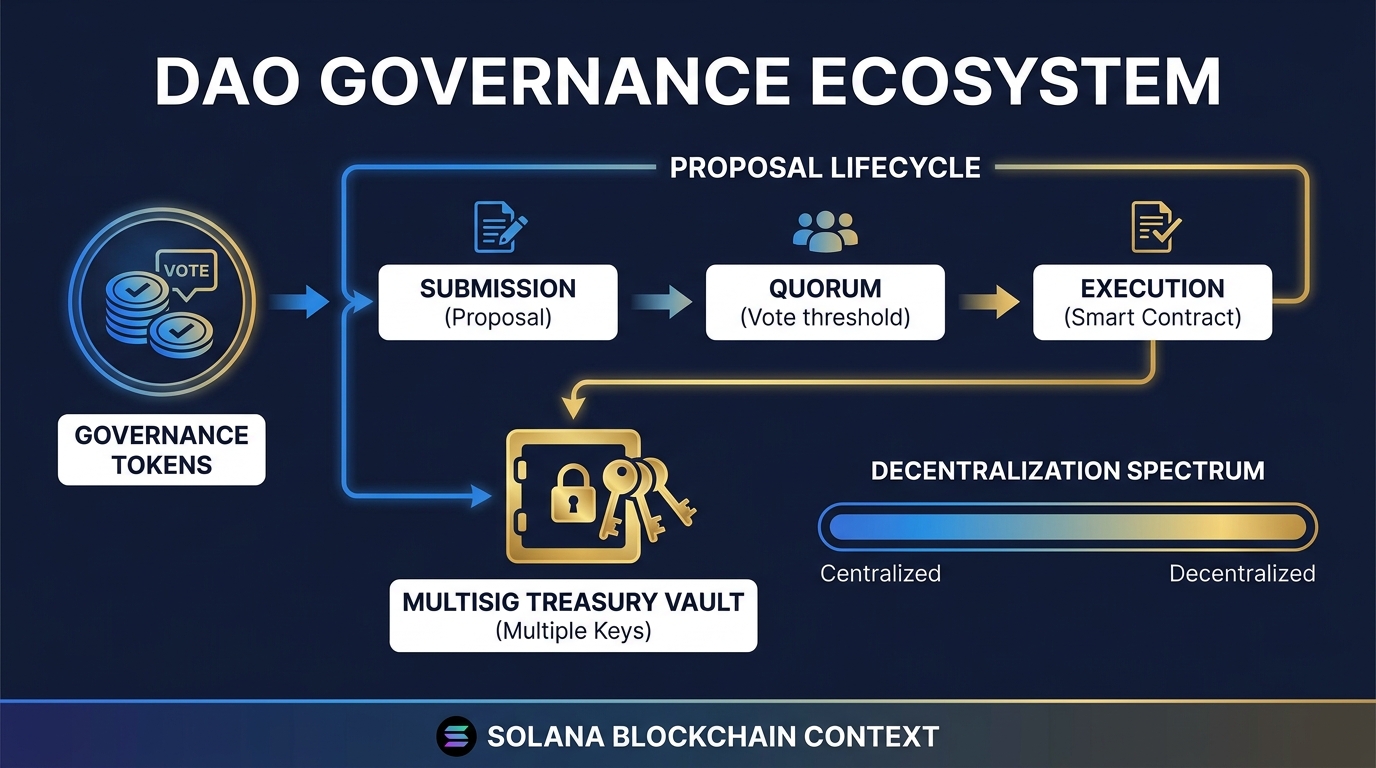
Figure 1:Chapter 11 Explainer Infographic: The complete governance map — from governance tokens as voting power, through the proposal-quorum-execution lifecycle, to the multisig treasury that nobody controls alone. Every arrow is a decision encoded as code.
Who decides? In a company, a board of directors votes and a CEO signs the check. In a country, a legislature debates and a president signs the bill. In most organizations, the answer to “who decides” is a chain of hierarchy, job titles, and legal authority. In your token economy, the answer is whoever you encode — and the tools to encode it take an afternoon.
This chapter is about governance: the system through which a group of token holders makes collective decisions about shared resources. We will build two things that form the foundation of any decentralized organization. First, a multisig treasury using Squads — a wallet that requires multiple people to approve any transaction, the same principle behind corporate bank accounts that require two signatures on checks over a certain amount. Second, a governance space on Realms — a voting system tied directly to your token, where holders submit proposals, quorum is enforced automatically, and winning votes execute on-chain.
By the end, you will not just understand how DAOs work conceptually. You will have a working one, with a real treasury and a completed vote.
1Governance Tokens: Voting Power as an Asset
To understand a governance token, start with something you already know: a share of corporate stock.
When you own one share of Apple, you own two things. You own a financial claim — a fractional interest in the company’s profits and assets. And you own a political right — the right to vote on shareholder resolutions, board elections, and major corporate decisions. Most retail investors focus on the financial claim and ignore the political right, because for any individual holding 100 shares of a trillion-dollar company, the vote is meaningless. But for institutional investors holding millions of shares, the vote is enormously valuable. Governance is the asset.
A governance token works the same way, but the political right is the primary value, and it is enforced not by corporate law but by smart contracts. When you hold 10,000 units of a governance token, you hold 10,000 votes. You can submit proposals, vote on proposals others submit, and delegate your votes to representatives you trust — just like shareholders delegate to fund managers. The key difference is that when a proposal passes, no board of directors has to approve it, no bank has to process it, and no lawyer has to file paperwork. The smart contract executes the approved action automatically.
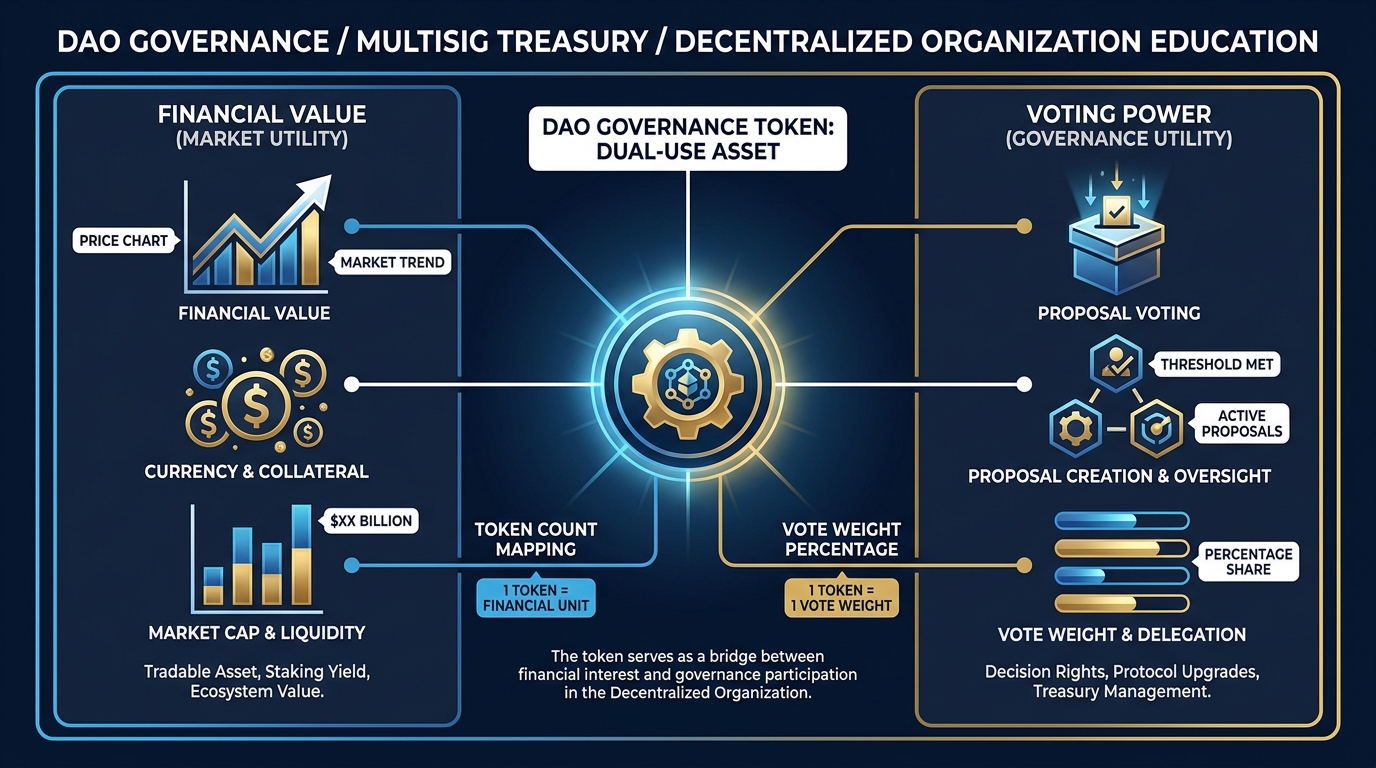
Figure 2:Governance Token as Dual Asset: Token holders simultaneously hold a financial claim and a political right. In most governance systems, one token equals one vote — making token concentration the primary determinant of governance power.
This is both the beauty and the danger of token governance. The beauty: every rule the organization runs by is visible in the smart contract, and any rule change requires passing through the same transparent voting process. There are no backroom deals, no regulatory exemptions, no “that’s just how it’s always been done.” The danger: whoever holds the most tokens holds the most votes, which means governance power can be purchased.
We will come back to the danger at length. But first, we need to understand the lifecycle of a governance decision.
2DAOs Through Familiar Analogies
A DAO — a Decentralized Autonomous Organization — sounds alien until you realize you have almost certainly been a member of one of its ancestors.
Think about a homeowners’ association. Every homeowner in the neighborhood pays dues into a shared treasury. The HOA has rules — you cannot paint your house neon green, you must maintain your lawn. When someone wants to change a rule, they submit a proposal at the annual meeting. Other homeowners vote. If a majority approves, the rule changes. If it fails quorum — not enough people showed up to vote — the proposal dies, regardless of how the votes split.
Or think about a credit union. Unlike a bank owned by shareholders, a credit union is owned by its members — the depositors. Members elect a board, vote on major policy decisions, and share in profits through better interest rates rather than stock dividends. The governance structure is member-driven by design.
Or think about shareholder votes. Every publicly traded company holds an annual meeting where shareholders vote on board elections, executive compensation, mergers, and other major decisions. The votes are weighted by share count. A hedge fund holding 15% of outstanding shares has 15% of the voting power — far more than any individual retail investor.
A DAO is the digital descendant of all three. Like an HOA, it governs a shared resource using community rules. Like a credit union, its members are its owners. Like a shareholder meeting, its votes are weighted by holdings. The difference is that the bylaws are smart contracts, the treasury is a blockchain address, and the governance process executes without human administrators.
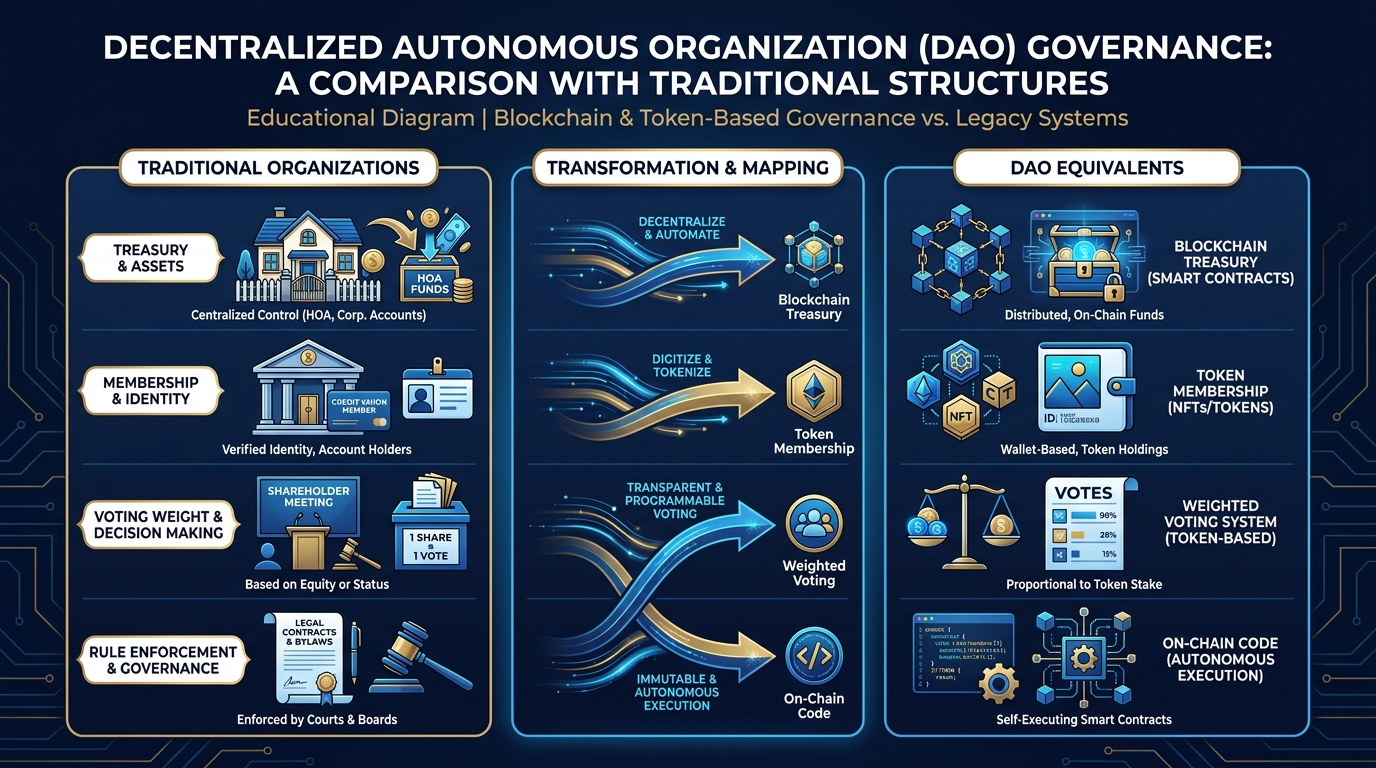
Figure 3:DAO Through Three Familiar Lenses: The homeowners’ association, the credit union, and the shareholder meeting each share structural DNA with a DAO. The DAO replaces legal enforcement with smart contract execution and paper ballots with on-chain transactions.
The word “Autonomous” in DAO is a bit aspirational. Most DAOs today are not fully autonomous — humans still write the code, submit the proposals, and build the products. But the governance process itself is autonomous: once a proposal passes, the execution happens on-chain without any human having to push a button. That automatic execution is what makes DAO governance qualitatively different from any prior form of collective decision-making.
3The Governance Lifecycle: Proposal, Quorum, Execution
Every governance system — from the U.S. Congress to a neighborhood HOA — follows the same basic lifecycle. In a DAO, that lifecycle is encoded in smart contracts.
Step 1: Proposal Submission
A holder with enough tokens submits a proposal. Most governance systems require a minimum token balance to submit (the “proposal threshold”) to prevent spam. On Realms, this is configurable — you set the minimum amount of your token a wallet must hold before it can open a vote.
A proposal is not just text. On Solana’s Realms, a proposal includes an optional “instruction” — a specific on-chain action that will execute automatically if the proposal passes. This could be a token transfer from the treasury, a parameter change in your program, or a multisig signing event. The instruction is encoded in the proposal itself, so voters know exactly what they are approving before they cast a vote.
Step 2: Deliberation
After submission, there is a discussion period. Holders debate the merits in Discord, forums, or on-chain comment threads. This is the qualitatively human part of governance — the part no smart contract can automate. Good governance systems build in enough deliberation time (typically 48 hours to two weeks, depending on the stakes) for informed opinion to form.
Step 3: Voting
The voting window opens. Token holders cast votes — yes, no, or abstain. In token-weighted voting, the weight of your vote is proportional to your token balance at a “snapshot” block — a specific point in the chain’s history. Snapshots prevent manipulation: if you could buy tokens after you saw how a vote was going, you could buy a winning position. The snapshot freezes the power distribution at a defined moment.
Step 4: Quorum Check
When the voting window closes, the system checks whether quorum was reached. Quorum is a minimum threshold of participation — without it, a proposal cannot pass, regardless of how the votes split. This protects against decisions being made by a tiny unrepresentative minority.
Here is where many DAOs fail in practice. If your token has 10 million circulating supply and your quorum threshold is 4 million tokens participating, but most holders are passive — they bought for price appreciation and never engage with governance — you will never reach quorum. The governance system is technically functional but practically paralyzed.
This tension between token distribution and governance participation is one of the central design problems in the field. More on that in the Governance Attacks section.
Step 5: Execution
If quorum was reached and the yes votes exceed the threshold (often 51%, sometimes supermajority for major decisions), the proposal passes. On Realms, the attached instruction executes automatically. The treasury sends the approved amount. The parameter changes. The multisig signs. No human administrator has to intervene.
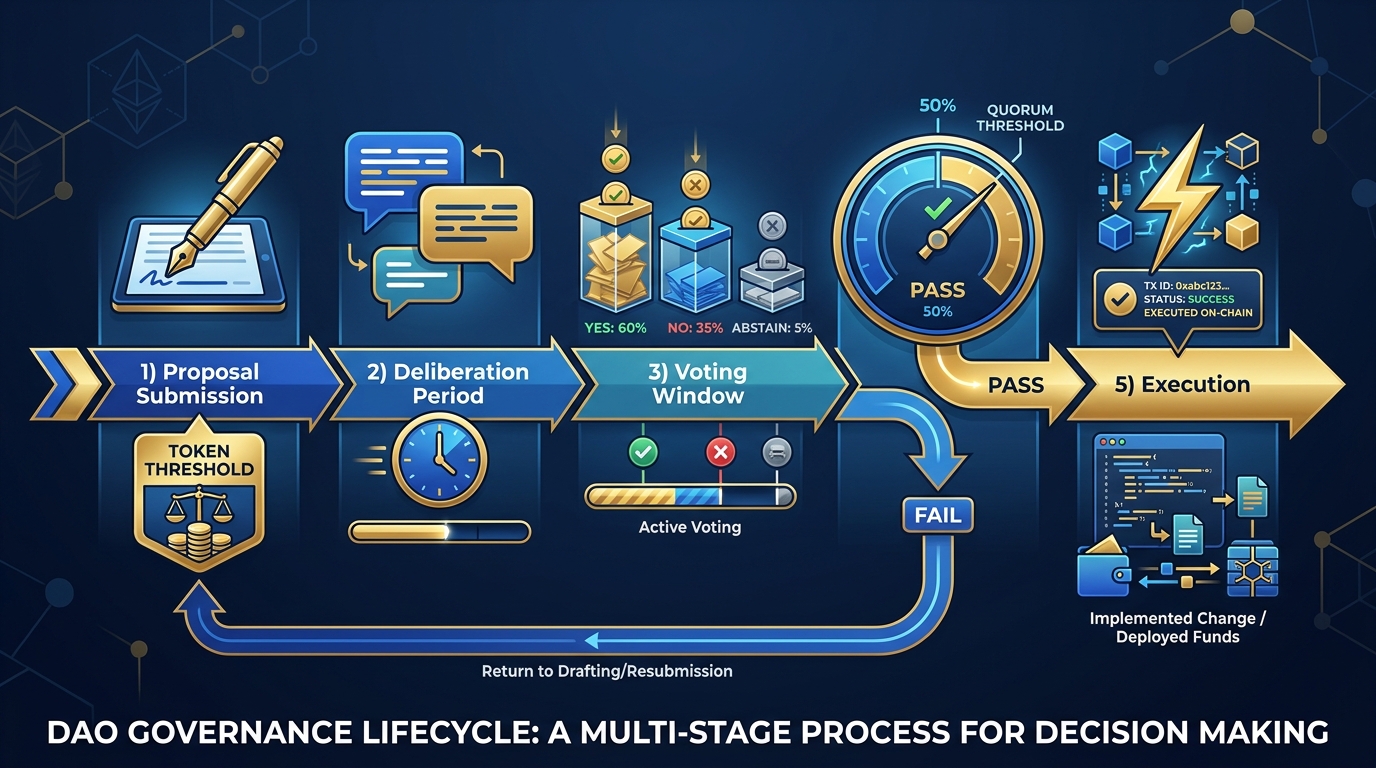
Figure 4:The Governance Lifecycle: From proposal submission through automatic execution, every step is enforced by smart contracts. The quorum check is where most DAO proposals die — not from opposition, but from apathy.
4Multisignature Wallets: Nobody Holds the Keys Alone
Before we get to full DAO governance, we need to talk about the first governance decision every project makes — and almost always gets wrong.
When you launch a token, your treasury starts in a single wallet. You are the only signer. You could transfer every token, drain every SOL, and shut down the project in a single transaction. Nothing stops you but your own ethics. This is an enormous trust problem, and it is the reason that serious projects move their treasuries to multisignature wallets before anything else.
A multisig wallet requires M-of-N signatures to approve any transaction. The most common setup is 2-of-3: there are three authorized signers, and any two of them must approve before a transaction executes. This is the same principle behind the corporate controls you see in traditional finance: most corporate bank accounts require two authorized signers on checks above certain amounts. Wire transfers at banks require dual authorization. Not because either person is untrustworthy, but because the system cannot depend on any single person’s integrity, judgment, or security.
Think of it like a safe deposit box at a bank. The bank holds one key. You hold the other. Neither of you can open it alone. Multisig is the same principle applied to a blockchain wallet: distribute the keys so that no single person — and no single point of failure — can move the funds unilaterally.
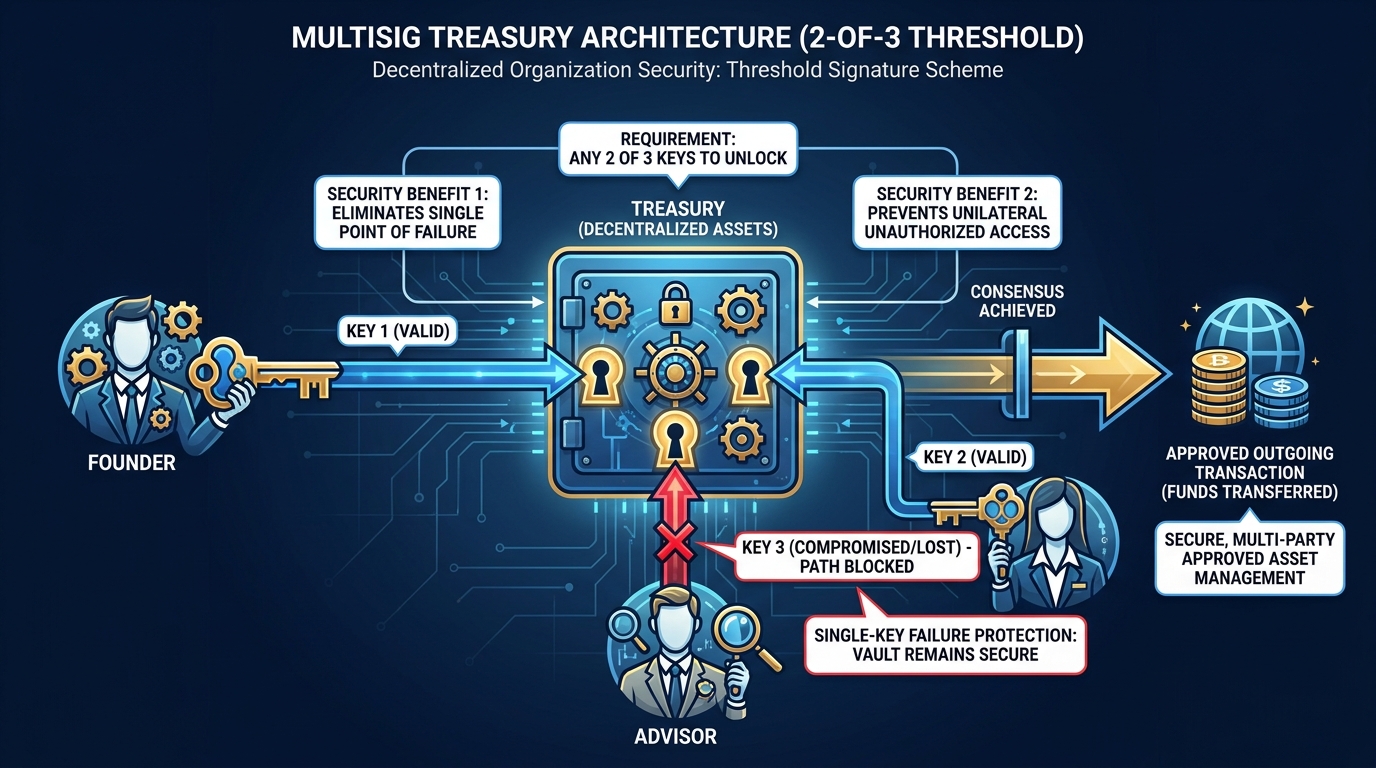
Figure 5:Multisig Treasury Structure: A 2-of-3 multisig requires any two of three authorized signers to approve each transaction. One signer losing access does not freeze the treasury. One signer going rogue cannot drain it.
On Solana, Squads is the leading multisig platform. It provides a clean interface for creating a multisig vault, adding co-signers, and managing proposals. A “proposal” in Squads is any transaction the vault wants to make — a SOL transfer, a token transfer, a program upgrade. Once you create a proposal, the other signers receive a notification and can approve or reject. When the threshold is met, the transaction executes.
The corporate analogy maps cleanly:
| Corporate Control | Multisig Equivalent |
|---|---|
| Dual-signature bank account | 2-of-3 multisig |
| Board resolution required for major spending | Proposal + approval threshold |
| CFO + CEO signatures required | Two named signers must approve |
| Audit trail of all approvals | Immutable on-chain record |
| Separation of duties | No single key controls funds |
▶ Watch: Bitcoin’s Lightning Network, Simply Explained! (5 min)
The multisig is not just a security measure. It is a governance statement. When you put your treasury in a 3-of-5 multisig and publish the signer addresses, you are telling your community: nobody controls this alone, including me. That signal is worth more than any whitepaper promise.
5Managing the Treasury, Not Just Guarding It
The multisig answers who can move the money. It says nothing about what the money should be. A vault full of your own token is not a treasury — it is a bet on your own token, made with the funds that are supposed to keep the project alive when that bet goes wrong. Managing the treasury is a policy problem, and the policy should be written down before anyone has to argue about it under pressure.
What the vault should hold. Chapter 4’s guidance stands as policy: 50–70% of the treasury in stablecoins or blue-chip assets, the remainder in your own token. The stablecoin portion is not idle capital — it is the portion of your treasury whose value does not collapse on exactly the day you need it most. When your token’s price falls, your operating costs do not.
Runway. Runway = stable assets ÷ monthly burn, and the rule is strict: runway is counted in stablecoins only. A treasury holding $1 million of its own token and $100,000 of USDC against a $20,000 monthly burn has five months of runway, not fifty-five. The token portion is upside, not oxygen. Compute this number monthly and publish it if you can — it is the single figure that tells your community whether the project survives the next bear market.
A written spending policy. Decide, in advance, who can propose spending and what size of spending needs what level of approval. A workable pattern: any signer can propose; spending below a threshold (say, one month’s burn) clears with the multisig alone; anything above it requires a governance vote on Realms — which is exactly what the proposal threshold you configure in this chapter’s activity is for. The policy turns “should we spend this?” from a personality conflict into a procedure.
Diversification. Converting treasury tokens to stablecoins is not betrayal — it is the fiduciary duty of anyone running a real organization. Do it on a schedule, and announce the schedule: scheduled, pre-announced conversions let the market price the flow in, instead of discovering it as a surprise sell wall.
The founder’s dilemma: selling your own token. Sooner or later the treasury must sell some of its own token to fund operations, and there is no way to do it that costs nothing. There is only a way to do it that costs the most: market-selling into your own thin pool (Chapter 5), where every sale moves the price against you and every observer reads the on-chain flow (Chapter 10’s exchange-inflow signal) as the team dumping. The alternatives, in order of preference: OTC sales to aligned, long-term buyers; time-weighted execution that spreads the sale across weeks; or an announced conversion schedule the market can price in advance. The mechanics differ; the principle is the same — never surprise your own holders with your own sell order.
Protocol-owned liquidity as a treasury asset. The LP position from Chapter 5 can itself live in the treasury: the DAO owns the pool position, earns its trading fees, and cannot rug its own community without a public vote. Protocol-owned liquidity converts the most rug-prone asset in the project into the most transparent one.
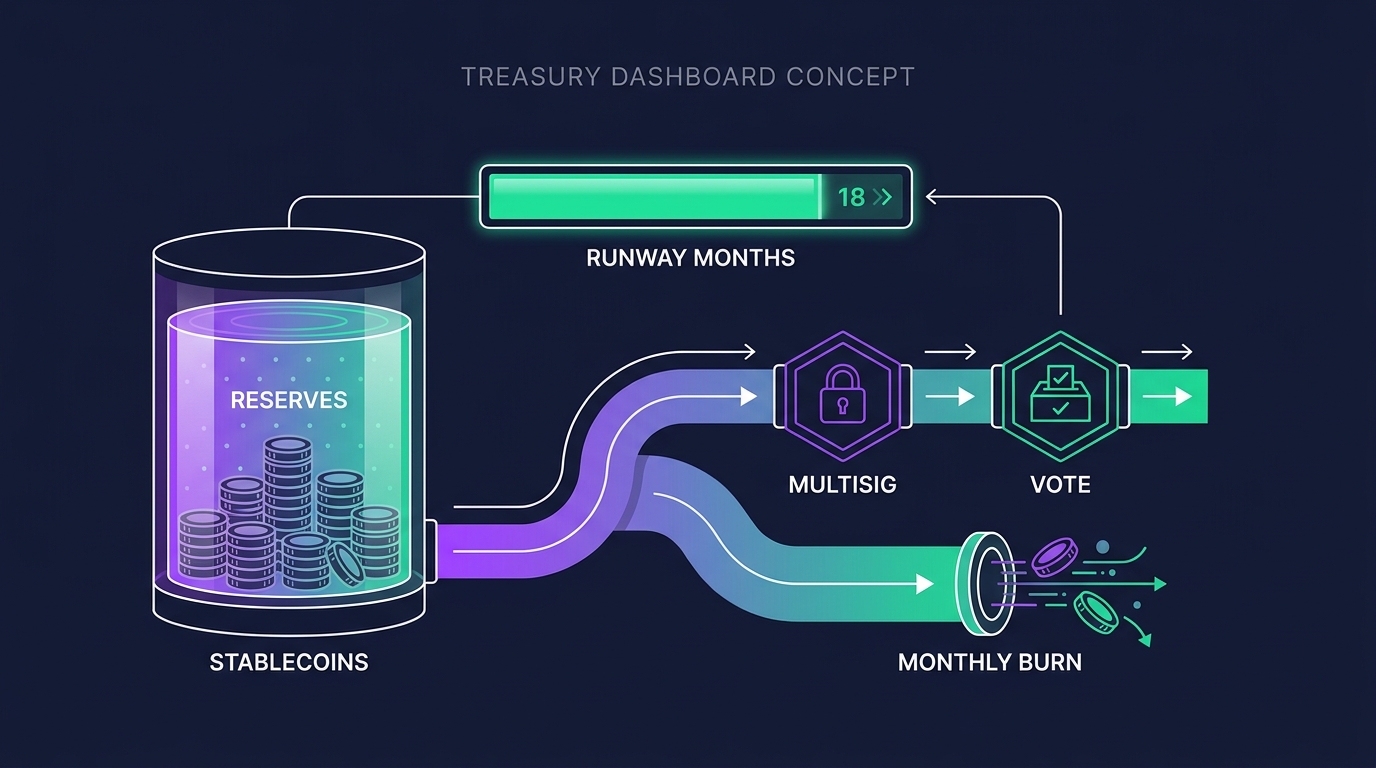
Figure 6:Treasury Management, Not Just Custody: Runway is counted in stablecoins only. Spending thresholds route small decisions to the multisig and large ones to a vote. Diversification happens on an announced schedule — never as a surprise into your own thin pool.
6Governance Attacks: What Can Go Wrong
Before you build your governance system, you need to understand how it fails. Governance attacks are not theoretical — they have happened to real projects, causing real losses.
Vote Buying
Also called “bribery attacks,” these occur when a wealthy actor purchases tokens specifically to win a vote, then sells them immediately after. The attacker’s cost is roughly proportional to the market impact of their buying and selling, which for thinly traded tokens can be quite low. If the vote controls a treasury worth $500,000 and an attacker can swing it by spending $50,000 on temporary token acquisition, the attack has a positive expected value.
The defense is snapshot-based voting combined with time locks. If your governance system takes a snapshot of token holdings 72 hours before voting opens, an attacker cannot acquire tokens and immediately vote. Combine this with a time lock on execution — a delay between when a vote passes and when it executes — and the community has time to spot and respond to malicious proposals before they cause damage.
Low Turnout Capture
This is more insidious than vote buying because it requires no bad faith from the attacker. If your token is widely distributed but most holders never vote, a small, organized minority can consistently win governance decisions even with modest holdings.
Imagine a token with 100 million units circulating. Your quorum threshold is 10 million (10%). Your governance forum has an active community of 500 people who hold 8 million tokens between them. Quorum never reaches 10 million because the other 92 million tokens belong to holders who bought on an exchange and never engage. That engaged minority of 500 people effectively controls governance — not because they cheated, but because everyone else opted out.
The defense is a mix of lower quorum thresholds (more achievable), delegation (passive holders can delegate their voting power to active representatives), and governance incentives (token rewards for participation).
Whale Capture
When a single wallet — or a small group of coordinating wallets — controls enough tokens to pass any proposal unilaterally, governance becomes theater. The whale decides, and the vote is a formality.
This is the hardest problem in token governance, because it directly conflicts with the property rights of large holders. If someone bought 20% of your token’s supply on the open market, do they not have a legitimate claim to 20% of the governance power? The philosophical answer is uncomfortable: maybe they do, and maybe that is okay. The practical answer is that projects can design governance systems with caps on voting weight per wallet, quadratic voting (where your voting power grows as the square root of your holdings, not linearly), or time locks that reduce the effectiveness of sudden large acquisitions.
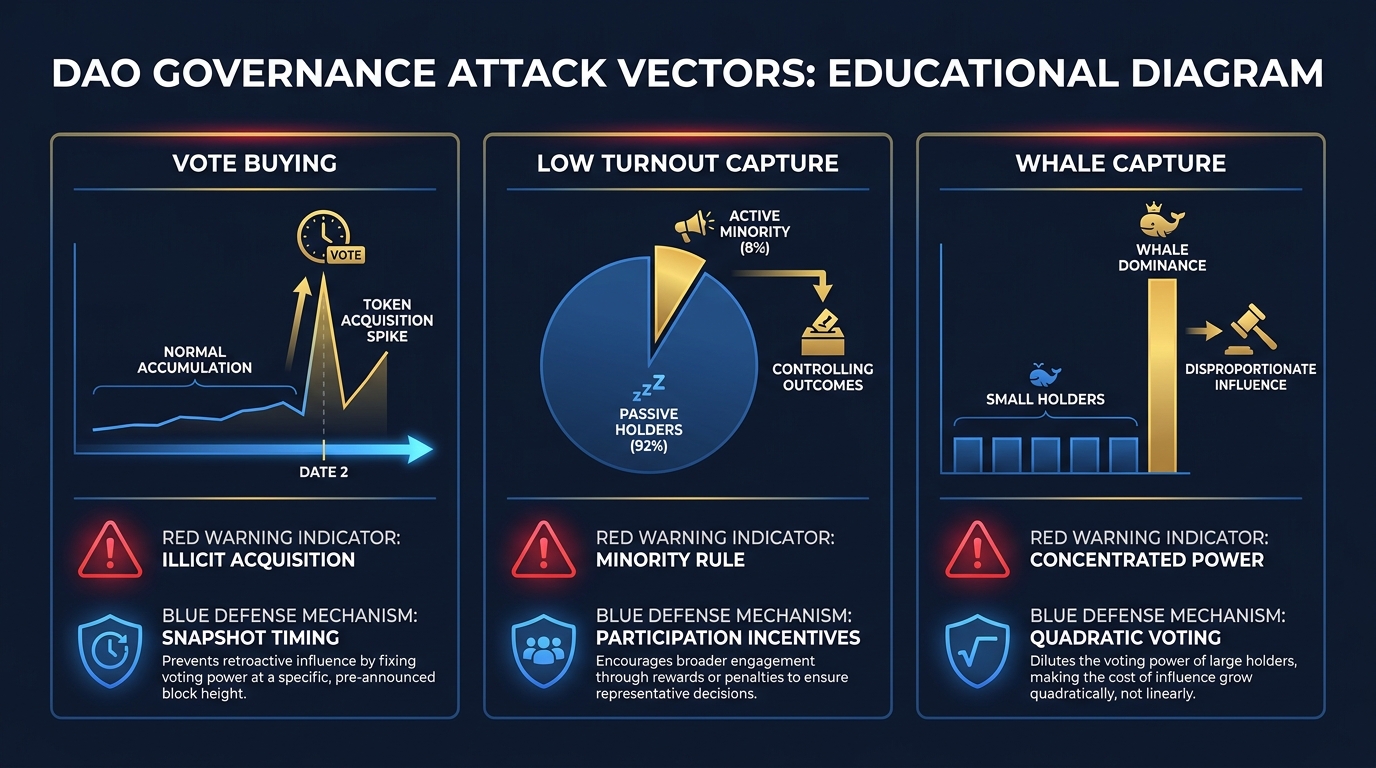
Figure 7:Three Governance Attack Vectors: Vote buying exploits timing. Low turnout exploits apathy. Whale capture exploits concentration. Each requires different design defenses — but none is fully preventable without trade-offs.
7The Decentralization Spectrum: Where You Actually Sit
There is a narrative in the blockchain industry that projects should be “fully decentralized” and that anything less is a failure or a fraud. This is a useful ideal for some contexts and a destructive fantasy for early-stage projects.
The reality is a spectrum, and most successful projects consciously position themselves somewhere in the middle.
At one end: full founder control. One wallet controls the treasury, the upgrade keys, the contract parameters. Efficient, fast, aligned — and utterly dependent on the trust and competence of one person or small team. This is appropriate for a project in the first days of existence, before there is a community to govern.
Moving along the spectrum: multisig control. The treasury requires multiple signatures from a known, trusted group — founders, lead investors, key community members. Decisions are made by this small council. Still fast, but with distribution of risk. The community cannot be harmed by any single person going rogue.
Further along: delegated governance. Token holders elect a council or set of representatives who make day-to-day decisions. Full holders can override on major questions. This is how many DAOs actually work in practice — a small active group handles routine governance, with the broader community reserved for constitutional questions.
At the other end: on-chain token governance. Every decision — from treasury allocation to contract upgrades — goes through a public vote. Token holders have full, direct control. Slow, potentially paralyzed by quorum problems, but maximally decentralized.
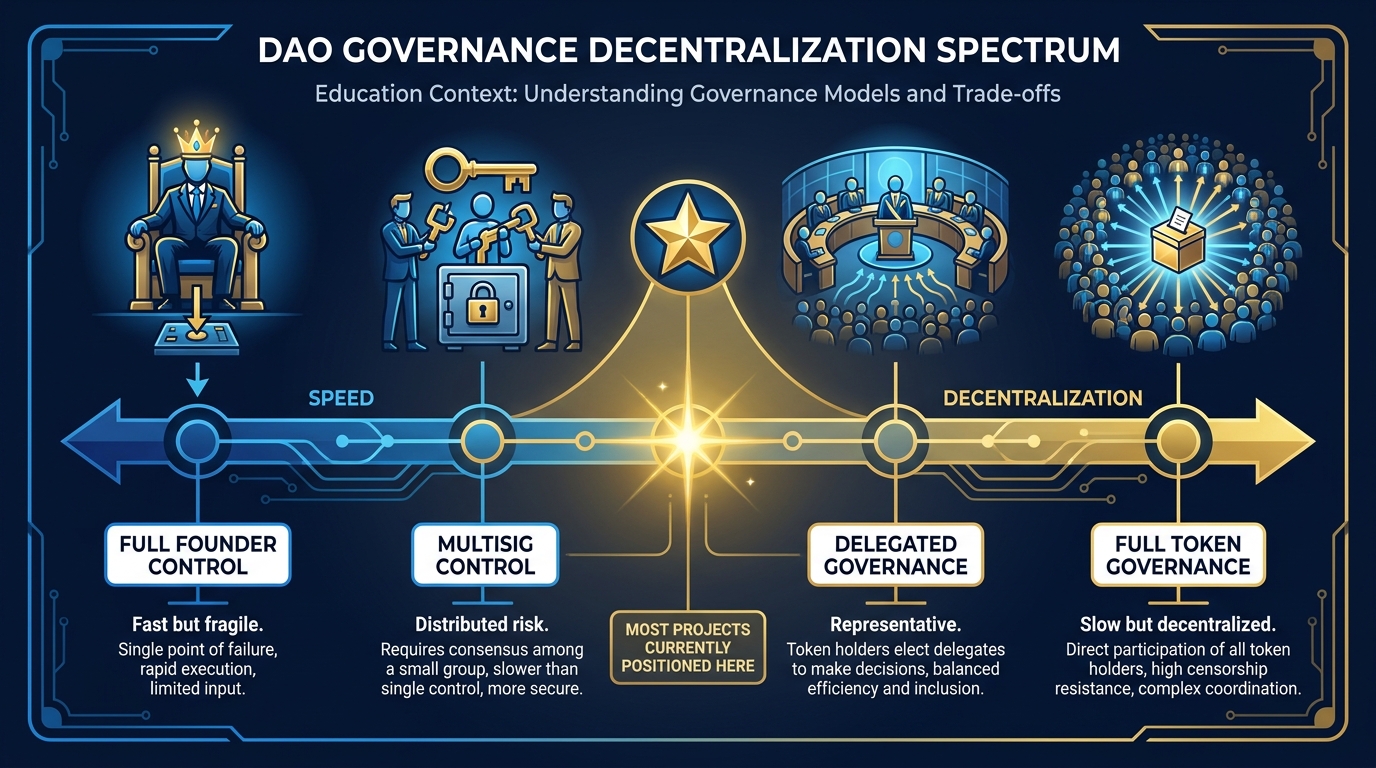
Figure 8:The Decentralization Spectrum: No project starts at full decentralization, and many never get there — nor should they. The appropriate governance model depends on the project’s maturity, community size, and risk tolerance.
The most sustainable trajectory is deliberate progression: start with a multisig, add delegation as the community grows, move to broader token governance as the protocol matures. Compound Finance, Uniswap, and Aave all followed versions of this path — maintaining tight control early, then progressively expanding governance rights as the communities demonstrated the capacity to use them responsibly.
The worst governance decisions are the ones made out of narrative obligation — projects that rush to “full decentralization” before the community is ready, producing systems that are technically decentralized but practically ungovernable.
8The Legal Wrapper: A DAO Is Not Yet a Legal Person
Your DAO can vote, spend, and execute — but it cannot sign an office lease, open a bank account, or appear in court. In the eyes of most legal systems, it does not exist. And the default that fills that vacuum is worse than nonexistence: in several U.S. rulings, an unincorporated DAO has been treated as a general partnership — which means every token-voting member is potentially personally liable for the whole organization’s obligations. Vote once on a proposal, and a plaintiff’s lawyer may argue you are a partner in everything the DAO ever does.
The reference case is the CFTC’s action against Ooki DAO. In 2022 the CFTC charged the DAO itself — not a company, the DAO — with operating an illegal trading platform, served it by posting in its online help forum, and won by default judgment in 2023. The court accepted the theory that the DAO was an unincorporated association whose token holders had voted on its operations. The message to every DAO participant was unambiguous: decentralized governance does not place you outside the law; it may place all of you, individually, inside it.
The answer is a legal wrapper: a recognized legal entity that the on-chain governance directs. The wrapper holds the treasury’s bank account, signs contracts, employs people, and pays taxes — while proposals passed on Realms tell it what to do. The main options:
Wyoming DAO LLC. Wyoming was the first U.S. state to recognize DAOs as a species of LLC (2021). Members get limited liability, and the operating agreement can state that governance happens on-chain — the smart contract is the management mechanism, recognized in the filing.
Marshall Islands DAO LLC. A non-U.S. equivalent: the Marshall Islands recognizes DAO LLCs with on-chain governance and no requirement that members be identified individually, which suits pseudonymous communities.
Cayman Islands foundation company. A foundation company has no members or shareholders at all — it is an orphan entity run by directors under a charter that can bind them to follow on-chain votes. This is the common structure for protocol foundations that hold treasuries and intellectual property.
Swiss association (Verein). The structure behind several major protocol foundations: a member-based non-profit association under Swiss law, straightforward to form, long track record with crypto projects.
Which wrapper fits depends on where your members are, whether the token itself creates securities exposure, and what the entity must do in the physical world — questions that belong in the same conversation with counsel as the Howey analysis. Chapter 12 covers entity choice alongside the “efforts of others” prong; for now, the design rule is simple: if your DAO will ever touch a dollar, a contract, or an employee, wrap it before it does.
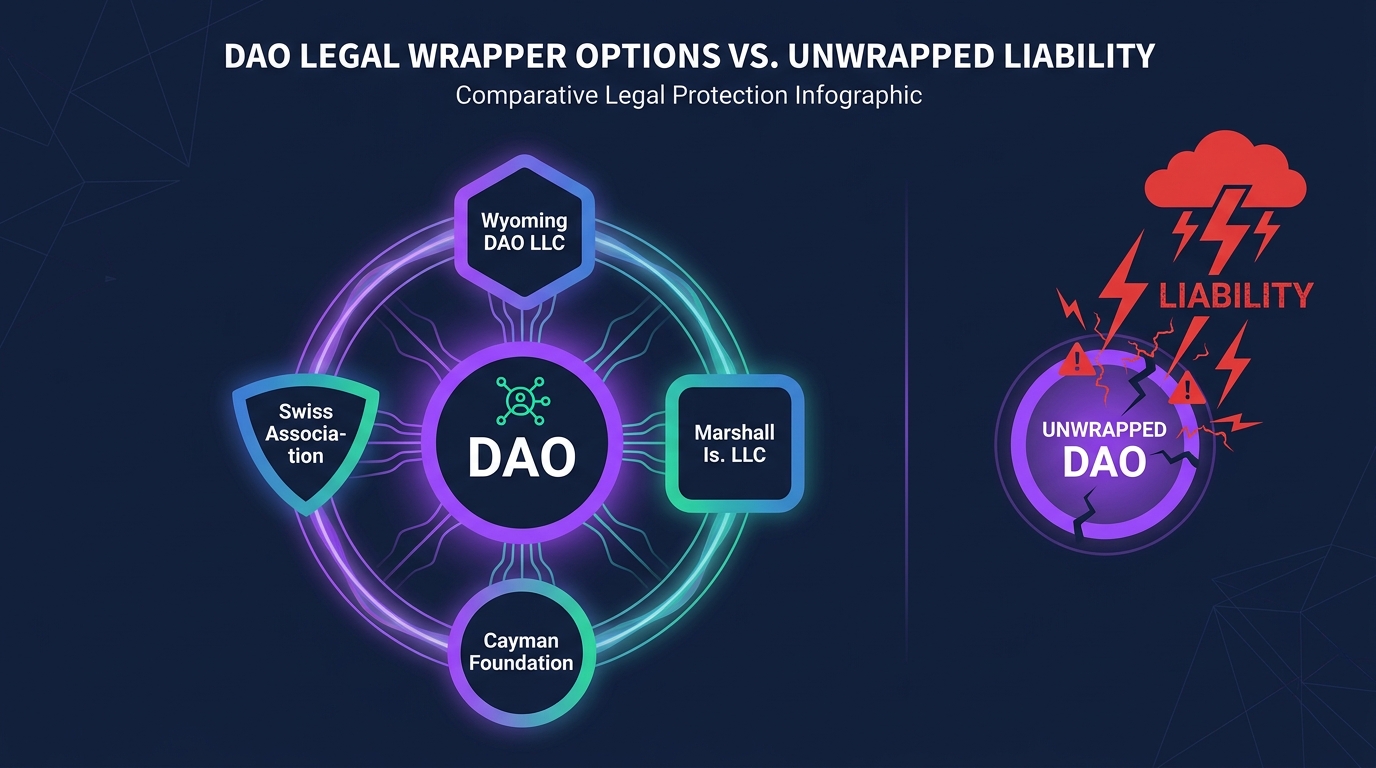
Figure 9:Four Legal Wrappers for a DAO: An unwrapped DAO defaults, in several U.S. rulings, to a general partnership — every voter potentially liable. Each wrapper trades some formation cost for limited liability, a bank account, and the ability to sign contracts, while on-chain governance directs the entity.
9Activity: Form the DAO
This is where the chapter becomes hands-on. By the end of this activity, you will have a working DAO: a multisig treasury with classmates as co-signers, a Realms governance space tied to your token, and one completed proposal that executed on-chain.
9.1Part 1: Create Your Multisig Treasury on Squads
You will need: Your Phantom wallet (with your token from earlier chapters), the wallet addresses of two classmates who will serve as co-signers.
Navigate to app.squads.so and connect your Phantom wallet.
Click Create Squad. Give it a name — something like “[YourToken] Treasury” — and choose 2-of-3 multisig as your configuration.
Add your own wallet as signer #1. Add your two classmates’ wallet addresses as signers #2 and #3. Confirm that all three addresses are correct before proceeding.
Click Create and approve the transaction in Phantom. Squads will deploy the multisig vault on Solana. Copy the vault address — you will need it in the next step.
Once the vault is live, initiate a token transfer from your own wallet. Send 5–10% of your token’s total supply into the vault. This represents the portion of your token economy managed by the DAO treasury.
After the transfer, verify the vault balance in the Squads UI. Your two co-signers should also be able to log in and see the vault — ask them to confirm.
In Squads, open Settings → Members and walk through (without executing) adding a fourth signer and raising the threshold to 3-of-4. Screenshot the proposal screen. This is the succession step from Chapter 12: rotating a signer in or out is itself a multisig proposal, and knowing the path before you need it is the difference between a routine change and a locked treasury.
9.2Part 2: Set Up Your Governance Space on Realms
Realms (app.realms.today) is the standard governance platform on Solana. It is where proposals live, where votes happen, and where on-chain execution gets triggered.
Navigate to Realms and click Create DAO. Select Multisig Wallet if you want governance to reflect your Squads setup, or Token Governance to create a fully token-weighted system. For this activity, use Token Governance.
In the token governance setup, enter the mint address of the token you created in Chapter 3. Realms will verify it on-chain.
Configure governance parameters:
Min tokens to create proposal: Set this to 1 (since you are testing with a small distribution)
Min tokens to vote: 1
Approval quorum: 60% (a supermajority — conservative for testing)
Vote duration: 24 hours (shortened for the lab; real DAOs use longer periods)
Click Create Realm and approve the transaction. Realms will create your DAO on-chain. Copy the Realm address.
Distribute a small amount of your token to your two classmates so they have voting power. They will need to “deposit” the tokens into the governance account in Realms to activate their voting rights — there is a “Deposit Governance Tokens” step in the Realms UI.
In Realms → your DAO → Params/Config, screenshot the governance parameters and identify the proposal threshold, vote duration, and any execution delay (time lock). If a time lock is configurable, set one of 1 hour and note what changes in Part 3: the proposal will pass but the Execute button will not fire until the delay elapses — the window in which a community catches a malicious or flawed proposal.
9.3Part 3: Submit and Execute a Real Proposal
Now for the actual governance. You are going to propose, vote on, and execute a real on-chain action: a small airdrop from the treasury.
In Realms, navigate to your DAO and click New Proposal.
Title it something like: “Fund Inaugural Airdrop — Distribute 100 Tokens to Each Governance Member.”
Write a brief description explaining the rationale: airdrops activate holder engagement and reward early governance participation.
Add an instruction: select Token Transfer, enter your multisig vault as the source, and set up the transfer details. For the lab, you can simplify by proposing a transfer from your own wallet rather than the multisig — the mechanics of the proposal and vote are identical.
Submit the proposal and approve the transaction.
Ask your classmates to log in to Realms, find your proposal, and cast their votes. You vote yes. They vote yes. Watch the vote counts accumulate in real time.
After 24 hours (or if your governance allows early execution once quorum is clear), click Execute when the proposal passes. The on-chain instruction fires. The tokens move. The airdrop happens.
Screenshot the completed vote — the proposal status showing “Executed” with the transaction signature. This is your proof of work.
9.4Part 4: Treasury Policy (15 minutes)
Write a half-page treasury policy for your token:
Target stablecoin percentage of the treasury (use the 50–70% guidance from Managing the Treasury, Not Just Guarding It as your starting point, and justify any deviation).
Monthly burn estimate — what the project spends per month, in dollars.
Runway in months — stable assets ÷ monthly burn, counted in stablecoins only.
Spending thresholds — what size of spending the multisig alone can approve, and what requires a Realms vote.
The conversion plan — how you would convert 10% of the treasury’s token holdings to USDC without moving the price. Name the method (OTC sale, time-weighted execution, or announced schedule) and why.
Submit the policy with the executed-proposal screenshot from Part 3.
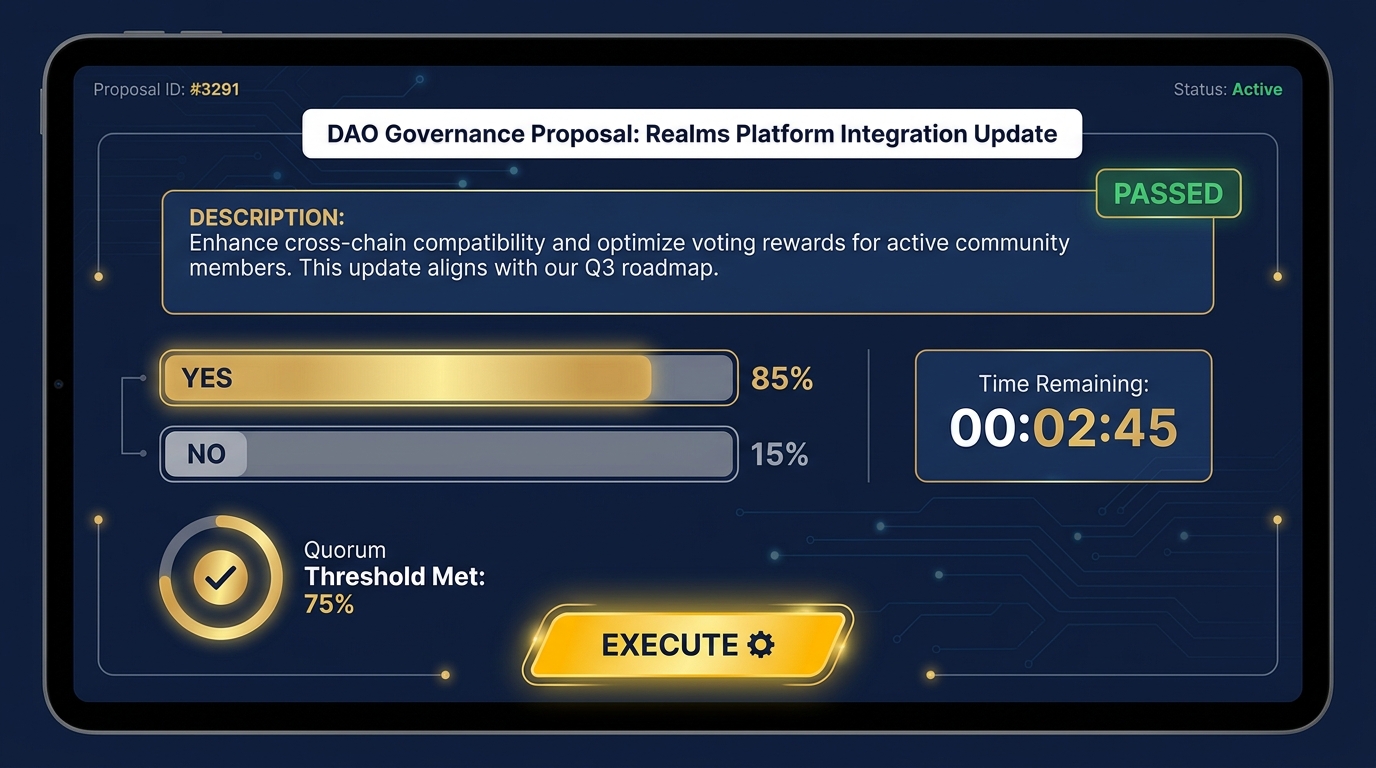
Figure 10:Realms Proposal Interface: A passed proposal shows vote counts, quorum achieved, and the Execute button ready to fire. Once clicked, the attached instruction runs on-chain automatically — no administrator required.
9.5What You Have Built
Pause and look at what just happened. You proposed a treasury action. Holders voted. The vote passed quorum. The blockchain executed the result. No bank, no lawyer, no administrator, no intermediary of any kind touched this process.
That is a DAO. Not as an abstract concept. As a system you built and ran today.
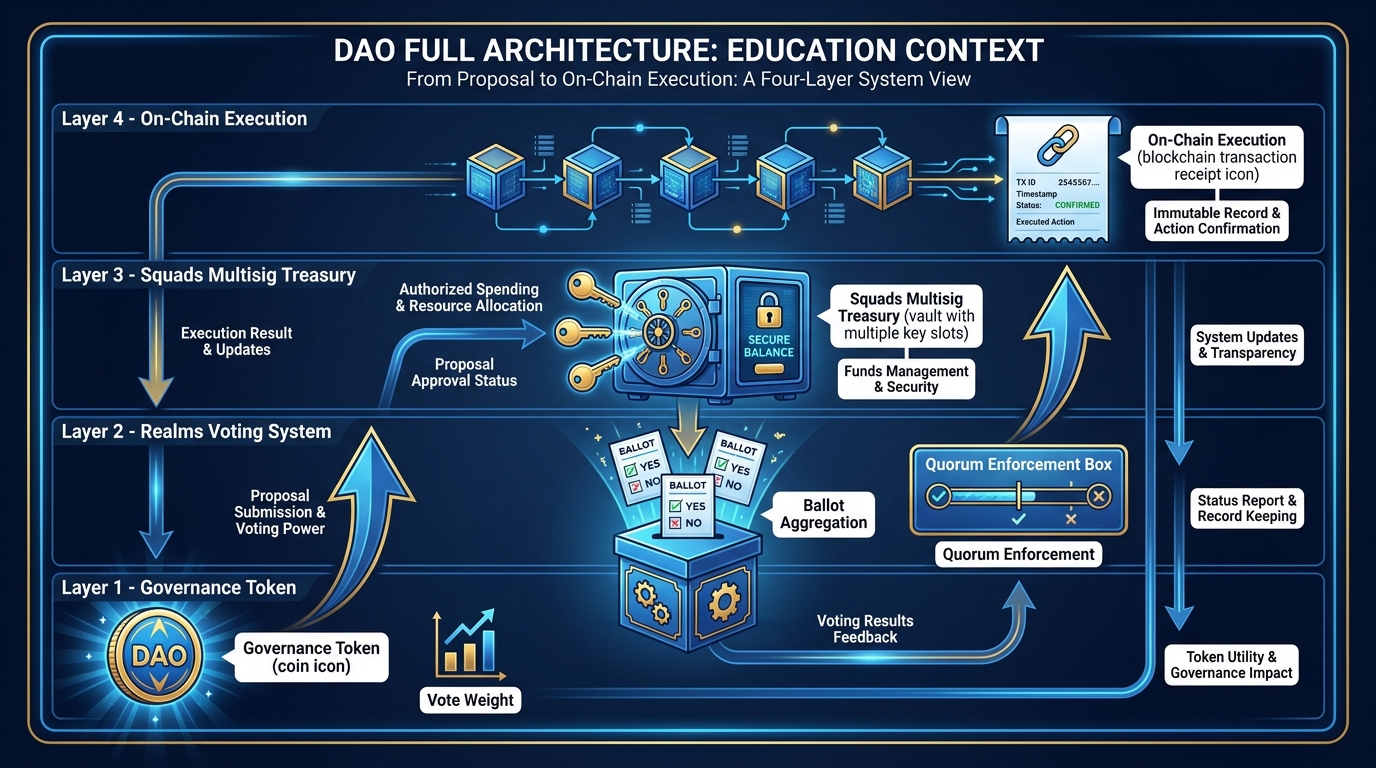
Figure 11:Your DAO Architecture: Governance token provides voting power. Realms aggregates votes and enforces quorum. Squads holds treasury funds with multisig protection. On-chain execution connects all three — no human administrator required between proposal and outcome.
10Real-World Cases
MakerDAO: Governing a $10 Billion System
MakerDAO governs the DAI stablecoin — a $10 billion-plus system entirely controlled by MKR token holders. Every parameter that matters — the stability fee charged on loans, the liquidation ratios for collateral, which assets can be used as collateral — is set by governance vote. This is not ceremonial. When MakerDAO governance voted to add real-world assets (physical loan portfolios from traditional banks) as collateral in 2022, it was a decision that brought billions of dollars of traditional finance assets on-chain, made by token holders, executed automatically. The governance system is the company’s constitution.
Compound: The Model Everyone Copied
Compound Finance built one of the first sophisticated token governance systems in DeFi and then open-sourced it. The “Compound Governor” smart contract — which defines how proposals are submitted, votes are counted, and instructions are executed — became the template for dozens of subsequent governance implementations, including Uniswap. Understanding Compound’s governance is understanding how most of DeFi votes.
▶ Watch: What is a Bitcoin hard fork? Simply Explained! (4 min)
The Juno Network Incident: Whale Capture in Real Life
In 2022, the Cosmos-based Juno Network passed a governance proposal to “claw back” a large allocation of tokens from a single whale wallet that the community believed had gamed an airdrop. The proposal passed with broad community support. But the execution had an error — the wrong wallet address was in the proposal, and the clawback hit an innocent exchange custodial wallet instead of the intended target. A second vote corrected it.
The incident illustrated both the power and the fragility of on-chain governance: the community could act decisively against a bad actor, but the automatic execution of a flawed proposal was irreversible. Time locks — delays between vote passage and execution — exist precisely to catch this kind of error before it causes permanent damage.
Uniswap: Governance as Brand
Uniswap’s UNI token began trading near $3 on September 17, 2020 and roughly doubled within a day, giving it a market cap in the billions — before Uniswap governance had made a single meaningful decision. The value was not current utility; it was future optionality. Holders were buying the right to vote on the direction of the leading DEX, on fee switches, on grants, on protocol upgrades. Governance power was so obviously valuable that the market priced it immediately. This is the clearest evidence that governance tokens are genuinely assets, not just voting chips.
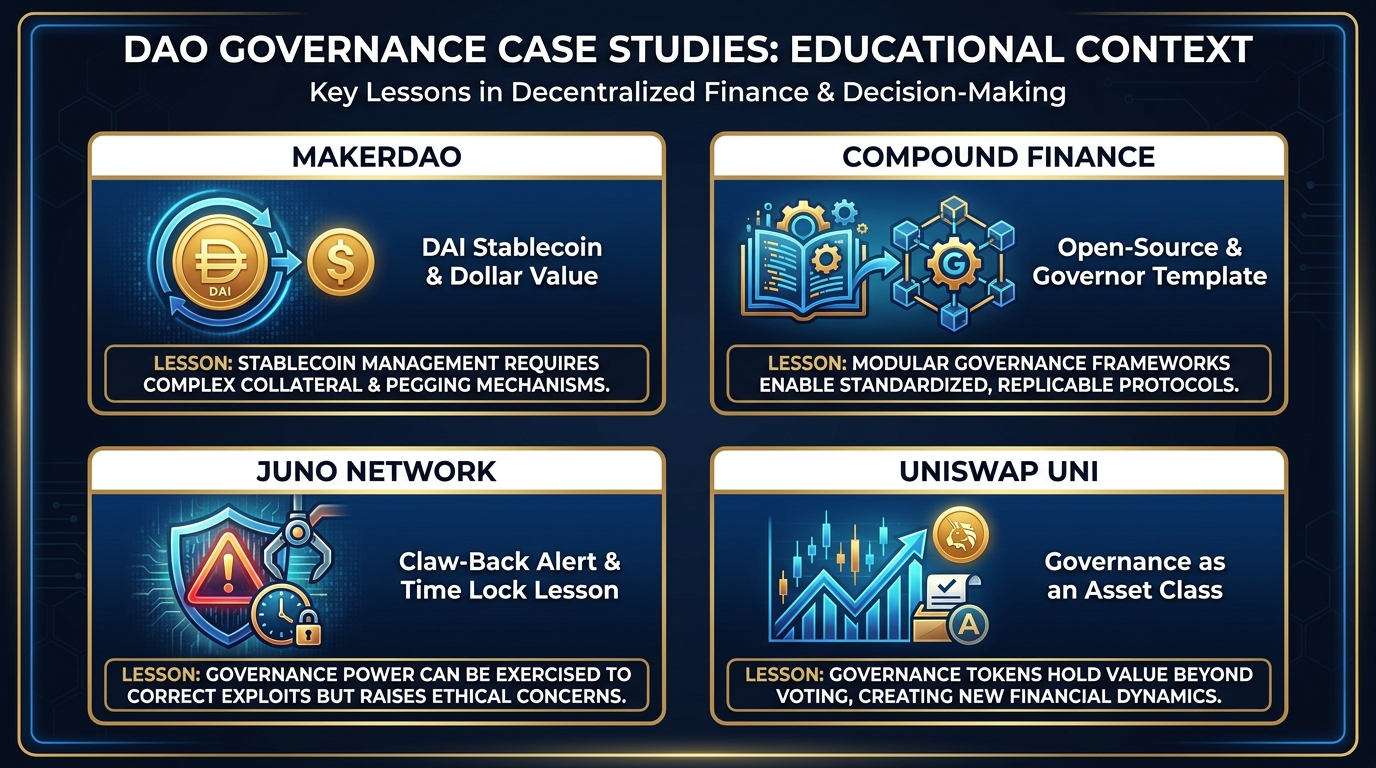
Figure 12:Four DAO Case Studies: MakerDAO governs billions. Compound set the template. Juno learned the hard way about time locks. Uniswap proved governance is an asset class. Each teaches a distinct lesson about what governance systems can do and how they fail.
11🎯 In-Class Assignment: DAO Formation Report (10 pts)
Details and instructions will be provided in class.
Points: 10
12💬 Discussion
In your DAO, one token equals one vote. That means the largest holder has the loudest voice — exactly like a shareholder meeting. Is that democracy, plutocracy, or just honesty about how power works? Could you design something better?
The one-token-one-vote system is honest about something most governance systems pretend is not true: power is not equal. In a shareholder meeting, the hedge fund with 12% of the float does not have the same influence as the retail investor with 100 shares, and nobody pretends otherwise. Token governance makes this explicit and algorithmic instead of implicit and political.
But “honest” is not the same as “right.” Democracy as an ideal is not one-dollar-one-vote — it is one-person-one-vote, because we believe every citizen has equal standing regardless of wealth. The question is whether a token economy is more like a company (where owners govern in proportion to ownership) or more like a polity (where stakeholders govern as equals).
Some alternatives have been tried. Quadratic voting makes each additional vote more expensive — n votes cost n² tokens in total, so each additional vote costs more than the last (the nth vote costs 2n−1): 1, 3, 5… Ten votes cost 100 tokens; a hundred votes cost 10,000. This compresses the power of large holders without eliminating it. Conviction voting weights votes by time: holding a vote position for longer builds more voting power, rewarding long-term commitment over short-term speculation. Reputation systems give voting power based on contribution history rather than token balance — harder to buy, easier to earn.
Each system has costs. Quadratic voting is sybil-vulnerable: a whale can split tokens across a thousand wallets and recover most of their power while pretending to be a thousand citizens. Reputation systems are opaque and gameable in different ways.
The honest answer is that there is no perfect governance system — only systems that optimize for different values with different trade-offs. One-token-one-vote is the simplest, most transparent, and most easily understood by outsiders. Its trade-off is concentration of power. Alternatives reduce concentration but add complexity and new attack surfaces.
What you design should reflect the community you are actually building, not the one you imagine. A protocol used primarily by a small group of sophisticated technical users might work well with reputation governance. A mass-market consumer token probably needs something simple and widely understood. The governance system is not separate from the community — it is one of the clearest expressions of what the community believes about itself.
12.1Discussion Guidelines
Write a minimum 300-word original post that responds to the discussion prompt. Your post must:
Take a position on whether one-token-one-vote is appropriate for your specific token project from this course
Include at least one scholarly or credible citation (academic paper, reputable news source, or documented governance case study)
Propose at least one concrete modification to improve your governance design and explain the trade-offs
After posting, respond to at least two peers with substantive feedback — not just agreement, but engagement with their reasoning. Challenge their assumptions, build on their ideas, or offer a counterexample from a real project.
13Glossary
DAO Decentralized Autonomous Organization. A collective governed by smart contracts rather than traditional legal and corporate structures. Rules are encoded in code, treasury is held on-chain, and decisions are made by token holders through public voting processes.
Governance Token A token whose primary utility is voting rights over a protocol or organization. Holders can submit proposals, vote on proposals, and often delegate their votes to representatives.
Multisig Short for multi-signature. A wallet or account that requires approval from M of N authorized signers before any transaction can execute. The most common configurations are 2-of-3 and 3-of-5.
Squads The leading multisig platform on Solana. Allows groups to create shared vaults, submit transaction proposals, and require threshold approval before funds move.
Realms The leading DAO governance platform on Solana. Supports token-weighted voting, proposal submission with on-chain instructions, quorum enforcement, and automatic execution of passed proposals.
Quorum A minimum threshold of participation required for a governance vote to be valid. If fewer than the quorum threshold of tokens participate, a proposal fails regardless of how the votes split.
Proposal Threshold The minimum token balance a wallet must hold to submit a governance proposal. Prevents spam and ensures proposers have skin in the game.
Vote Snapshot A specific block height at which token balances are recorded for voting purposes. Prevents manipulation by buying tokens after seeing how a vote is trending.
Time Lock A delay between when a governance proposal passes and when its associated instruction executes. Gives the community time to spot and respond to malicious or flawed proposals before they cause permanent damage.
Vote Delegation The ability of a token holder to assign their voting power to another wallet — a representative who votes on their behalf. Allows passive holders to participate indirectly.
Quadratic Voting A voting system where the cost of additional votes grows quadratically. n votes cost n² tokens in total, so each additional vote costs more than the last (the nth vote costs 2n−1): 1, 3, 5… Ten votes cost 100 tokens; a hundred votes cost 10,000. Compresses power concentration compared to one-token-one-vote.
Conviction Voting A governance mechanism where voting power accumulates over time. The longer you hold a vote position, the more weight it carries. Rewards long-term commitment over short-term coordination.
Whale Capture A governance failure mode where a small number of large token holders effectively control governance outcomes, reducing the system to a formality for everyone else.
Governance Attack Any attempt to manipulate a governance system to extract value or push through self-serving proposals at the expense of the broader community. Includes vote buying, low-turnout exploitation, and flash loan attacks.
Sybil Attack An attack in which one entity creates many fake identities or wallets to game a system that assigns power per identity rather than per token. Particularly relevant when governance systems try to limit per-wallet voting power.
Legal Wrapper A recognized legal entity — an LLC, foundation, or association — that a DAO’s on-chain governance directs. The wrapper holds the bank account, signs contracts, employs people, and pays taxes, giving members limited liability that an unincorporated DAO does not provide.
DAO LLC A limited liability company statute (pioneered by Wyoming in 2021, also available in the Marshall Islands) that recognizes on-chain governance in the operating agreement, so the smart contract is the legally acknowledged management mechanism and members receive limited liability.
Foundation Company A Cayman Islands entity with no members or shareholders, run by directors under a charter that can bind them to follow on-chain votes. The common structure for protocol foundations that hold treasuries and intellectual property.
General Partnership Liability The default legal treatment of an unincorporated DAO in several U.S. rulings: every token-voting member is potentially personally liable for the organization’s obligations. The CFTC’s action against Ooki DAO is the reference case.
14Chapter Summary
Governance is not a feature you add to a token economy — it is the architecture underneath everything else. The decisions you encode about who can propose, how votes are weighted, what quorum looks like, and where treasury funds live will shape your project’s culture and resilience for years.
The two tools in this chapter — Squads for multisig treasury and Realms for on-chain voting — are not exotic. They are the standard infrastructure that serious Solana projects use in production. By completing this chapter’s activity, you have done exactly what founding teams do when they formalize their governance: moved funds into a shared vault, set up a public voting process, and run a real proposal to completion.
The conceptual foundation matters as much as the tools. A DAO is a company whose bylaws execute themselves. A multisig is the first governance decision that matters — because nobody should hold the keys alone. And the decentralization spectrum is not a linear path toward some ideal end state. It is a design space where you choose the position that fits your community, your maturity, and your risk tolerance — and revisit that choice as all three evolve.
Walk Away With:
✅ A 2-of-3 multisig treasury on Squads with co-signers
✅ A token-governed DAO on Realms linked to your token
✅ One completed proposal — submitted, voted on, executed on-chain
✅ A framework for understanding governance attacks and how to design against them