Legal, Risk, and Running It for Real
The Questions a Lawyer, a Regulator, a Scammer, and a Customer Will Each Ask
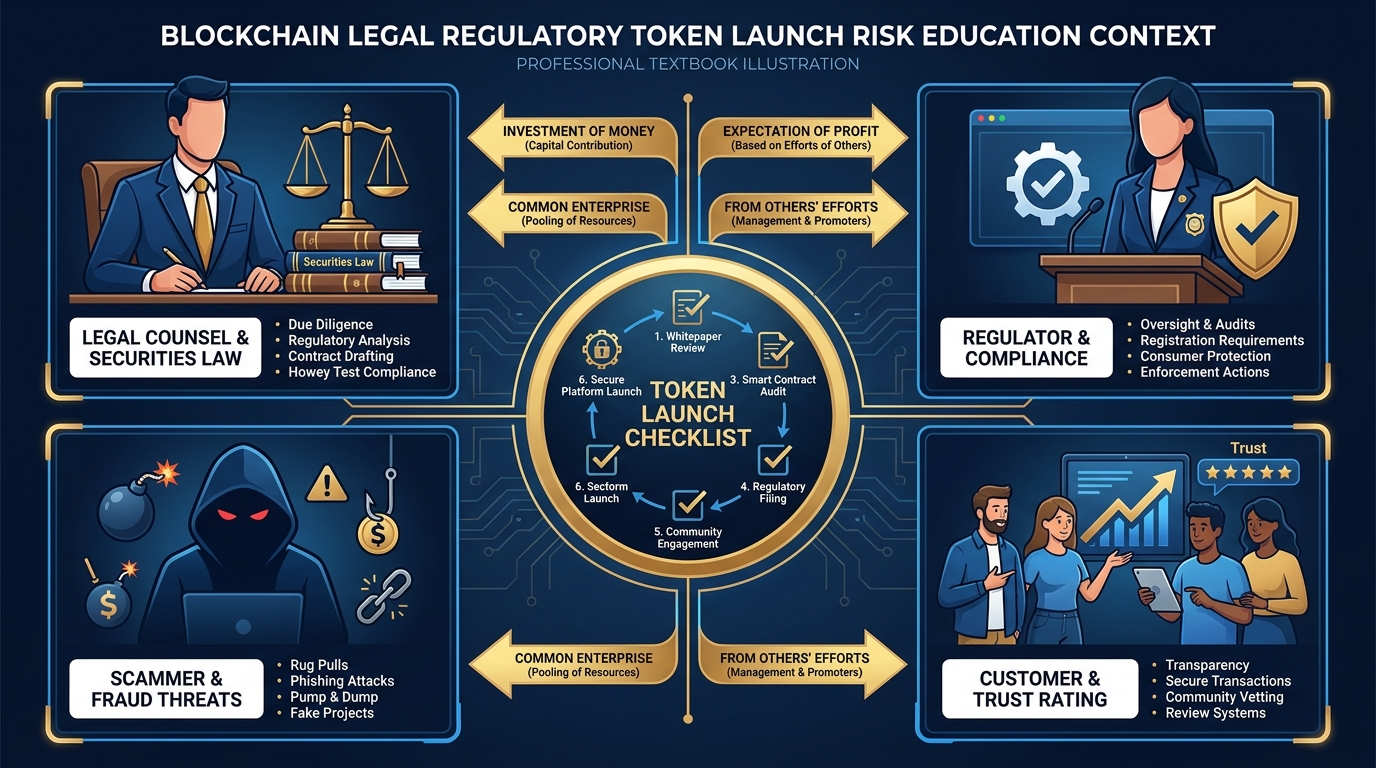
Figure 1:Chapter 12 Explainer Infographic: Every token economy faces four audiences simultaneously — legal scrutiny, regulatory oversight, adversarial attack, and customer trust. The surviving projects answered all four questions before launch, not after.
You have built an economy. You have designed your token, launched it on-chain, built a liquidity pool, distributed it to early holders, added utility, written your first program, issued memberships as NFTs, read your own analytics, and structured governance so that decisions require community approval. You have done, in a semester, what teams at major companies are still figuring out.
Now the world gets a vote.
This chapter is about the questions that come next — the questions a lawyer will ask when reviewing your structure, the questions a regulator will ask when deciding whether your token is a security, the questions a scammer will ask when looking for the fastest path to your funds, and the questions a customer will ask before trusting you with their money. These are not hypothetical questions. They are the questions that have ended real projects, landed founders in court, and wiped out communities overnight.
The difference between the projects that survive and the projects that collapse is not technical sophistication. It is preparation. The surviving projects thought about these questions in advance. The failing projects discovered them by accident, at the worst possible time.
1The Securities Question: Is Your Token a Security?
Start with the most consequential question in the space, because getting it wrong has sent people to federal prison.
When you issue a token, you are doing something that looks — to a regulator’s eye — very much like issuing a financial instrument. You are creating an asset that people will buy, hold, and sell in the hope of making money. The question the U.S. Securities and Exchange Commission will ask is straightforward: is this a security? If the answer is yes, you have just entered one of the most heavily regulated areas of American law, and operating without registration is a federal crime.
The legal test for this question dates to 1946. The Supreme Court case SEC v. W.J. Howey Co. established what is now called the Howey test. A financial instrument is a security if it involves: (1) an investment of money, (2) in a common enterprise, (3) with an expectation of profits, (4) derived primarily from the efforts of others.
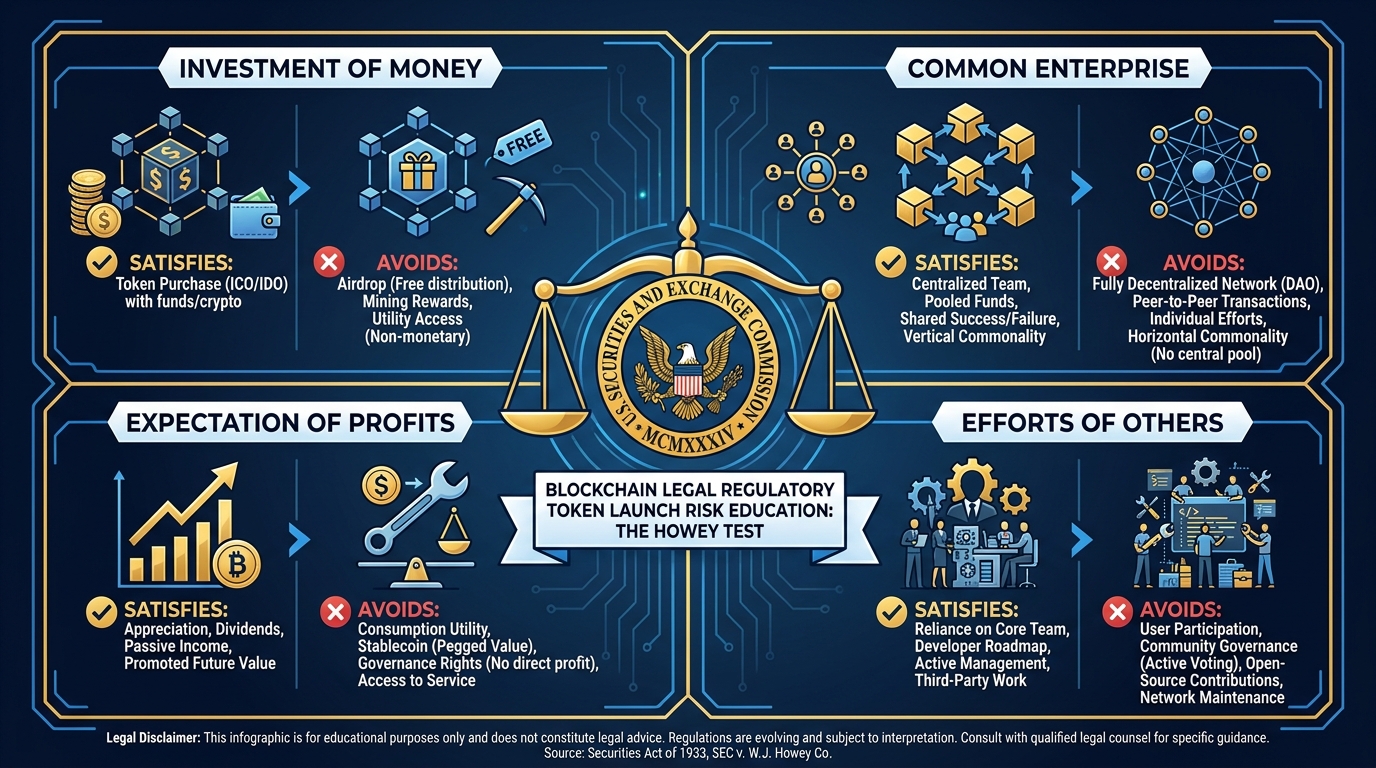
Figure 2:The Howey Test Applied to Tokens: Every prong of the test can be satisfied or avoided by deliberate token design choices. Understanding which design features trigger each prong is the foundation of legal token architecture.
Let us walk through this in plain language, because the nuances matter enormously.
Investment of money. When someone buys your token, they give you something of value — SOL, USDC, or dollars. Prong one is satisfied almost automatically for any token sold through a public sale or liquidity pool.
Common enterprise. Is the fate of your investors tied together and tied to your actions? If you are building a platform and all token holders benefit when the platform grows, the answer is almost certainly yes.
Expectation of profits. This is where design choices begin to matter. Did you market the token by describing how it would increase in value? Did your whitepaper project a token price? Did early investors receive discounts, implying they expected to sell at a higher price later? If you marketed scarcity and upside, you created an expectation of profit.
Efforts of others. This is the most critical prong and the one where blockchain projects most commonly fail. If token holders are depending on you — your team, your development efforts, your business decisions — to make the token valuable, then they are relying on the efforts of others. Fully decentralized projects where the protocol runs itself and no central team is responsible for value creation may avoid this prong. Projects with a core team driving development, partnerships, and roadmap execution almost certainly do not.
1.1How Token Design Shifts the Answer
The Howey test is not a wall — it is a set of levers. Thoughtful token design can shift the analysis, reduce risk, and move a project from the securities category toward safer alternatives.
Consumptive utility: If your token is primarily used to access goods or services — not held for appreciation — the third prong weakens. A token that buys compute credits and expires after use looks very different from a token that is marketed as a store of value.
Decentralization: If no central team controls the protocol, the fourth prong weakens. The SEC has indicated that sufficiently decentralized protocols may move from securities to commodities or currencies over time. Bitcoin and Ethereum (post-merge) have both been treated as commodities by the CFTC rather than securities by the SEC, precisely because no central issuer can be held responsible for their value.
Airdrops vs. sales: Tokens that are earned, not purchased, weaken the first prong. If users earn tokens through participation rather than buying them, the “investment of money” element is less clear. This is one reason many projects have moved toward earned distribution models.
Restricting secondary trading: Some projects have restricted secondary market sales during initial periods. If holders cannot sell their tokens, it is harder to argue they purchased them with an expectation of profit from price appreciation.
None of these techniques eliminate legal risk. They reduce it and shift the analysis. The only way to know where a specific project stands is to work with a securities attorney who specializes in digital assets — and those conversations are worth having before launch, not after a subpoena.
1.2If It Is a Security: The Exemption Map
Concluding that your token is a security is a compliance path, not a dead end. Securities law does not say “you may not sell this” — it says “you may not sell this without registering, unless an exemption applies.” The exemptions are well-worn roads, and token projects use them every year. The standard options:
Regulation D 506(c). Sell only to accredited investors (individuals above income or net-worth thresholds, and institutions), verify their status, and you may solicit publicly — advertise the raise, tweet about it, pitch it on a podcast. Resale is restricted: buyers generally cannot resell to the public for a holding period. This is the most common route for token sales to funds and angels, precisely because it permits open marketing while confining the buyers to those the law presumes can bear the loss.
Regulation S. Sell only to buyers outside the United States, with procedures ensuring the offering does not flow back into U.S. markets during a restricted period. Often run in parallel with a Reg D tranche: accredited U.S. buyers under 506(c), offshore buyers under Reg S.
Regulation Crowdfunding (Reg CF). Raise a capped amount (low single-digit millions) from the general public — unaccredited buyers included — through an SEC-registered funding portal, with disclosure requirements scaled to the raise. The trade-off: caps on how much each investor may put in, and the portal’s process.
Regulation A+. The “mini-IPO”: larger public raises (up to the tens of millions) from the general public, but only after the SEC qualifies an offering circular — a months-long disclosure and review process with ongoing reporting. The most expensive exemption, and the only one that produces freely tradable tokens for retail buyers.
The on-chain half of the map is already in your toolkit: the transfer restrictions these exemptions require — holding periods, accredited-only transfer — map directly to Token-2022’s default account state (frozen) and permanent delegate extensions (Chapter 3). New token accounts start frozen until the issuer verifies the holder; the delegate enforces clawback where the law demands it. This is how compliant RWA tokens work (Chapter 2): the exemption defines who may hold, and the token program enforces it.
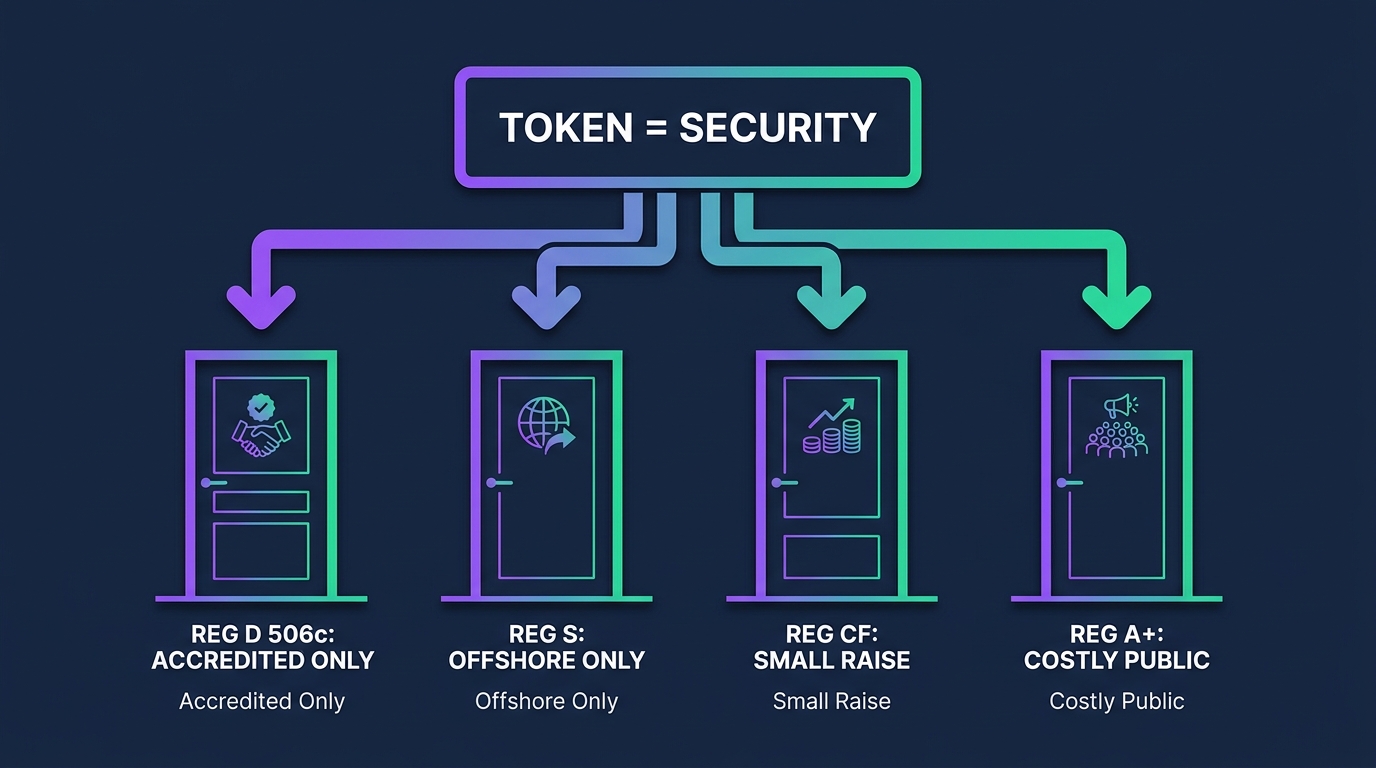
Figure 3:The Exemption Map: If the token is a security, four exemptions define who may buy it and how. Each exemption’s transfer restrictions map to Token-2022 extensions — the law defines the rule, the token program enforces it.
2Money Transmission, AML, and FinCEN
Securities law is one regulator. FinCEN — the Financial Crimes Enforcement Network, the U.S. Treasury’s financial-crimes unit — is another, and it asks a completely different question. The SEC asks what did you sell? FinCEN asks whose money did you move?
Under U.S. rules, an entity that accepts and transmits value on behalf of others is a money services business (MSB) — specifically, a money transmitter. An MSB must register with FinCEN, maintain a written AML (anti-money-laundering) program, perform KYC (know-your-customer) identification on its customers, and file suspicious-activity reports. Most states pile a second layer on top: a state money-transmitter license, obtained state by state, each with its own bond and examination requirements. Operating as an unregistered money transmitter is a federal crime independent of anything securities law says about your token.
FinCEN’s guidance on convertible virtual currency distinguishes three roles. A user — someone spending or receiving their own tokens for their own purposes — is not an MSB. An exchanger — someone in the business of exchanging tokens for fiat or other tokens for customers — is. An administrator — someone with authority to issue and redeem a virtual currency — is too. The trap for a token issuer is that ordinary-sounding product decisions can cross the line: an issuer that redeems its tokens for fiat on demand, runs a custodial wallet holding customers’ tokens, or operates a swap desk executing trades for customers can find itself an MSB without ever having thought of itself as a financial institution.
Practical rules for the reader:
Self-custody and peer-to-peer transfers are not transmission. Users holding their own keys and sending tokens to each other implicate no MSB duty for you.
Running a hosted wallet or an on/off-ramp is. The moment you hold customers’ value or convert it for them, you are in FinCEN territory and likely in fifty state regimes as well.
Sanctions screening applies to everyone. OFAC (the Office of Foreign Assets Control) prohibits transacting with sanctioned persons and addresses regardless of whether you are an MSB — which is why USDC has a freeze authority and has used it under sanctions orders (Chapter 1).
The decision is worth a diagram and an hour with counsel: if your business model includes custody, redemption, or exchange for customers, the MSB analysis belongs on the launch checklist next to the Howey analysis.
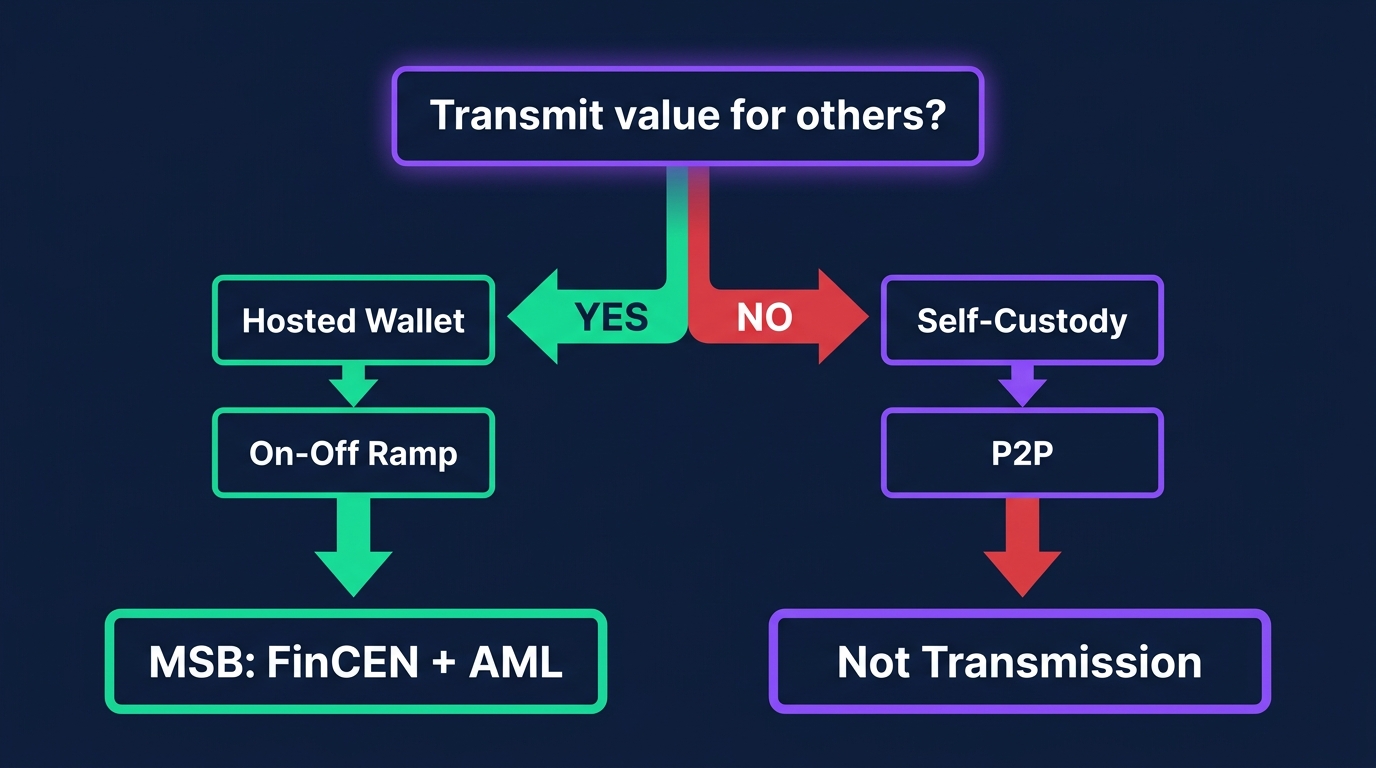
Figure 4:The MSB Decision Tree: FinCEN distinguishes users (not MSBs) from exchangers and administrators (MSBs). Custody, redemption, or exchange for customers triggers federal registration, an AML program, KYC, and state licensing. OFAC sanctions screening applies to everyone, MSB or not.
3Disclosure and Transparency: Legal Shield and Marketing Tool
Here is a counterintuitive truth about legal risk in token economies: the best legal protection is often also your most effective marketing strategy.
Disclosure — publishing clear, honest information about your token’s risks, mechanics, allocation, team, and business model — serves two functions simultaneously. Legally, it reduces the exposure created by any material misrepresentation or omission. Marketing-wise, it builds exactly the kind of trust that converts skeptical early adopters into committed community members.
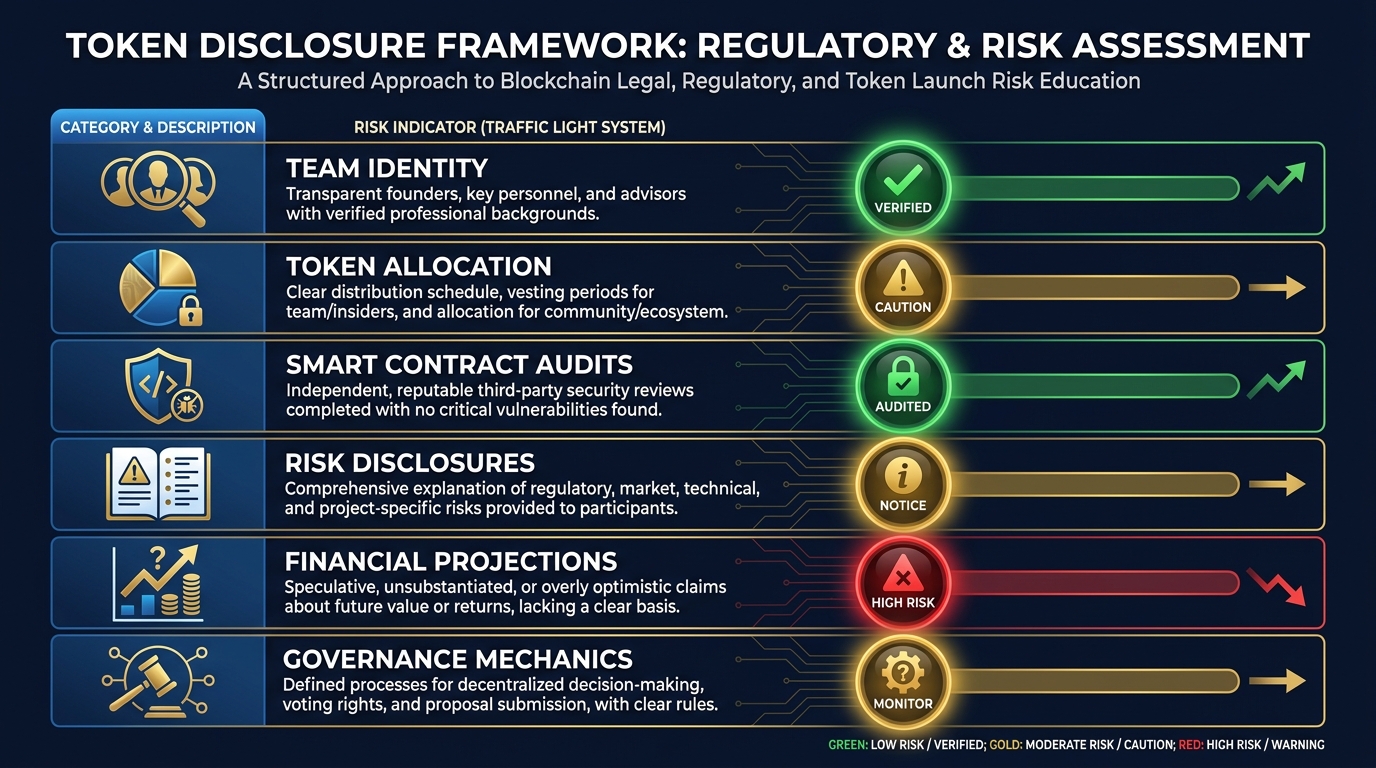
Figure 5:Token Disclosure Framework: Six categories of information that sophisticated investors, regulators, and community members will expect to find. Projects that publish all six voluntarily are vastly less exposed than those that hide behind anonymity.
Team identity. Anonymous founding teams were once fashionable in crypto. They are increasingly a red flag to serious investors and a liability in regulatory proceedings. If your project is a serious business, your team members should be identifiable. This does not mean publishing your home address — it means having LinkedIn profiles, professional history, and names attached to the project.
Token allocation. One of the fastest ways to lose community trust is to have your allocation schedule discovered after the fact. Publish it first. How many tokens exist? How many did the team receive? What is the vesting schedule? How many are reserved for the treasury, for ecosystem development, for early investors? Every major token project that survived the 2022 bear market published this information voluntarily. Every major project that collapsed amid scandal had obscured it.
Smart contract audits. An independent audit of your token contract — performed by a reputable security firm — is both a legal risk-reduction tool and a community trust signal. Publish the audit report publicly. Link to it from your website. If the audit found issues and you fixed them, publish that too. Transparency about process is as valuable as a clean report.
Risk disclosures. Yes, this means telling people that they might lose everything. It means acknowledging that blockchain technology is experimental, that regulatory conditions may change, that your business might fail, and that the token might lose all value. This feels counterintuitive as marketing — but it is the kind of honesty that sophisticated investors require, and it is the kind of honesty that differentiates serious projects from scams.
4Key Management: The Infrastructure Nobody Talks About
Every token economy has one catastrophic single point of failure that is almost never discussed in technical curricula: who holds the keys?
Think about what “holding the keys” means in practice. Your token mint authority is a keypair — whoever controls that keypair can mint unlimited additional tokens. Your upgrade authority for any programs you’ve deployed is a keypair — whoever controls it can replace your smart contract with any code they want. Your treasury multisig requires M-of-N signers, but each of those signers has keys. Your liquidity pool admin, your governance executor, your freeze authority — all keypairs.
In a traditional business, you solve this problem with a combination of institutional custody (your bank holds the money), role-based access control (the CFO can authorize payments, the junior analyst cannot), and backup processes (the bank can recover your account if you lose your password). In blockchain, there is no bank. There is no password recovery. There is no “the smart contract said to do it but actually we will reverse it.” The keys are the authority, absolutely and irreversibly.
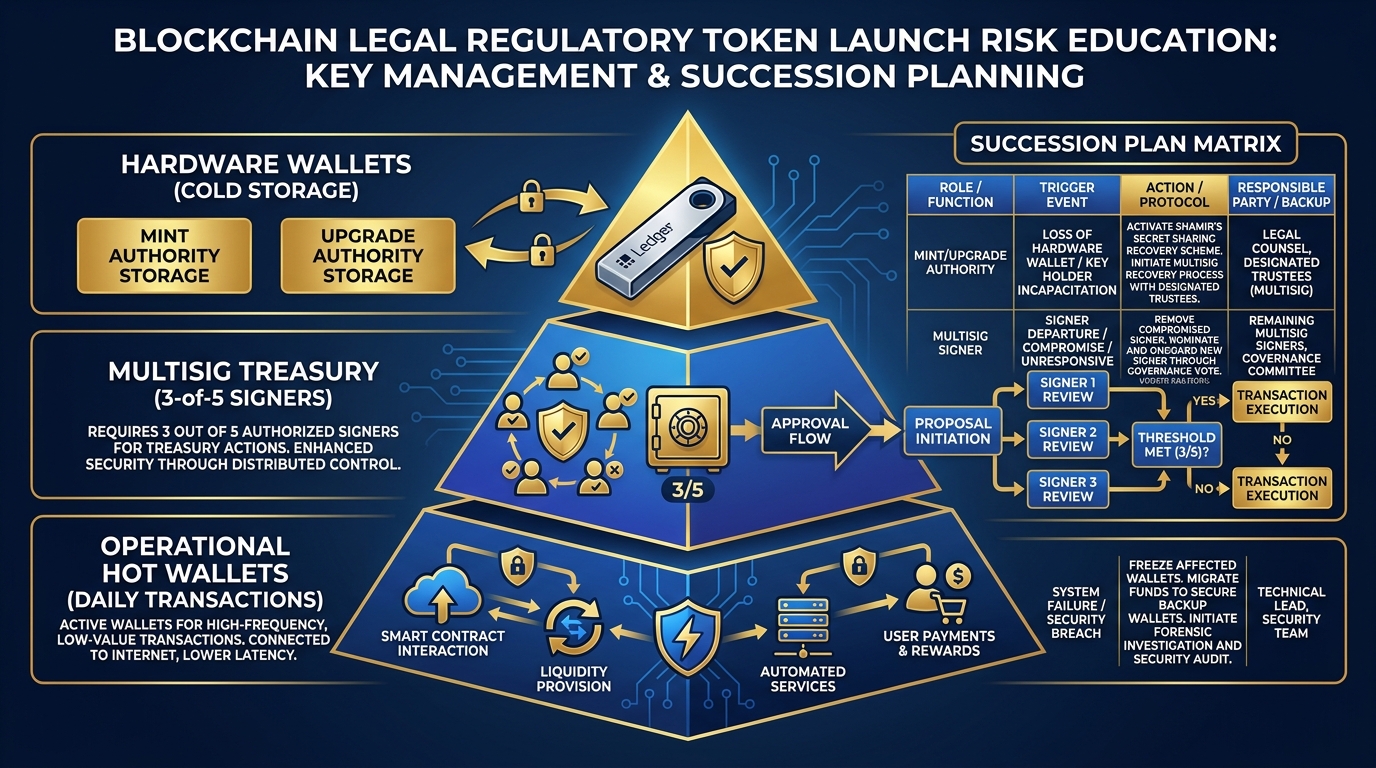
Figure 6:Key Management Hierarchy: A professional token economy uses three tiers of key security. Hot wallets for daily operations. Multisig for treasury and major authorities. Hardware wallets for anything that cannot be recovered. Succession planning ensures the project survives the departure of any single person.
4.1Hardware Wallets
A hardware wallet is a physical device — a Ledger or Trezor — that stores private keys in a chip that never connects to the internet directly. To sign a transaction, you physically press a button on the device. A malware infection on your laptop cannot steal the key because the key never leaves the hardware.
For any authority that controls meaningful value or irreversible actions — your mint authority, your upgrade authority, your multisig signing key — a hardware wallet is not optional. It is the minimum baseline. Keeping these keys on a browser extension wallet, on a cloud server, or as a plain text file is a question of when, not if, you will lose them.
4.2Multisig
A multisig wallet requires M signatures out of N authorized signers to execute any transaction. For example, 2-of-3 multisig means any two of three designated people must approve each transaction. This eliminates the single-point-of-failure problem: no single person can steal the treasury, and no single accident can lock it permanently.
On Solana, Squads is the standard for multisig treasury management, as you built in Chapter 11. The practical architecture for a serious project looks like this: treasury lives in a 3-of-5 multisig; major authorities (mint, upgrade) are either revoked entirely or held in multisig; day-to-day operational wallets hold only what they need for the next few days of operations.
4.3Succession Planning
What happens if the lead developer is hit by a bus? What happens if the founding team disbands? What happens if one of your multisig signers is unavailable for a month?
These are not morbid questions. They are the questions that determine whether your project survives personnel changes. A professional token economy has written answers to all of them:
Who are all the keyholders, and how do you contact them if one becomes unreachable?
What is the process for rotating a signer out of multisig and adding a replacement?
Where are hardware wallets stored, and who knows? (Not publicly — but at least one other trusted person.)
Is the seed phrase for any critical wallet written down, and where is that document?
What authorities have been revoked, what have been frozen, and what remains live?
Write this document. Store it securely. Update it whenever the team or keys change.
5The Threat Landscape
Your token economy has adversaries. Most of them are not sophisticated hackers — they are opportunists using social engineering, impersonation, and basic fraud mechanics that have worked in crypto for years. Understanding the attack surface is the prerequisite for defending it.
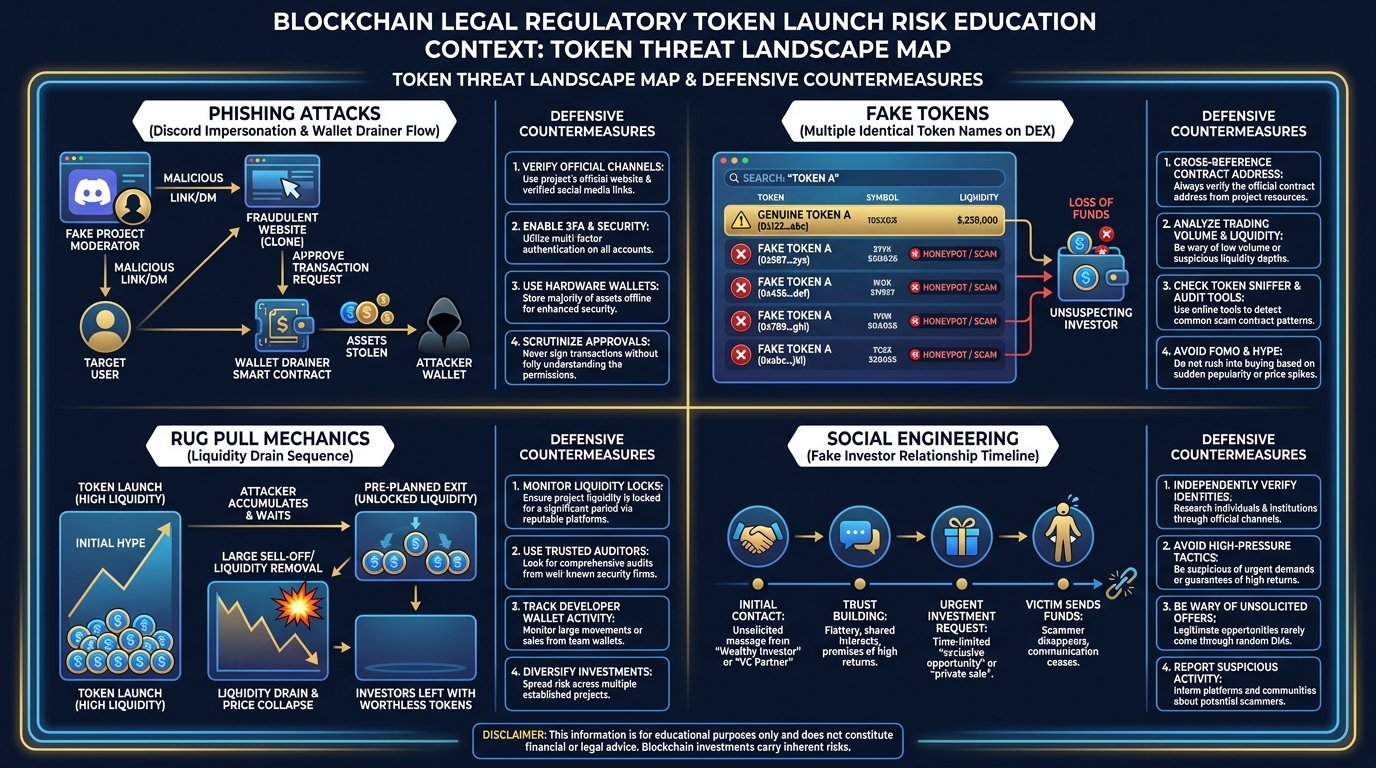
Figure 7:The Token Economy Threat Landscape: Four categories of adversarial attack, each with real examples from recent history. Projects that understood these vectors in advance survived; those that discovered them through a crisis did not.
5.1Phishing
Phishing in a token economy takes several forms. Classic phishing: a Discord message from “Admin” telling you that your wallet has been flagged and you need to connect it to a verification site — which is actually a drainer that empties your wallet in a single transaction. Discord impersonation: someone creates a username nearly identical to yours and DMs your community members with “official” updates. Airdrop phishing: fake tokens appear in your wallet (because anyone can send tokens to any Solana address) that contain a description linking to a draining site.
Defense: A professional project has a clear, repeated, written policy: no team member will ever DM users first, ask for seed phrases, or ask users to connect wallets to external sites. This policy should live in your Discord server rules, your onboarding messages, and your website. It will not stop all phishing — but it gives your community a reference point when they receive suspicious messages.
5.2Fake Tokens
Because creating a Solana token costs less than $1 and takes minutes, fraudsters create tokens with names and ticker symbols identical to legitimate projects. A new user searching for “USDC” or your token’s ticker on a decentralized exchange may find multiple results — and only one of them is real. The others are worthless tokens designed to confuse buyers into thinking they are purchasing the legitimate asset.
Defense: Publish your token’s mint address prominently and repeatedly. Put it on your website, your Discord, your Twitter bio, your documentation. “Our official token address is: [address]. Any other token with the same name is not ours.” Make it impossible for a careful user to mistake an impostor for you.
5.3Rug Pull Mechanics
A rug pull is when the founders of a project drain the liquidity pool, sell their token holdings, and disappear — leaving all other token holders with worthless assets. This is fraud, legally speaking — but by the time anyone realizes it has happened, the funds have often been moved through mixers and the team is unreachable.
Understanding the mechanics helps you recognize them in other projects and helps your own community understand how your project is structured differently. A classic rug pull requires several things: the founders hold a large percentage of the supply (concentrated allocation), they control the liquidity pool with the ability to remove liquidity at will, there is no vesting schedule locking their tokens, and there is no smart contract-enforced limitation on their ability to drain.
Defense for your project: Publish your team’s allocation and vesting schedule. Lock liquidity through a service like Raydium’s liquidity lock feature. Revoke or multisig the most dangerous authorities. These are not guarantees — but they are the verifiable signals that distinguish a legitimate project from a rug setup.
5.4Social Engineering
Social engineering attacks target humans, not systems. The goal is to manipulate a team member into performing an action that compromises the project. Common vectors include: fake investors who build rapport over weeks before asking for a wallet connection to “review the deployment”; fake auditors who claim to have found a critical bug and need emergency access to demonstrate it; fake partnerships where a “business development team” at a major protocol asks for administrative access to integrate; and personal relationships built over Discord that are revealed to be entirely fictitious.
DeFi-specific risks — oracle manipulation, bridge exploits, liquidation cascades, composability failure — are covered in Chapter 5, DeFi Risk; treat every protocol you integrate as part of your attack surface.
6Operational Risk: What “Immutable” Actually Means
Blockchain is often marketed as immutable and censorship-resistant. This is technically accurate — and operationally terrifying for anyone running a real project.
Immutability means that when you make a mistake, it stays made. A bug in your token contract that allows infinite minting cannot be patched with an update pushed to a database — unless you built in upgradeability, and even then, deploying the fix requires going through your governance process. A wrong transaction that sends $10,000 USDC to the wrong address cannot be recalled. A poorly worded governance proposal that passes cannot be unilaterally reversed by the team.
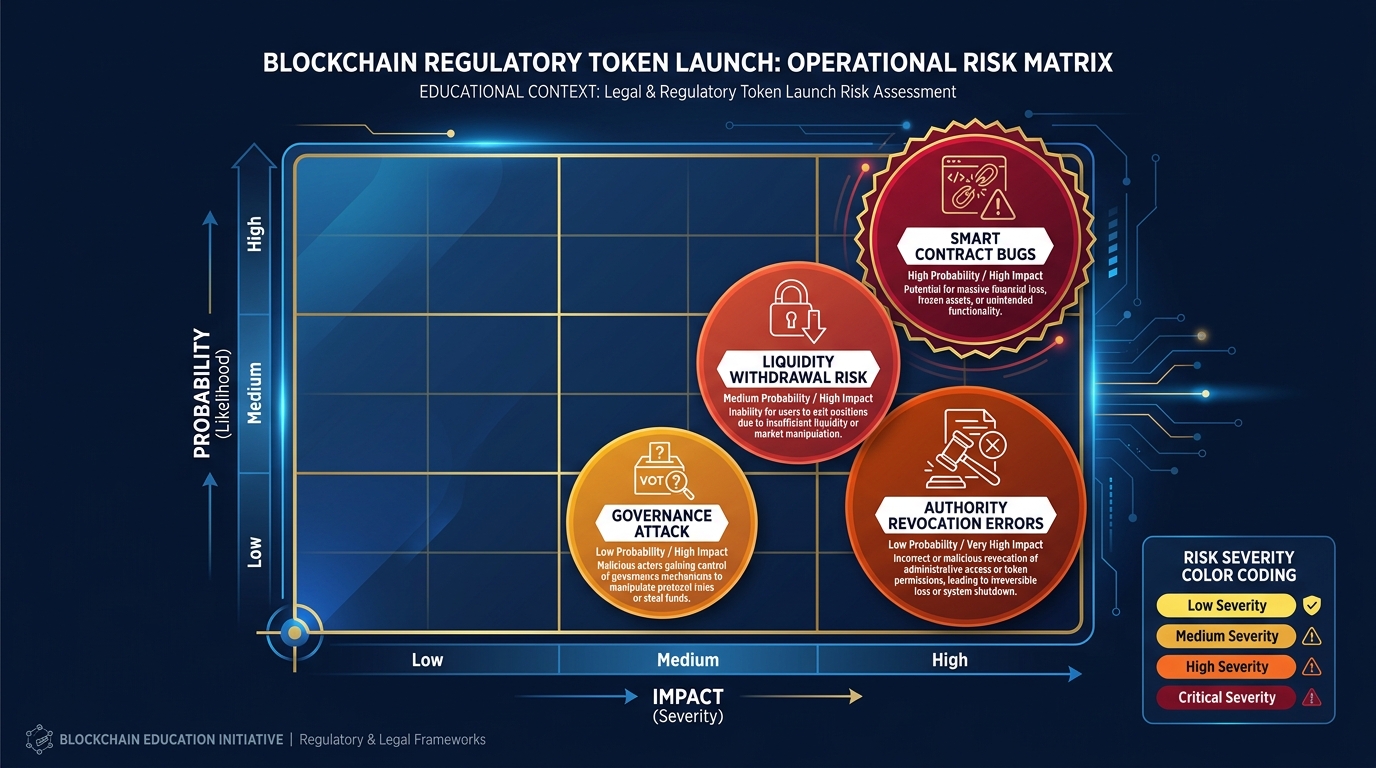
Figure 8:Operational Risk Matrix: The four most common operational risks in a token economy, mapped by probability and impact. High-probability, high-impact risks require mitigation before launch; lower-probability risks require response plans that can be activated on short notice.
6.1Liquidity Withdrawal Risk
Your token has value to the extent that people can buy and sell it. Your liquidity pool is what makes that possible. If the pool is fully owned and controlled by the founding team, they can drain it at any time — which is exactly what a rug pull is. But liquidity withdrawal risk also exists for entirely legitimate reasons: market conditions deteriorate, the team needs capital for operations, a liquidity provider decides to exit.
Mitigation: The gold standard is locking a portion of liquidity through a time-lock contract. “X% of the initial liquidity will be locked for 12 months and cannot be removed by anyone.” This is a credible commitment that community members can verify on-chain. The remainder can be managed by the team or by a governance-controlled treasury, but the locked portion provides a floor of confidence.
6.2Authority Revocation: The Irreversible Decision
Your mint authority, freeze authority, and upgrade authority can each be revoked — permanently and irreversibly. Once you revoke the mint authority, no one can ever create more tokens. Once you revoke the upgrade authority, the program can never be modified.
These decisions should be made deliberately, documented publicly, and timed carefully. Revoking mint authority is a powerful trust signal that the token supply is truly fixed. But doing it before your tokenomics are fully proven locks in decisions you may not be able to reverse if the project evolves. Most projects revoke mint authority after the initial distribution is complete and the supply is where it should be. Revoking upgrade authority is more dramatic — it means your program lives forever exactly as written, bugs included. Some projects do this to signal maximum decentralization; others maintain upgradeability through a governance-controlled multisig.
6.3Governance Attack Vectors
When token-weighted governance controls the treasury, governance itself becomes an attack surface. The attack is simple: buy enough tokens to pass a malicious proposal. In practice, a “governance attack” looks like this: an attacker accumulates voting power (either by purchasing tokens on the open market or through flash loans if the governance system allows it), submits a proposal to send the entire treasury to their wallet, and passes it if they have sufficient votes and insufficient quorum requirements or time delays exist.
Defense: Governance systems designed for real money require several protections. A time delay between a proposal passing and execution — called a “timelock” — gives the community time to recognize an attack and respond. High quorum requirements make it harder to pass anything without broad participation. And token concentration monitoring — watching for unusual accumulation by a single wallet — provides early warning.
7The Professional Launch Checklist
Launching a token economy without a checklist is like opening a restaurant without a health inspection. The absence of a systematic review does not mean nothing will go wrong — it means you will not find out what went wrong until it already has.
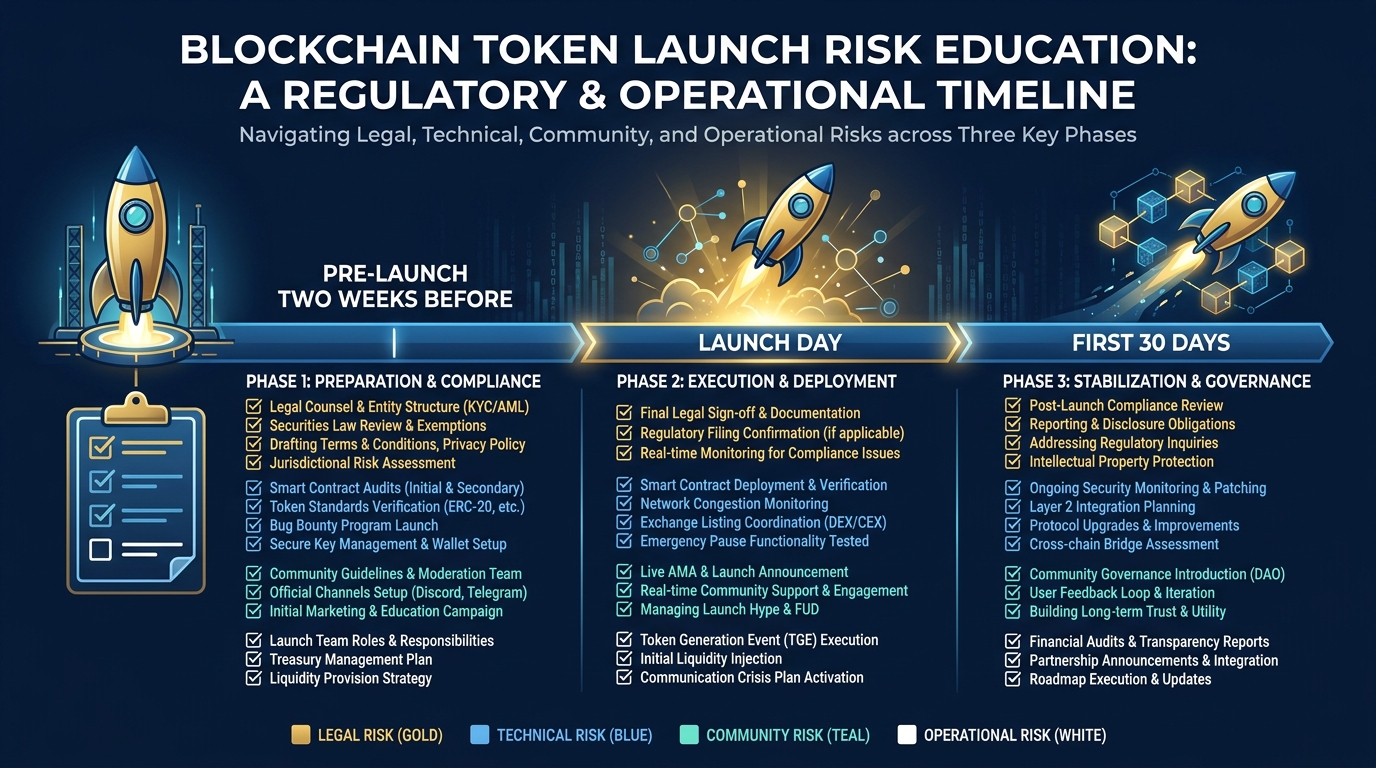
Figure 9:Professional Token Launch Timeline: A three-phase launch framework organizing legal, technical, community, and operational tasks across the pre-launch preparation, launch day, and first-month operations windows. Projects that follow this sequence spend less time in crisis management.
7.1Pre-Launch (Two Weeks Before)
Legal and disclosure:
Consult with a digital assets attorney about your specific structure
Publish the one-page token explainer (this chapter’s activity) on your website
Document and publish the full token allocation and vesting schedule
Document what authorities you have revoked and what remains active
Write and publish the community security policy (no DMs, no seed phrase requests)
Tax treatment of the airdrop, contributor payments, and treasury sales reviewed (Chapter 6)
MSB/money-transmitter analysis completed if you custody, redeem, or exchange for customers
Technical:
Contract audited by an independent security firm
Multisig configured with the correct signers and threshold
Hardware wallets operational for all high-value authorities
Key management documentation written and distributed to relevant team members
Liquidity lock configured if applicable
Testnet deployment fully tested by at least three team members who were not involved in writing the code
Community:
Token mint address published prominently in every channel
Discord security rules pinned and verified-role system active
FAQ document covering the most common scam scenarios published
Community moderators briefed on common attack patterns
7.2Launch Day
Mint authority decisions finalized (revoke or multisig)
Initial liquidity provided at pre-announced price
All official communication channels posting simultaneously
Team members on standby in Discord and Telegram for the first 24 hours
Monitor for impersonation accounts and fake token creation in the first hour
7.3First 30 Days
Weekly on-chain analytics review (wallet concentration, liquidity health, trading volume)
Community AMA at day 7 and day 30
Governance proposal for first community decision (demonstrates the system works)
Any issues flagged in the audit fully resolved and documented
First external partnership or utility integration announced
8The One-Page Explainer: Communicating Your Economy
The one-page explainer is the most undervalued artifact in the token ecosystem. Major projects spend enormous effort on their technical whitepaper, their Discord server architecture, and their tokenomics spreadsheets — and then try to explain everything to a potential investor or partner in a rambling conversation that takes 45 minutes and ends with the other person confused.
The one-page explainer forces clarity. If you cannot explain your token economy clearly on a single page, you do not yet understand it well enough yourself. Writing it is an act of thinking, not just communication.
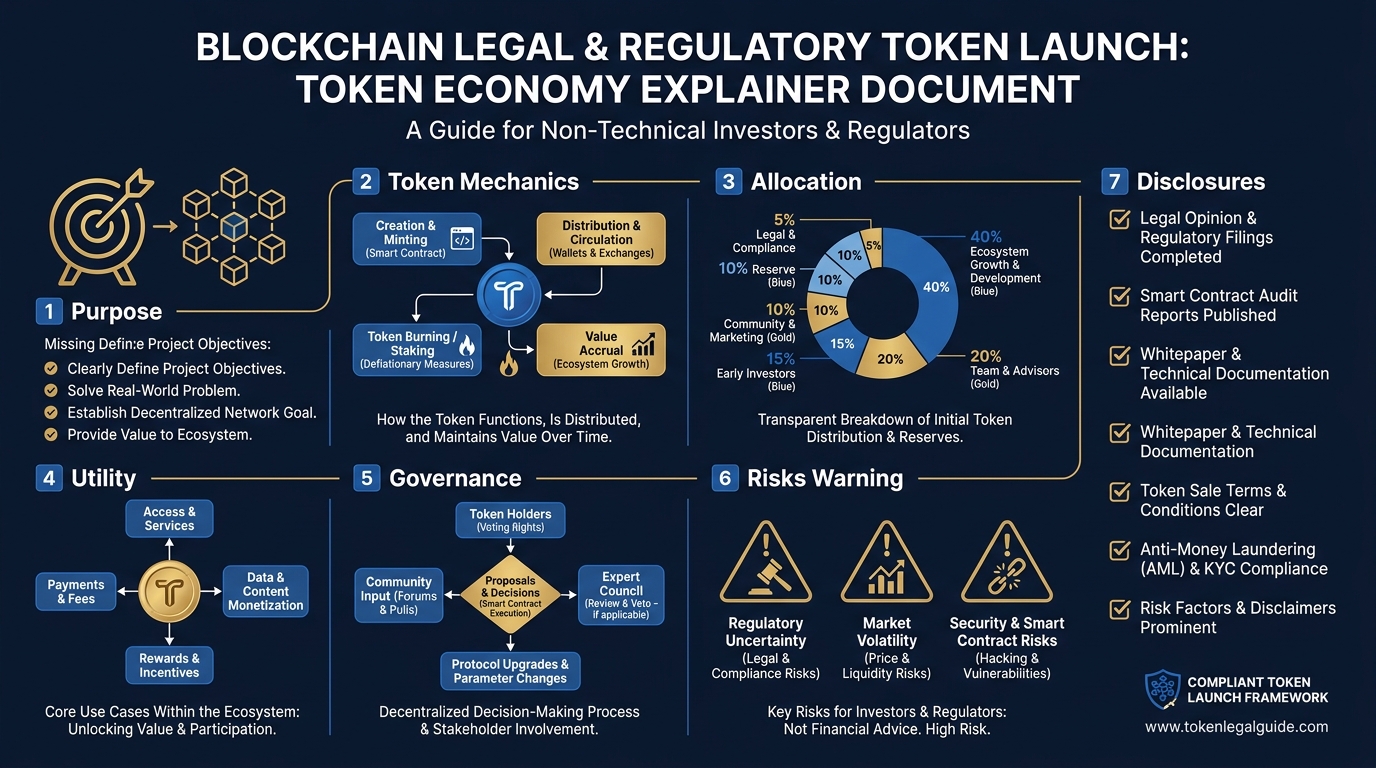
Figure 10:One-Page Token Explainer Template: The seven sections that must appear in any investor- or regulator-facing summary of a token economy. Each section should be no more than two to three sentences — enough to answer the core question without requiring technical knowledge.
The seven sections:
1. Purpose. What problem does this token economy solve? For whom? Why does it need a token rather than a traditional loyalty points system or equity structure?
2. Token mechanics. What is the total supply? Is it fixed or inflationary? How are tokens created and destroyed? What is the current circulating supply versus the maximum supply?
3. Allocation. Where did all the tokens go? Team, investors, treasury, ecosystem development, community airdrop — expressed both as percentages and as absolute numbers. When do the team’s tokens vest? When can early investors sell?
4. Utility. What can you do with this token? Is it used to access goods or services? To participate in governance? To earn yield through staking? Utility should be specific — “can be exchanged for platform credits at a fixed rate” is better than “used within the ecosystem.”
5. Governance. Who makes decisions about this project? Is there a DAO? A multisig? A core team? How does the community participate in significant decisions? What happens if the team disagrees with a community vote?
6. Risks. What are the three largest risks to this project? Be honest. Regulatory risk (the legal status of the token may change), technical risk (smart contracts may contain bugs), market risk (the token may lose all value), team risk (key personnel may depart). Sophisticated investors respect honest risk disclosure far more than glossy promises.
7. Disclosures. Is this a utility token or a security? Has it been reviewed by counsel? Are there jurisdictions where it is not available? Is it registered with any regulatory authority?
9The Launch Checklist as a Living Document
One mistake projects make is treating the launch checklist as a one-time event rather than an ongoing operational framework. The legal, security, and trust questions do not stop being relevant after the first day of trading. They evolve.
Regulatory environments change. The SEC issues new guidance. A jurisdiction that was permissive becomes restrictive. A new exchange listing requires additional compliance documentation. New security vulnerabilities are discovered in common Solana program patterns. Community members are targeted by increasingly sophisticated social engineering attacks.
▶ Watch: Will GDPR kill blockchains? (9 min)
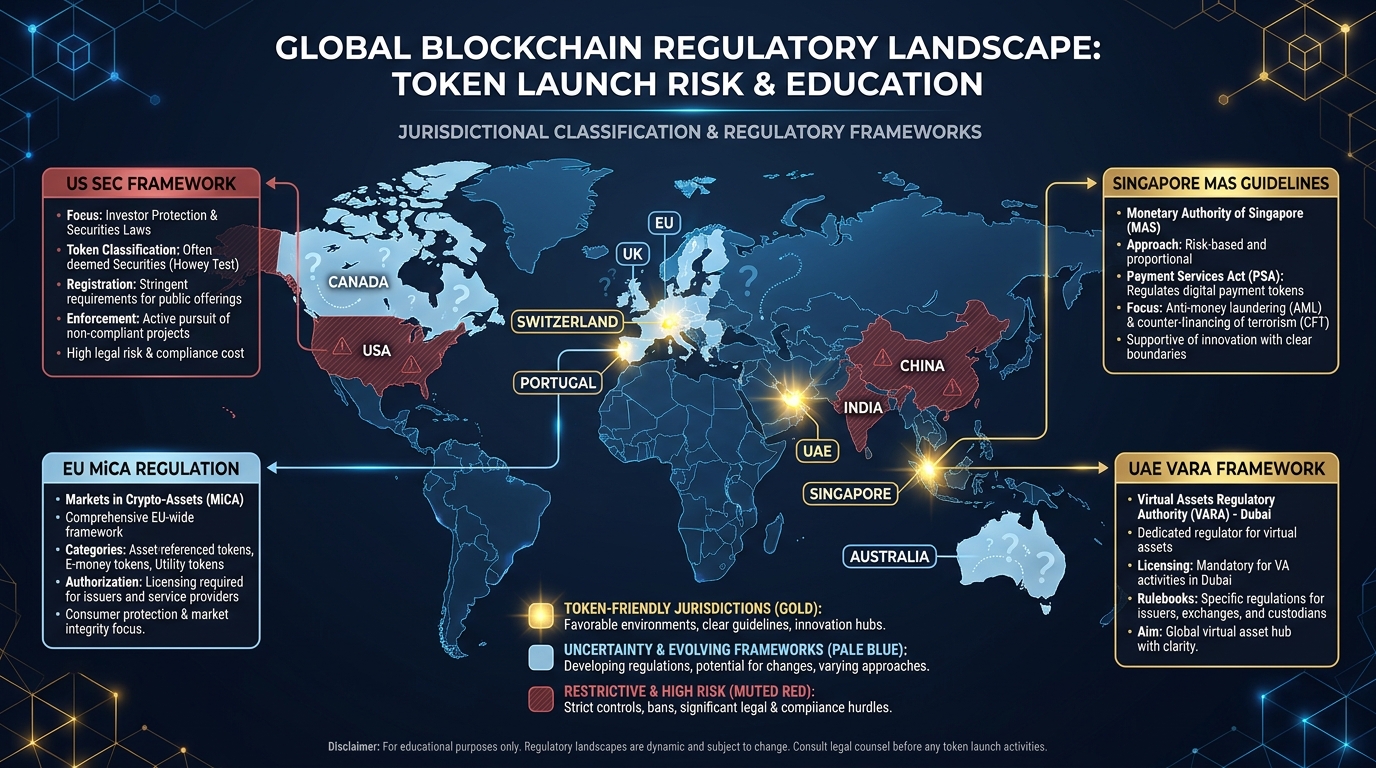
Figure 11:Global Token Regulatory Landscape (2025-2026): The legal environment for token economies varies dramatically by jurisdiction. Projects operating internationally must navigate multiple regulatory frameworks simultaneously — often with conflicting requirements.
Treat your launch documentation, security policies, and disclosure materials as living documents that are reviewed quarterly and updated whenever material conditions change.
10Case Study: The Projects That Got It Right
Understanding what success looks like — not just failure — is essential for building a mental model of what “professional” means in this space.
Uniswap’s governance launch. When Uniswap launched the UNI token in September 2020, the initial distribution was a retroactive airdrop — 400 UNI to every address that had ever used the protocol. This avoided the “investment of money” prong of Howey by distributing tokens earned through protocol use rather than purchased in a sale. The team allocation was fully disclosed with a four-year vesting schedule. The governance framework was published in advance. The audit was public. This is textbook professional token launch — and it is why Uniswap has operated for years without SEC enforcement action while many contemporaries faced legal challenges.
Helium’s regulatory navigation. Helium, which had been operating a token-incentivized wireless network, proactively sought legal clarity about its HNT token rather than waiting for enforcement. The project worked with counsel, modified its disclosure practices, and ultimately migrated the network to Solana in 2023. The migration itself required a governance vote — which passed because the community trusted the team’s transparency record. Proactive legal engagement, not avoidance, was the survival strategy.
The FTX collapse lesson. FTX is the counter-case that every token project should study. At its peak, FTX appeared to be one of the most professionally operated exchanges in crypto. The forensic analysis afterward revealed the opposite: commingled customer funds, opaque financial structures, no meaningful audit, and a concentration of control in a single person. The lesson is not that crypto is inherently dangerous — it is that opacity eventually collapses. Transparency is not just ethics; it is the operational strategy most likely to produce a project that actually survives.
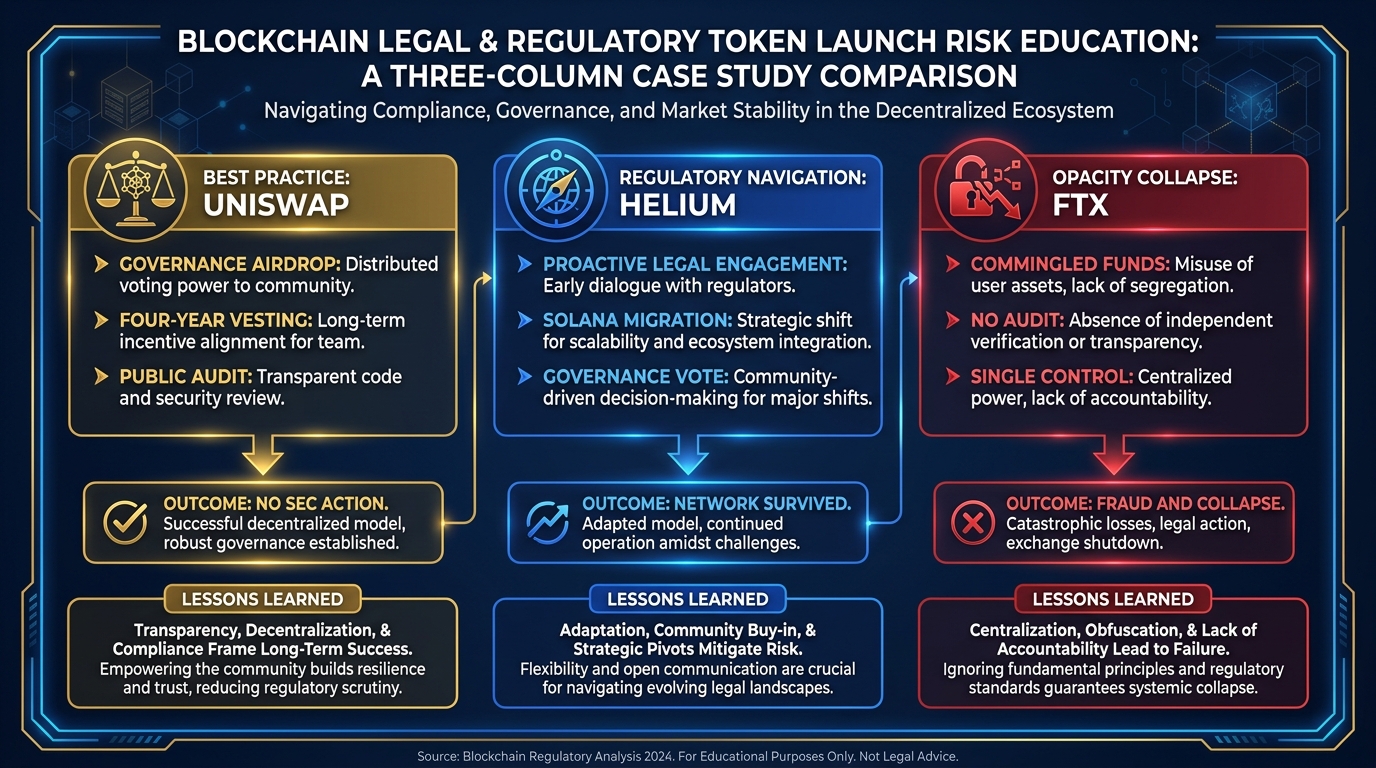
Figure 12:Three Token Economy Case Studies: Uniswap’s proactive governance launch, Helium’s regulatory navigation, and FTX’s opacity collapse illustrate the same principle from three angles: the projects that survived answered the legal, regulatory, and trust questions on purpose, before the questions became crises.
▶ Extended Viewing: Full Conference Talk (31 min)
11🎓 Glossary
Howey Test The four-prong legal test established by the 1946 Supreme Court case SEC v. W.J. Howey Co. that determines whether a financial instrument is a security: investment of money, in a common enterprise, with an expectation of profits, derived primarily from the efforts of others.
Security A financial instrument regulated by the SEC under the Securities Act of 1933 and the Securities Exchange Act of 1934. Selling unregistered securities is a federal crime. Whether a token is a security is determined primarily by the Howey test.
Utility Token A token that provides access to a specific product or service. The label “utility token” does not automatically exclude a token from securities law — regulators assess function and marketing, not labels.
Key Management The system by which cryptographic private keys are generated, stored, backed up, and controlled. Poor key management is the most common cause of permanent, unrecoverable loss in blockchain projects.
Hardware Wallet A physical device (e.g., Ledger, Trezor) that stores private keys in a chip that never connects to the internet directly. The gold standard for securing high-value keys.
Multisig A wallet configuration that requires M signatures out of N authorized signers to execute any transaction. Eliminates single-point-of-failure risk for treasury and administrative keys.
Rug Pull Fraud in which project founders drain a liquidity pool, sell their token holdings, and disappear — leaving other holders with worthless assets. Requires concentrated founder allocation, controllable liquidity, and no vesting or lock-up mechanisms.
Phishing A social engineering attack in which an attacker impersonates a legitimate entity to trick a target into revealing sensitive information or performing a damaging action, such as connecting a wallet to a malicious site.
Timelock A governance mechanism that enforces a delay between a proposal passing and its execution. Gives the community time to identify malicious governance proposals before they take effect.
Governance Attack An attack in which an adversary accumulates sufficient token-weighted voting power to pass a malicious governance proposal — typically to drain the treasury.
Disclosure The practice of publishing material information about a project — team, allocation, risks, smart contract audits — that investors and regulators need to make informed decisions.
Authority Revocation The permanent and irreversible removal of administrative power from a key. For example, revoking the mint authority means no additional tokens can ever be created. Irreversible by design.
Liquidity Lock A mechanism by which liquidity pool tokens are committed to a time-lock contract, preventing the founding team from removing liquidity for a specified period.
One-Page Explainer A single-page, non-technical summary of a token economy covering purpose, mechanics, allocation, utility, governance, risks, and disclosures. Written for investors, regulators, and customers who do not have technical blockchain backgrounds.
Succession Planning Documentation describing what happens to key management, project operations, and governance if a key team member becomes unavailable. Required for any project that intends to operate beyond its founding team.
FinCEN The Financial Crimes Enforcement Network, the U.S. Treasury’s financial-crimes unit. Administers the Bank Secrecy Act, registers money services businesses, and issues the guidance that determines when a token project has crossed into money transmission.
Money Services Business (MSB) A FinCEN-defined category that includes money transmitters — entities that accept and transmit value on behalf of others. MSBs must register with FinCEN, run an AML program, perform KYC, and typically obtain state money-transmitter licenses. FinCEN’s virtual-currency guidance treats exchangers and administrators as MSBs; users spending their own tokens are not.
AML Anti-money-laundering. The written program of policies, monitoring, and suspicious-activity reporting that registered money services businesses must maintain under the Bank Secrecy Act.
KYC Know Your Customer. The identification and verification of customers that AML programs require before providing financial services. See also Chapter 1’s discussion of custodial onboarding — exchanges perform KYC because they are MSBs.
OFAC The Office of Foreign Assets Control, the U.S. Treasury office that administers sanctions. Transacting with sanctioned persons or addresses is prohibited for everyone — MSB or not — which is why USDC’s issuer maintains and has used a freeze authority.
12🎯 In-Class Assignment: The Launch Document (10 pts)
Details and instructions will be provided in class.
Points: 10
13💬 Discussion: Technology, Use, or Intent — What Should the Law Regulate?
You have spent this course building something that, depending on how it is structured, might be a loyalty program, a security, a currency, or a collectible. A points system at your local coffee shop, a share of stock, a dollar bill, and a Pokémon card are legally and economically four completely different things — and the same Solana token can look like any one of them depending on how it was designed, marketed, and used.
That ambiguity is not an accident. Blockchain technology is deliberately general-purpose. The same infrastructure that powers a legitimate loyalty rewards program can power an unregistered securities offering. The same smart contract architecture that enables a community governance system can enable a fraudulent rug pull. The technology itself is neutral.
So here is the question: should the law regulate the technology, the use, or the intent — and can it tell the difference?
Regulating the technology would mean treating all blockchain-issued tokens as securities (or as all the same thing), regardless of what they do. This is administratively simple but economically catastrophic — it would ban a loyalty points system for the same reasons it bans a speculative ICO. Almost no serious legal scholar advocates this position.
Regulating the use is where current law mostly sits. The SEC does not care that you used blockchain technology — it cares whether buyers expected to profit from your team’s efforts. The CFTC does not care about the underlying code — it cares whether the asset is a commodity. The approach is functional: what does this thing actually do, and which regulatory box does it fit in? The challenge is that function can change. A token issued as pure utility can later develop a speculative secondary market that makes it look like a security.
Regulating the intent is the hardest approach, because intent is internal and often post-hoc. Did the founders intend to run a loyalty program, or did they intend to raise capital from investors hoping for price appreciation? Intent-based regulation requires reading minds — which is why it shows up primarily as evidence in fraud cases rather than as a registration standard.
The honest answer is that the law is still working this out, and the regulations written in the 1930s for equity markets were not designed with permissionless, pseudonymous, globally-accessible digital assets in mind. The SEC, the CFTC, Congress, and regulators in fifty other countries are all simultaneously trying to answer the same question with different frameworks, different incentives, and different constituencies.
Your job, as someone building in this space, is not to wait for that question to be answered. It is to make deliberate choices — about your token structure, your marketing language, your disclosure practices, and your legal counsel — that reflect honest answers to honest questions about what you are building and for whom.
13.1Discussion Guidelines
Write a minimum 250-word initial post taking a clear position on the following: Given what you have built in this course, do you believe the technology, the use, or the intent is the right object of token regulation — and why? Use at least one credible or scholarly source (a law review article, a regulatory guidance document, a Supreme Court opinion, or a peer-reviewed academic paper). Then respond to at least two peers with substantive engagement — challenge their position, extend their argument, or offer a counterexample. “I agree” is not a response.
14🔬 Hands-On Lab: Red-Team Your Own Project
14.1Individual Analysis: Know Your Exposure
Before you can defend your token economy, you have to know where it is exposed. Work through each of the following and write one honest sentence of assessment for your own project:
Howey analysis. Go through each prong of the Howey test for your token. For each prong, state whether it is satisfied, arguably satisfied, or clearly not satisfied — and explain why.
Allocation transparency. Is your allocation fully documented and publicly accessible? If not, what is missing?
Key management. Who holds the keys to your project’s most sensitive authorities? Is any single person a single point of failure?
Threat inventory. Which of the four threat categories (phishing, fake tokens, rug pull mechanics, social engineering) are you most exposed to, given your project’s current structure?
Operational risk assessment. Identify your three largest operational risks. For each, describe what happens if it materializes and what the mitigation looks like.
Buyer’s Check yourself. Run Chapter 10’s 60-second Buyer’s Check on your own token and paste the result into your one-page explainer’s Risks section. If your own token fails a check that takes one minute, assume every serious buyer will run it too.
Phishing drill. Write the exact Discord message a scammer would send your holders — the impersonation, the urgency, the link. Then write the pinned security rule that defeats it. Knowing the attack from the inside is what makes the defense specific instead of generic.
Regulator drill. In one paragraph each, answer: “Is this a security?” (Howey analysis above), “Are you a money transmitter?” (the Money Transmission, AML, and FinCEN section), and “What did your airdrop recipients owe in tax?” (Chapter 6’s tax box).
14.2Group Build: The Investor Panel Presentation
Using AI as a thinking partner, build your investor panel presentation — a five-minute verbal presentation of your token economy suitable for a panel of investors, customers, and regulators who have never heard of your project.
Begin by asking Gemini to identify the three hardest questions an adversarial investor would ask about your specific token design. Use those questions to stress-test your one-page explainer and your Howey analysis. Revise your presentation based on what the AI identified as weaknesses.
Groups should be prepared to present their token economies to the class as if to an investor panel. The panel (your classmates and instructor) will ask one hard question each. Your job is not to have perfect answers — it is to demonstrate that you thought about the question in advance.
15🏁 Walk Away With
By the end of this chapter, you have a launch-ready token economy and the document that explains it. Specifically:
A Howey analysis for your own token that you can discuss with an attorney
A one-page explainer written for a non-technical reader
A key management plan that eliminates single points of failure
A threat inventory with documented mitigations for each vector
A launch checklist you have walked through for your own project
A launch-ready presentation you can give to an investor panel
The capstone artifact is the one-page explainer. It is the single document that proves you understand what you built — not just technically, but legally, commercially, and ethically. A token economy that can be explained clearly on one page to a non-technical reader is a token economy that was designed with intention.
“The test of whether you understand something well enough is whether you can explain it clearly to someone who doesn’t.” — Adapted from Richard Feynman